
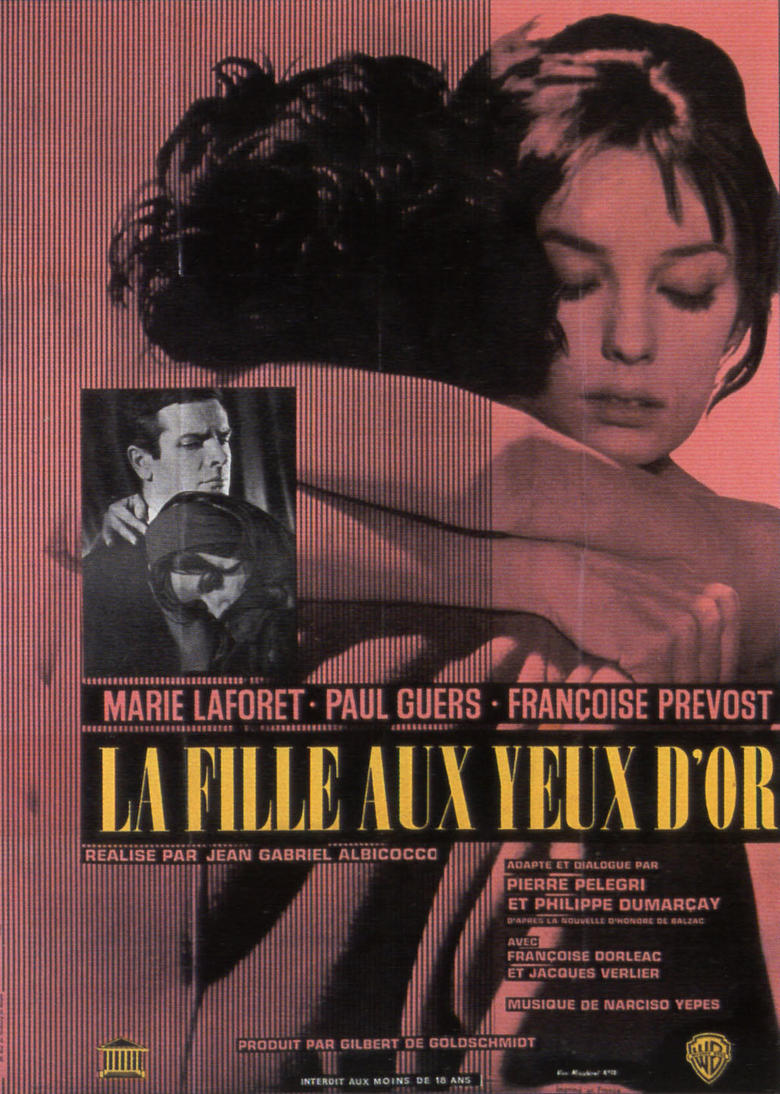
It’s been noted that when making La Fille aux yeux d’or, Jean-Gabriel Albicocco was producing a film that existed more on the margins of late-period Italian neo-realism than the French New Wave, a movement he is often considered to be an early pioneer of, albeit one that isn’t particularly celebrated outside of a few films that are of interest to scholars of this period in filmmaking. Such an idea is definitely one that piqued my curiosity, and working through this film, itself an adaptation of the novella by Honoré de Balzac, it definitely isn’t difficult to see where such an assertion comes in – lavish in some ways, but also quite austere in others, Albicocco’s adaptation is quite a fascinating work that takes on the intimidating task of not only adapting Balzac, but also contemporizing him, bringing his themes to the twentieth-century in a way that didn’t only show their inner relevance to a more modern perspective, but also retaining the underlying themes that made them so impactful in the first place. La Fille aux yeux d’or isn’t necessarily a major work in the oeuvre of the writer, but through taking some of the fundamental ideas and employing them in a truly creative manner, Albicocco achieved a really effective work of experimental drama, a film that may be somewhat impenetrable and takes a lot of adjusting, but ultimately has some terrific ideas, and the good sense to establish a unique voice while not becoming too ensconced in its own ambition to neglect the more interesting side of this story, resulting in a tremendously effective drama that is more of a slow-burning manifesto on mid-century romance than it is a by-the-numbers literary adaptation, which only serves to make it even more fascinating, and buttress some of the more compelling themes embedded within it.
What is most notable about La Fille aux yeux d’or is how it is less of a direct adaptation, and more a work that is mostly inspired by the Balzac novella. These kinds of forays into literary adaptation are often difficult to achieve successfully (since it’s far easier to just work from what was written already than to undertake the effort to transpose these ideas into a different setting), but which Albicocco does very well. We first notice that this isn’t going to be the constricting period drama we’d expect from a more direct exploration of Balzac’s work (even if he himself was more of a renegade than contemporary audiences give him credit for), but an effervescent and entertaining experimental film that blends soaring romance, intricate drama, psychological thriller and even some dark comedy, creating a stylish, thought-provoking work that extends beyond the boundaries of a more traditional look into the story of Henri de Marsay, whose very existence has been repurposed from nobleman to wildly successful fashion photographer, allowing him to retain the quality of being a part of the high-class world, but in a way that lends him some contemporary depth and allow his philandering actions to be seen in a way that can actually be quite recognizable, even if by modern standards, this adaptation of La Fille aux yeux d’or can feel like something of a relic from the past. Despite some of its ideas may seem outdated by virtue of being representative of some indelible concepts restricted to this particular period, such as the rise of high-fashion and the influence of international contact in the formative years of what would come to be known as the “Swinging Sixties”, there’s a familiarity present in this film that Albicocco explores really well, evoking some fascinating ideas that all go towards constructing La Fille aux yeux d’or as a very effective film about the intersections between power and desire.
La Fille aux yeux d’or treads through some very interesting narrative and thematic territory, which is a result of the director’s persistent efforts to look beyond the ideas established by the author, and actually assimilate them into a contemporary context that feels both artistically-resonant and relevant to more modern themes – we’re more likely to understand the world of high fashion and the decadence that comes with celebrity than we are to be familiar with the machinations of the French nobility. This gives the audience the opportunity to actively engage with these stories, which overlap in very insightful and unexpected ways. La Fille aux yeux d’or takes some interesting risks, but they tend to pay off extremely well, especially when it comes to commenting on issues of the contrast between masculinity and feminity, sexuality (this is one of the earlier examples of bisexuality being openly discussed in a film, even if it takes a while to actually get to this aspect of it) and other broad notions of identity. The film has a whole is quite subversive for its time, while is part-and-parcel of the French New Wave – but what differentiates Albicocco’s intentions with this film from those of many of his artistic compatriots at the time was that he was seeking something slightly more offbeat, not necessarily to start a conversation on philosophical matters in the sense of some other prominent scholars-turned-filmmakers who worked under the movement, but rather to be descriptive of a broad range of ideas. This manifests in the way the film looks – the compositions are bare at first, but soon prove to be positively brimming with life. The film makes use of frantic energy to show the unstable world it is intent on evoking, and extreme close-ups to convey the deep intimacy it’s hoping to achieve, which creates a surprisingly rousing work of artistic disruption.
There’s a noted lack of existential angst in La Fille aux yeux d’or, with the more prominent ideas of identity coming into contact with broader themes of external “performance” – it makes sense that the central figures in this film are a fashion photographer and a model, since there’s a great deal of discussion to be had in terms of the roles such individuals play – one uses her appearance as a vessel for art, while the other attempts to capture that fleeting beauty and imprint it permanently, another form of artistic expression – and the film as a whole reconsiders the role such individuals play by questioning who the people behind the camera, or under the gorgeous garments, actually are and how they function outside of their professional lives. Albicocco wasn’t content on leaving it there – the decision to relocate Balzac’s story to this particular setting was not accidental – there’s an idea that all these characters are concealing something. Secrecy pervades throughout La Fille aux yeux d’or, each one of these individuals harbouring some hidden truth that gradually unravels as the film progresses – and setting the drama within the world of fashion was an interesting choice, not only as it evokes a distinct style, but because it allows the film to explore the vapid, emptiness that underpins the excess, providing some poignancy commentary without ever becoming too weighed down by the meandering provocations that often pulsated throughout these films at this particular time.
La Fille aux yeux d’or is an extremely intelligent work, and one that shows Jean-Gabriel Albicocco as a supremely underrated talent. His work demonstrated a keen sense of curiosity, which he portrayed in his distinct style, both visually and narratively. The idea of adapting a literary work by Balzac into a meditative, stream-of-consciousness psychological thriller is audacious in itself, so even the most pivotal elements become almost peripheral to the overriding ambition of the film – filled with strong performances, particularly from the central trio of Paul Guers, Marie Laforêt and Françoise Prévost (all of which do very well in playing these artists who represent different strata of the bourgeois artistic world they seem to be against, but can’t help reaping the benefits of being associated it), and made with an intensive curiosity and willingness to provoke some deeper themes, La Fille aux yeux d’or is certainly something of an essential work of experimental arthouse cinema, and its relatively obscurity is surprising, since it manages to effectively dismantle many of the most prominent problems with the French New Wave while the movement was still in its infancy, being just as smart and philosophical, but avoiding the nihilistic ambivalence that sometimes caused these works to be more cynical than they were insightful towards the human condition. In short, La Fille aux yeux d’or is a tremendously entertaining film that manages to be thought-provoking and thoroughly compelling, both in the story it tells and the emotions it evokes along the way.
 The Postmodern Pelican