
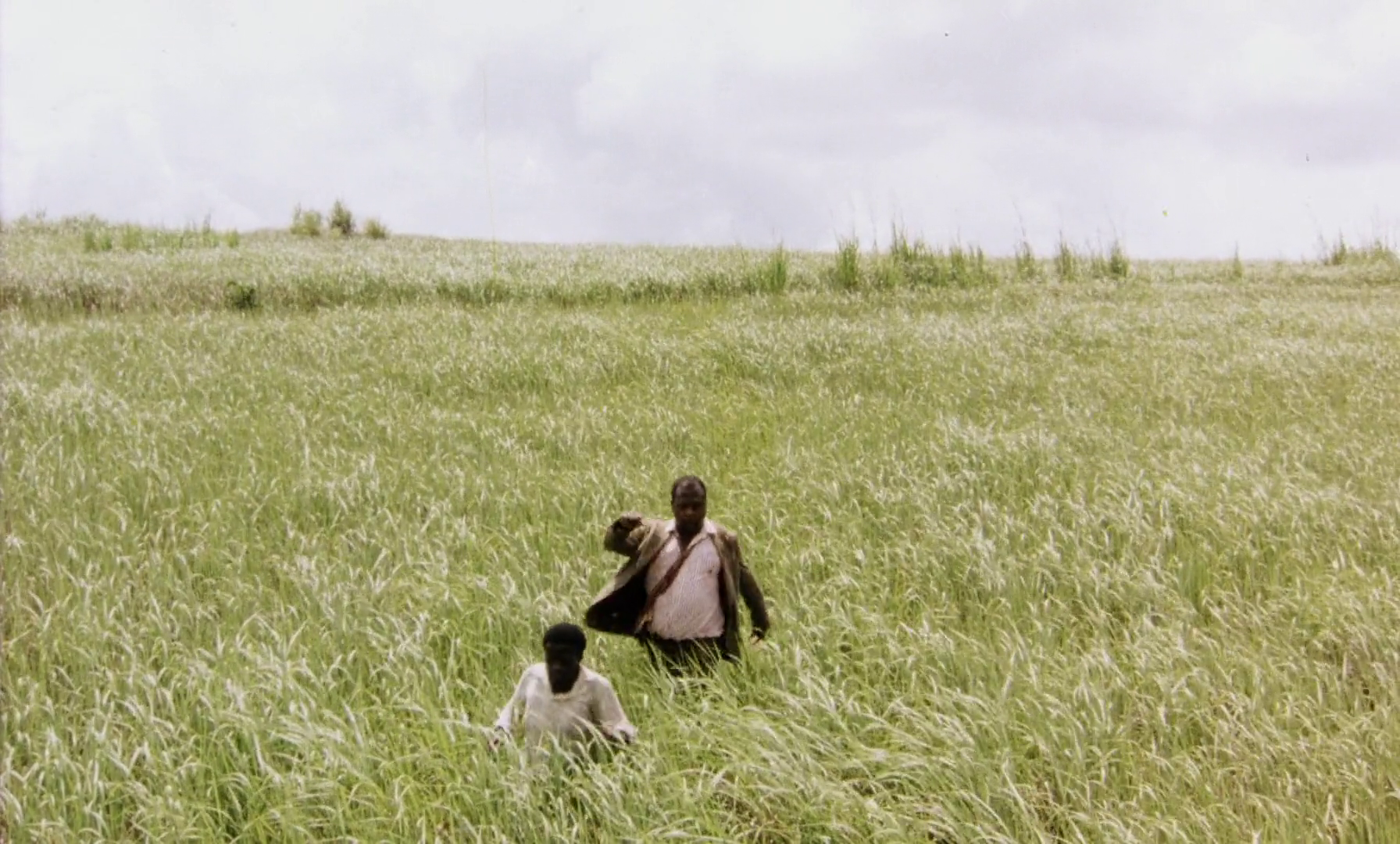
In a small village somewhere in the middle of Côte d’Ivoire resides Gnamien Ato (Pierre Gondo), a humble pig-farmer who tries to go about his life without getting in the way of anyone around him, but constantly becomes the subject of much derision, based on his status as the local laughingstock. However, after being assaulted one evening and thrown into the river by some thugs, he is visited by a vision, who proclaims that the humble farmer is to become Magloire le Premier (“My Glory the First”), who is supposed to be the cousin of Jesus Christ. He is intended to be a messenger, sent to spread the Holy Word to the heathens who populate his village. At first, no one believes that this pig-farmer could possibly be a prophet – but his ability to persuade absolutely anyone to his sacred mission soon wins him many believers, as he converts several of his local villagers to Christianity. Meanwhile, he is relishing in his newfound status, acquiring an enormous amount of respect from those around him, including the very people who used to mock him for his vocation and apparent lack of education. Deciding that having the last laugh isn’t satisfactory enough, Magloire decides to continue to spread his message – but this time, its gradually moving away from Christianity, and becoming akin to a cult, with his converts losing sight of the original message, and instead devoting themselves to worshipping the person sent there to put them on the path to righteousness. Magloire starts to be driven crazy by his lust for power, and begins to act erratically, constantly pushing the boundaries of his reputation, and causing his followers, many of whom have nothing but blind faith, to the extreme in ways that he states are tests of their faith, but really just benefit him and his agenda to dominate. However, pride tends to come before the fall, and Magloire is heading towards a spectacular fall from grace.
As I’m sure has been made very clear in the past, I’m predisposed to seeking out obscure works of world cinema, particularly those that hail from under-represented countries. Much of my focus has gone to Africa, a continent composed of innumerable cultures, the vast majority of which haven’t benefitted from the international recognition they deserve, especially from within the culture’s own perspective, with many mainstream representations of Africa in past decades coming from foreign filmmakers venturing into various countries and using them as a backdrop for western-focused projects. This is an unfortunate situation but doesn’t mean there has been any shortage of fascinating works produced throughout the continent over the years, one of which is In the Name of Christ (French: Au nom du Christ), a subversive dark comedy that manages to be one of the most singularly terrifying works of satire ever put on film. Director Roger Gnoan M’Bala is an essential voice in African cinema, whose work is profoundly fascinating but deeply underexplored – and the recent traction received by In the Name of Christ by a small but dedicated group of admirers over the past few years consolidates how we should be taking M’Bala seriously as an important filmmaker, whose vision is unique, and absolutely remarkable in how he manages to push the boundaries of what was previously possible in these kinds of stories. Dark, deceptive and astonishing, In the Name of Christ feels like a pivotal work that requires a much wider audience – and like many great pieces of world cinema, it is perched and anxiously awaiting discovery by those who are willing to surrender themselves to one of the most incredibly powerful satires of the past thirty years, and a necessary work that has somehow sadly been reduced to obscurity, but is ripe for newfound recognition due to a recent restoration.
As a former French colony, Côte d’Ivoire has a storied history, particularly in regards to the spread of European influence over the course of the colonial period. Part of the process of “civilizing” the region entailed an outright dismissal of traditional beliefs, which were subsequently replaced by western beliefs, with the most prominent obviously being Christianity. A deep working knowledge of the colonial project isn’t necessary to realize that this was the impetus for M’Bala’s wildly inventive dark comedy, which is essentially a work of unhinged anger siphoned into the form of a deliriously strange account of the mysteries of faith, as channelled through the vision of a director whose primary intention with this film was not merely to comment on the process of religious conversation, but a complete evisceration of the entire colonial project, without falling victim to its own audacity. Like many of cinema’s greatest satires, In the Name of Christ makes use of various concepts in disseminating its powerful message – allusion and allegory is the primary tool employed in this socially-charged comedy, with M’Bala defying conventions by exploring this story through the lens of something that combines classic African fables with Biblical stories, two forms of storytelling that are used extremely well in the context of the film, but are most effective when we see the director subvert them and turn these concepts, which are most often sources of comfort and gentle guidance but are here repurposed as the instruments of something very close to unhinged chaos. This makes the experience of seeing In the Name of Christ all the more incredible, since it goes in so many different directions, it’s impossible to put a saddle on it, but we’re still compelled to go along for the ride, even if we realize how unconventional and perilous it may be.
Satire is often conflated with socio-cultural comedy, especially in the modern context, where we often see a form of narrative where current affairs are funnelled through a form of broad comedy, which is then labelled as some work of satirical genius – this isn’t an invalidation of this brand of comedy (since satire in itself is often difficult to define precisely, as it comes in so many different forms). However, it’s not always supposed to make the viewer feel at ease, and one can easily argue that good satire often does the opposite – it puts the audience in a profoundly uncomfortable situation, where our preconceived notions of the world around us are challenged, often in agonizing ways. This seems to be the modus operandi of In the Name of Christ, which is a profoundly unpleasant work, which is entirely by design. M’Bala employs some fascinating methods – the story is told through a stream-of-consciousness style, being composed of a series of vignettes set over an indeterminate number of years, as we follow the journey of the main character from humble farmer to either a celestial being, or a raving lunatic with a messiah complex. Not linear in the traditional sense, the narrative focuses on establishing an atmosphere (which the director accomplished through the use of a striking score and stunning cinematography), in which the lives of these villagers, who go from liberated to slaves to an ideology, can be explored through a number of memorable moments that are both alluring and utterly repulsive. M’Bala achieves such a unique tone throughout In the Name of Christ, managing to convey his message through methods that can only be described as terrifyingly poetic – the further we venture into this film, the more the charming, upbeat exterior disintegrates, until we’re left with a truly harrowing piece of social and historical commentary that resonates, even with those who may not have the first-hand experience of the aftermath of colonialism.
Throughout the film, In the Name of Christ is work of profound provocation – whether in an early scene where the main character is finally recognized as something of a prophet (and where the news is reported in two different ways – through the elegant French compositions of a field report, and through a tribal ceremony, with the gentle tapping of the typewriter being interspersed with the hypnotic beating of a drum), or in the later moments, where the underlying fury manifests in some truly shocking images, M’Bala is persistent in his attempts to convey a particular message. Ultimately, In the Name of Christ isn’t just a blisteringly funny deconstruction of religious belief and the cult of personality, but mainly a vitriolic evisceration of cultural colonialism as a whole, a subject that has haunted the African continent for centuries now, and which it still struggles to fully recover from. The spectre of the past persists in so many aspects of individual histories and has proven to be horrifyingly indelible, especially when it comes to concepts as fundamental as religion, language and identity as a whole. M’Bala’s methods of looking at these ideas through a vaguely surreal lens may be peculiar, especially considering how the more popular method is through more gritty realism that focuses on rebuilding spirits through presenting the truth. Postcolonial surrealism is a branch of literature that may be more impenetrable (since, as is the case with the majority of postcolonial theory, is based on the idea of the empire “writing back”, which is rarely, if ever, done with anything other than subversive anger), but is often the most effective since the rage comes through in a wildly inventive manner, and often can latch itself onto the viewer in ways that we don’t realize until it strikes and leaves us utterly exhilarated, if not even slightly disturbed by the eruptive anger lurking just below the surface of these stories.
All of these ideas (and more) are encapsulated in what M’Bala does throughout In the Name of Christ, which is vehemently against the idea of moving beyond the past, since it has left so many intrinsic problems – and channelling these concepts through something like faith gives a film like In the Name of Christ the chance to be relatable to a much wider audience (but without losing the meaning), and to present it in a way that misleads us into thinking it’s going to be a charming, endearing comedy with a satirical lean is only part and parcel of the brilliance, since the unexpected directions the filmmakers take with this story is absolutely staggering, and consolidates that this is quite certainly an essential work of cinema, both in terms of an African perspective and in terms of global storytelling. Rooted in some combination of absurdism and darkly comical social horror, In the Name of Christ is a very unique piece that is motivated by both deep anger and artistic curiosity, with the director making sure there is some method to the madness, and creating something that is unsettling and provoking in both form and content, taking us on an unforgettable journey that is rarely ever pleasant, but undoubtedly essential. Films like In the Name of Christ have a tendency to be exhilarating, awe-inspiring pieces that are insatiable in their audacity and utterly exquisite in their creativity, even when they are at their most disconcerting. Cinema is usually used as a means of entertainment, but it takes something like this to remind us of its importance as a messenger of certain ideas – and while we may have different reactions to what the director is doing with a film like In the Name of Christ, there’s no way to deny the intimidating ambition of a film like this, which is one of the definitive works of postcolonial anger of recent decades, and a necessary work as a whole.
 The Postmodern Pelican