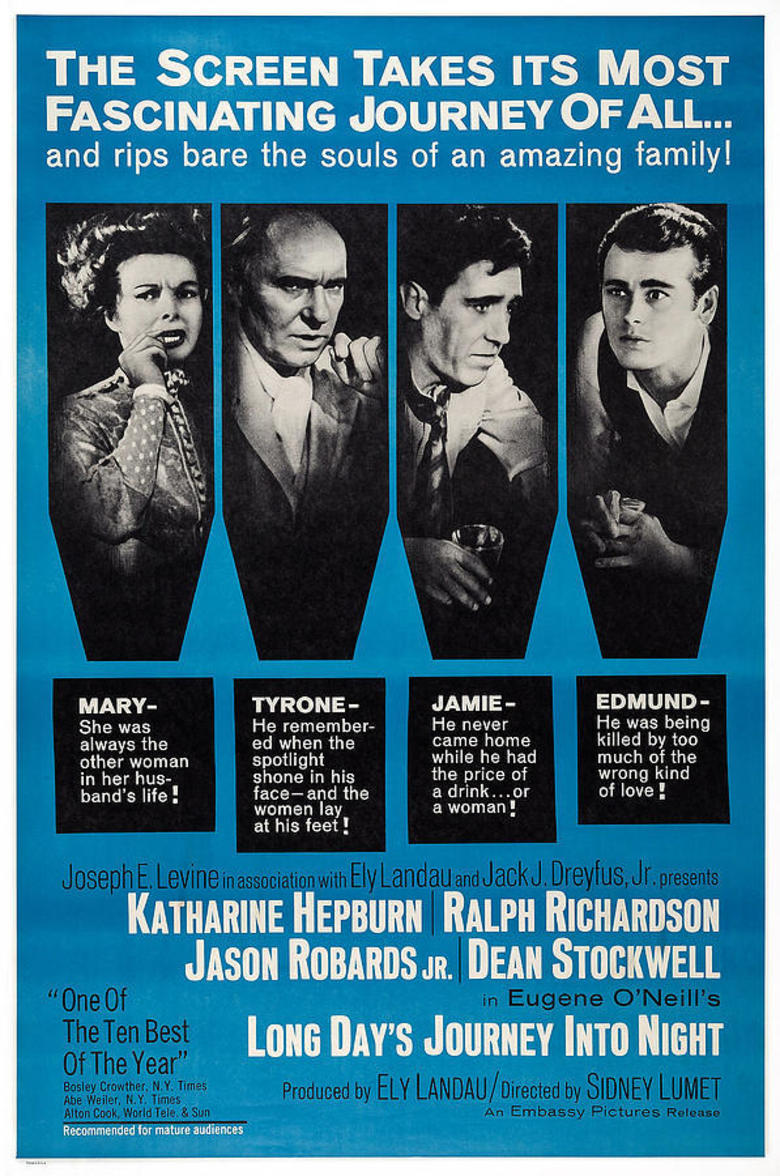
 Playwrights tend to know more about the human condition than just about anyone. This has never been more evident than through the work of Eugene O’Neill, whose status as arguably the most important American playwright of his generation (a distinction he may only be able to share with the likes of Arthur Miller and Tennessee Williams, even if they themselves are somewhat indebted to the work O’Neill did) went further than having the reputation for defining twentieth-century theatre, but also capturing a side of existence rarely conveyed in any medium at the time. Many argue that his finest work is Long Day’s Journey Into Night, a debate that really doesn’t hold much credence for different opinions since despite writing some masterpieces, none of O’Neill’s work comes close to touching what he does with this Connecticut-set family drama. The advice often given to novice writers is undoubtedly “write what you know”, which could have very easily been derived from O’Neill’s work here, with Long Day’s Journey Into Night being a work that sees the playwright venturing into his own memory, transporting the audience back to 1912, where he was a mere 24-years-old, as we watch with bated breath as he takes us on a whistle-stop tour of the endless trauma that pulsated in his family. This play was the subject of a fantastic film version by Sidney Lumet, who took O’Neill’s words almost verbatim and put them on screen in a way that far exceeds the archetypal theatrical adaptation, and instead manages to be one of the most profoundly moving works of cinema of the 1960s, a complex and harrowing look into the intimacies of O’Neill’s early adulthood, stretched over the course of a single day, as we come to know the writer and his family (here renamed as the Tyrones), as they go through the motions of living yet another day carrying the memories of the past and reconciling them with the present, to avoid the erosion of the soul that often comes with addressing old, unhealed wounds.
Long Day’s Journey Into Night occurred relatively early in the career of Lumet, when he was still a young and ambitious filmmaker, who seemed to be attempting to adapt works from every major American playwright of the twentieth-century – having already directed adaptations of Arthur Miller (A View from the Bridge) and Tennessee Williams (Orpheus Descending, retitled The Fugitive Kind), it was only a matter of time before he explored O’Neill. Without any doubt, this could be one of the most definitive works of theatre ever put on film, with Lumet’s outright refusal to simply settle for mounting a version of the play in a way that only marginally takes advantage of the cinematic form being a massive reason behind the success of this version. Stage-to-screen adaptations have a tendency to be either lifeless attempts to capitalize on their previous success, or they’re infused with far too much ambition, to the point where they become too insistent on showing their own immense audacity, and in the process lose their merits as films. Long Day’s Journey Into Night deftly avoids this, undoubtedly as a result of Lumet’s skilful vision, which he employs exceptionally well. What is often very endearing about Lumet as a filmmaker is that he knows when to lend his insights into a film, and when to allow the material to speak for itself. It goes without saying that anyone thinking that the words of Eugene O’Neill can ever be improved is severely misunderstanding the artistry the playwright put into every sentence of his plays, so it seemed only adequate that Lumet would directly adapt the play, word for word. This isn’t a rare occurrence, as other filmmakers have chosen this approach – but somehow here, it doesn’t seem like a result of laziness, but rather a decision of absolute necessity. O’Neill didn’t necessarily write plays in the traditional sense – he crafted elegant bursts of poetry that took aim at the core of the human condition, eviscerating it until there was nothing left. We weren’t shown a “slice of life” – we were given healthy doses of existential angst, served with wry humour and heartbreaking despair, all of which resounded with absolute sincerity from beginning to end.
Lumet implicitly understood this as being an unimpeachable truth of O’Neill’s play, and in his adaptation took a bold approach to the material that emphasized the form, rather than attempting to manipulate or tamper with the sheer perfection of the original work. Lumet had a chameleonic style, particularly in the earlier phase of his career, where his directorial vision was replaced with a more mercurial approach, where he would form his authorial voice with a more adaptive style. It gave him the chance to focus on bringing the original material to life, rather than purporting to be the ultimate authority on the work. However, this isn’t comparable to the idea of the proverbial “point-and-shoot” approach often used to disparage theatrical adaptations – Lumet brings a keen sense of flair to the proceedings, utilizing everything he possibly can to pay tribute to O’Neill’s play, while still giving it some complexity. Framing is most prominent in Long Day’s Journey Into Night – while it is a mammoth work of theatre, the confines stage doesn’t quite lend the play certain benefits, which are found in this adaptation. A technique as simple as a close-up, which is often taken for granted, becomes the source of some of the most incredibly moving emotions in the entire film – the camera moving slightly too close to an actor’s face, and lingering slightly too long, creates a sense of both uneasy despair and catharsis, as we see the pure, unhinged expressivity reflected in these actors – Long Day’s Journey Into Night is a very intimate work of art, so as obvious as a close-up or lingering shot would be in a regular film, they’re repurposed as essential moments here. There are some truly haunting images in this film, with Lumet taking every opportunity to bring some cinematic flair to a film that benefits greatly from it, and which is, in return, completely generous in how much material it affords those involved in the making of the film – how else does one explain the fact that Long Day’s Journey Into Night borders on three hours, but moves at such a steady pace, we barely even notice the length?
However, no one is going to knowingly sit through Long Day’s Journey Into Night for anything other than the acting, whether when seeing it on stage or in an adaptation. O’Neill’s dialogue is incredible and pulsates with such ferocity, but it doesn’t mean much if the actors aren’t committed to the parts. Lumet casts a quartet of some of the screen’s most incredible performers to take on these roles, each one of them giving career-best performances. Ralph Richardson takes on the part of the former matinee idol James Tyrone, Sr., who has faded from acclaimed thespian to a penny-counting miser who yearns for his days of fame. Richardson’s status in the industry is not to be underestimated – while he may have struggled with the visibility his contemporaries Laurence Olivier and John Gielgud had in terms of being cultural icons, there was no doubt he was operating on their level consistently, regardless of medium. Long Day’s Journey Into Night sees Richardson take on a character that is something of a departure from the Shakesperean roles he was most known for, instead playing a fundamentally grounded character that is anchored by his own humanity, while he adopts a larger-than-life outlook to overcome his immense insecurities. Richardson hits some truly incredible peaks in this film, finding a genuine brilliance in nearly every word. To praise him for giving a powerful performance is almost redundant since his entire career was built from excellence – yet, Richardson touched on something quite profound that he hardly saw from him or his contemporaries. The other two male leads are played by Dean Stockwell and Jason Robards, both of which rise to the opportunity to work within the confines of O’Neill and deliver staggering performances that certainly rival those of their intimidating co-stars. Dynamic, disruptive and utterly brilliant, Robards and Stockwell have some incredible moments, whether those of quiet introspection or eruptive emotion, that just stuns the viewer, and makes these characters simultaneously repulsive and alluring, which is a difficult achievement on its own.
Then there is the troubling matter of Katharine Hepburn. The problem with being perhaps the finest actress in the history of the English language means that one tends to accumulate a set of performances that are so incredibly brilliant, choosing one as a definitive work seems like a fool’s errand. Hepburn, the epitome of both grandiose talent and admirable longevity, had a prolific career that really can’t be reduced to a single film, at least not in the way many other performers tend to have associated with them. A deep analysis of her career isn’t appropriate for this moment, but what I can confidently say is that Long Day’s Journey Into Night may just be her finest moment, which is far from a controversial opinion, but also one that isn’t often shared. Her performance as Mary Tyrone is just a revelation – and I’m fully aware that saying a performance by Hepburn (especially in this stage of her career) is tantamount to praising Richardson for giving a powerful performance. However, what makes this particular performance so effective is how it condenses nearly everything about Hepburn’s talents that made her such an incredible actress into a single character. Mary is a complex woman – she’s a morphine addict who derides her husband and children for every drop of alcohol they consume, which she does with full-knowledge of her own vice, but without the self-awareness to question herself. She’s strong but volatile, carrying immense vulnerabilities, but having a strong sense of character that keeps her from fully deteriorating as a result of her addiction. Hepburn commands the screen like never before – she’s heartbreakingly tragic, hilariously funny and, more than anything else, entirely genuine. Each word that comes out of her mouth seems to have been written specifically for her, with her control over every aspect of the character just being impossibly wonderful. Hepburn’s career was populated by sacred classics, and while she very rarely deviated from outright brilliance, Long Day’s Journey Into Night may just be her finest moment, especially considering all the most poignant qualities in this performance are those that aren’t describable in coherent terms but are better left unspoken, discoverable by anyone who ventures into this incredible film.
If there was ever a work that could legitimately lay claim to not only being an enthralling work of humanistic storytelling but also a perfect example of character construction, it has to be Long Day’s Journey Into Night, which is composed of a quartet of fascinating characters that are each brimming with complexity, to the point where it becomes almost a delight to dissect each one of them. This certainly carries over to the film adaptation, which is an impressively strong version that takes some worthwhile risks in how it tells the story while keeping the heart of the peace almost entirely intact. Sidney Lumet was a filmmaker praised more for his reliability rather than his prowess, but Long Day’s Journey Into Night proves that he was able to take something as sacrosanct as a Eugene O’Neill play and take it from a work of essential theatre to one of the most poignant films of the 1960s, crossing into another medium in a way that feels thoroughly authentic. He does this through various methods that have sadly been unheralded, despite many moments in this film carrying such incredible creativity, with entire messages conveyed with something as inconsequential as the movement of the camera. This is not a run-of-the-mill theatrical adaptation that thinks a strong script and good acting is effective enough – it dares to be slightly different without taking on a renegade approach, which is ultimately incredibly rewarding for the viewer, who is immersed in this world that feels so familiar, yet also undeniably uncanny. Working with some of the finest actors across different generations, Lumet extracts some of the most impactful performances of the 1960s, providing us with the chance to see the likes of Katharine Hepburn, Jason Robards, Ralph Richardson and Dean Stockwell at their peak. It’s a thoroughly rewarding experience that pays off in unexpected ways – and whether the viewer is left entertained, heartbroken, exasperated or simply rendered speechless, there’s very little doubt that Long Day’s Journey Into Night is an astonishing work, a staggering piece of cinema that takes us on a gorgeous metaphysical journey that touches on issues of addiction and family conflict, and ultimately converges into one of the most shattering portrayals of the human condition ever captured on film.
 The Postmodern Pelican