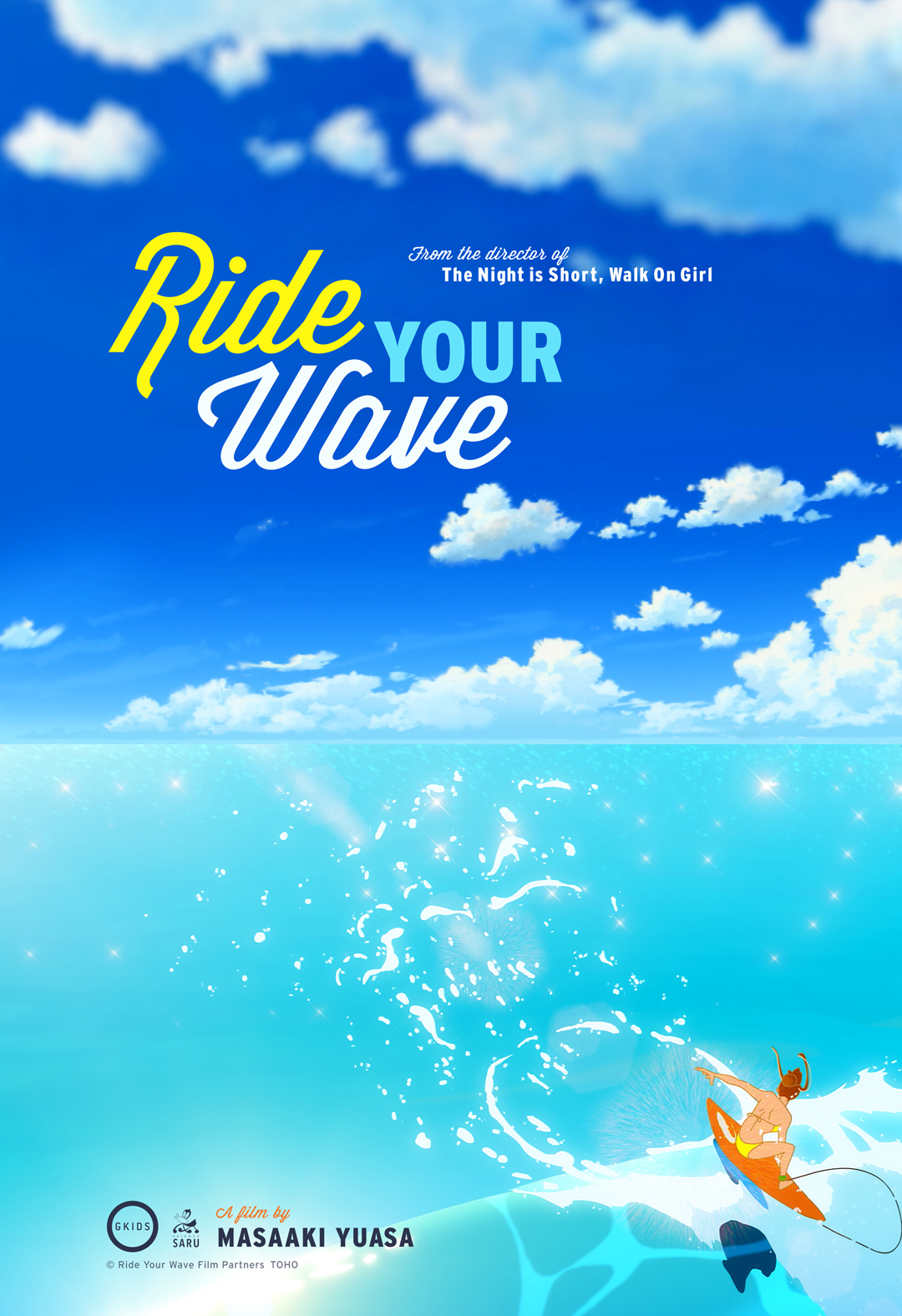
 Hinako Mukaimizu (Rina Kawaei) is a young girl venturing out into the terrifying world, finding herself in a seaside town in which she has enrolled to attend university, where she plans to study oceanography. This isn’t an interest borne out of nothing, since she has always been enamoured with the sea, spending many pleasant days surfing in any of the waters that are willing to take her. Alone in this town and without much direction, Hinako soon meets Minato Hinageshi (Ryota Katayose), a handsome young firefighter who immediately proves to be very different from the more aloof residents of the area. They strike up a great friendship, formed from their mutual fascinating in one another – and very soon, they find themselves falling deeply in love, with Hinako even going so far as to teach Minato her passion, involving in him her favourite activity as the two lovers surf through the crystal-blue waters, forgetting all their cares and embracing the tranquillity of the natural world, and the ebb and flow of existence. However, tragedy strikes when Minato is a bit too adventurous, causing him to lose his life, which devastates Hinako, who becomes reclusive and distant from everyone, abandoning surfing entirely and even moving far from the sea, in the hopes that avoiding the cause of her trauma will somehow help her heal. Yet, she finds herself being visited by an unexpected presence – the spirit of Minato has returned, confined to water, but can be evoked by Hinako singing their favourite song, which they encountered on their very first day together. They’re afforded the chance to be with each other, albeit very distantly, as the space between them – life and death – is far too great for them to fully go back to the way they were. However, they take what they can get – but at what cost will this reunion come, and how long can it possibly last?
When it comes to films focused on exploring trauma, Ride Your Wave (Japanese: きみと、波にのれたら) stands amongst the best of them. A complex and hauntingly beautiful character-driven drama that once again proves that some of the most heartfelt stories come through the animated form, director Masaaki Yuasa put together something truly incredible. A poignant and devastating look into the experience of losing someone, and the challenges that can come through the process of trying to rebuild from the shattering sensation of going through a loss. One of many poetic explorations fo these themes that Japanese cinema has been perpetually producing for decades, Ride Your Wave is such a charming, insightful portrayal of inextricably human issues, you tend to forget that you’re watching something animated, with the gorgeous style and incredible resonant story pulling us in and enveloping us, taking the viewer on an unforgettable journey punctuated with laughter, tears and, most importantly of all, unquestionable humanity. Yuasa truly did something extraordinary with Ride Your Wave, finding a way to convey incredibly deep and meaningful emotions without being gaudy or cheap in both story and its execution, rather delivering a heartfelt manifesto on a very real experience many of us have gone through in some way, where each moment resounds with the kind of authenticity a majority of bigger, more ambitious films often fail to infuse. Sincerity is woven into every frame of this film, where the honesty that comes from a genuine understanding of broader issues and the self-assured belief that one can pull it off convincingly and with the dedication required to not only speak to the minds of the viewers but also directly to our hearts.
The core of Ride Your Wave is essentially that of exploring death, using the great inevitability as a platform from which to build a beautiful, earnest depiction of grief that is incredibly emotional, but far from overwrought. Like many of the films in its national artistic ancestry, this film manages to run the gamut of emotions without resorting to the kind of inconsequential histrionics that viewers unconditioned to the sophistication of great Japanese dramas may expect. Where a lesser-achievement of a film would play a heavy-handed moment of commentary or unnecessary moralizing, Ride Your Wave goes a different direction, ensuring every moment is genuine, even if it can feel somewhat striking in a way that would be out of place had this film not been executed with such incredible precision, establishing exactly where it intended to go from the outset, and following through beautifully. This allows Yuasa to construct a gorgeous story that stands amongst the most moving representations of grief ever put on screen. This is never an easy subject to approach, but Yuasa does it so exceptionally well – it helps tremendously that the film around this story is absolutely stunning, which each frame being so striking and meaningful, we are glad to be lost in this world that appears so quaint and simple at first, but carries a depth that we may not expect at the outset.
The film does have its work cut out for it in this regard, since tackling death is never easy, and when the majority of your film consists of the main character learning to adapt in a world without their loved one, there is an inherent danger that it will be a very downbeat experience for the viewer, who may know to expect sadness, but not a film driven entirely by it. Yuasa approaches the storyline from the perspective of the present-absent, the psychological tendency for us to constantly feel the presence of someone we have lost, even though they’ve departed this world. Ride Your Wave takes this further by actually having the deceased Minato manifest as an aquatic spectre, a representation of the main character’s trauma that guides her through the grieving stage, and helps her move on, through simply eroding the sense of loss by gradually providing her with the closure she needed. Literature has often investigated what it is precisely that causes us to grieve the way we do, especially considering how no two people mourn in the same way – but we can all relate to the idea of yearning for one final moment, which not all of us manage to get most of the time. The story navigates treacherous territory, while still managing to find moments of tender humour that may not invalidate the broader message, but rather contributes to the varied, multifaceted nature of this work, which occupies several genres – drama, romance, light comedy, social-issue film – and succeeds in all of them, through applying a very simple but highly effective kind of emotional approach that keeps everything profoundly human, from beginning to end.
Ride Your Wave is a beautifully searing drama about loss that narrowly avoids being overly sentimental, and finds itself occupying an incredibly effective position that feels entirely genuine, without needing to grow into a harrowing, exploitative film about death, but rather the importance of embracing those lingering memories and cherishing them as a source of comfort, warmth and inspiration, especially in those moments when we need them the most. Undeniably, this film may not be seen as a major work – it is essentially a very simple story about a young woman experiencing loss for the first time, and coming to terms with her grief. There’s not much else to it than this, and in-depth discussions of other aspects of this film could be had but would be counterproductive to its overall aims, which manage to be a lot more interesting when we look at their broader implications, rather than getting lost in the minor details. Ride Your Wave takes the viewer on a truly extraordinary journey, and it doesn’t waver in its delicate approach to the difficult subject matter at any point, choosing instead to be an elegant, heartfelt depiction of a different kind of love story, one where memories are all we have to fill the empty spaces of despair – and for what its worth, the film succeeds exceptionally well at doing just that.
 The Postmodern Pelican