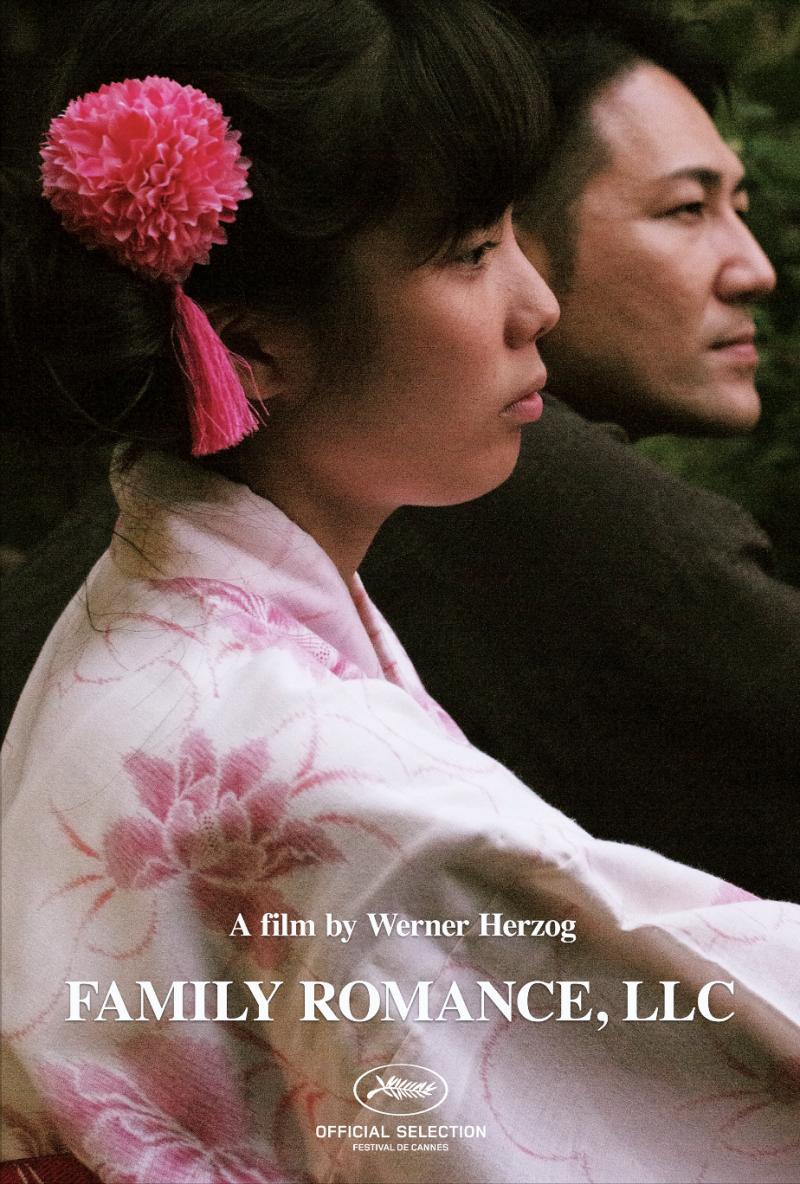
 Yuichi (Yuichi Ishii) is a mild-mannered entrepreneur whose business is gradually becoming quite a formidable force in contemporary Tokyo. His job description is simple: he pretends to be people for a living. He calls his company “Family Romance”, where he and his colleague (Takashi Nakatani) spend their days completing contractual obligations by a variety of local people, acting as surrogates for certain members of their family, as a way to either get someone out of a precarious situation, or to help someone process a loss, or simply to just be a companion for someone on their loneliest days. Yuichi’s current contrast is with shy teenager Mahiro (Mahiro Tanimoto), whose father has been absent since her infancy. He takes on the part of her father, playing the role of the paternal figure she never had, and getting to know her in a way that no one else does, which greatly pleases her mother (Miki Fujimaki), who has been desperately trying to help her daughter break out of her shell and see the world in all its beauty. Yuichi discovers that he is the one person Mahiro is able to open up to – she shares her questions about life, her curiosities and inner quandaries with him, causing him to realize that his line of work, while certainly admirable, does have its shortcomings, especially when he finds himself drawn to Mahiro as himself rather than through the role, wanting to act as her protector and guardian in a treacherous world. He also finds out that in his perfection of the technique of imitating others, he has lost sight of who he is himself since he’s lost in a career that sees him adopting numerous different roles, being able to be absolutely anyone – except for himself.
In a career that has spanned over fifty years, Werner Herzog is anything but an unaudacious filmmaker, with his work venturing across nearly every conceivable continent and finding a home in a number of genres. Essentially, he’s a huge personality that has even bigger ambitions, which have manifested in nearly every one of his films, regardless of whether or not they’re successful. His most recent narrative film is one that may be relatively minor for the director’s standards, but it’s just as fascinating as the majority of his works, an experimental Japanese-language drama that sees Herzog voyaging to the heart of the human condition, employing a kind of documentary-style realism to convey the story of a company that trades in intentional deceit. Family Romance, LLC is a truly interesting film, one that may (on occasion) fall victim to the limits of its premise, but which overcomes these obstacles through the sheer power of its objectives, which Herzog makes very clear from the first frame. His one discerning quality is his determination to always give the viewer something to think about, and whether through his narrative or non-fiction films, the director has consistently provided insightful explorations of certain issues that may range in how effective or entertaining they are, but are consistent in how compelling they are when Herzog hits his stride. Family Romance, LLC is certainly a film that pales in comparison to what the director has done before, but it still carries considerable weight, and conveys quite an endearing message, even if there are occasions where it seems to be getting lost in the shuffle of ambition that guided this film.
Herzog’s filmmaking methods are something so precise and prominent in his work, they tend to take over on occasion, where the experience of watching one of his films sometimes becomes akin to watching the director himself at work – this has very much guided his documentaries, which go against the principle that such a film should be about the subject rather than the filmmaker (who is merely an invisible presence capturing reality, at least in the school of non-fiction artistry that Herzog subscribes to), with the director often using his own status in the industry as something of a distinctive personality to infuse a certain kind of style into the work – it doesn’t mean that Herzog is egomaniacal, but rather that his approach is that of dedicating his life temporarily to one particular subject, and nothing else. This approach is quite present in Family Romance, LLC, albeit in a slightly different way, with the general atmosphere of this film being one that attempts to blur the boundary between fact and fiction in a way that Herzog is known to do, mostly with his documentaries, but occasionally when working in the realm of fiction. Reality is impinging on fiction in Family Romance, LLC (rather than the other way around), where the use of non-professional actors playing characters with the same names, and guerilla-style filmmaking that gives the film a documentary-style appearance, but where the authenticity of what we’re seeing on screen is undercut with the knowledge that what we’re seeing is constructed, an entirely intentional, and quite frankly quite revolutionary, tactic of narrative storytelling that may take its time to fully manifest, but carries such incredible meaning when it finally does.
The ultimate intention of Family Romance, LLC is to be a film about questioning the truth in all its forms, which is the theme that governs both the storyline and the main aims of the film in general. The character of Yuichi Ishii is a man whose entire life has been built around giving others satisfaction through hiring himself out to be a surrogate for their own personal challenges – whether playing the part of an absent father (who may or may not be dead), getting reprimanded for the mistakes of another, or being simply present in the lives of those who are lonely, the employees of the company trade in bringing others joy – but at what cost? The film masterfully looks into the relationship between truth and fiction, and how they’re not necessarily mutually exclusive concepts. Humanity is a fickle species, and we tend to latch onto certain concepts that may be constructed, but intentionally so: we sometimes tell ourselves stories to substitute for the truth, rather than face the harsh nature of reality. Herzog provokes many existential issues that lay dormant in a lot of films, presenting the audience with a strange but compelling story of a man seeking truth after his entire life has been defined by mastering the art of intentional deception. The first two acts of Family Romance, LLC are very simple and quite delightful, harbouring a faintly comedic tone that perhaps doesn’t evoke laughter, but rather dissipates a kind of enchanting humour that keeps us engaged. However, it’s in the final act, after the protagonist visits a hotel run by robots and comes to terms with the limits of reality, that the film really becomes quite effective – bewildering in a very effective way, and done through a mysterious but always captivating use of inextricably human themes. On a structural and narrative level, Family Romance, LLC is quite extraordinary, with Herzog not wasting a single moment in this film to espouse some deeper meaning, without losing the artistic integrity embedded in the film.
What starts as a vaguely amusing premise in Family Romance, LLC flourishes into an insightful and earnest depiction of the fragility of the human condition, an unflinchingly honest representation of the psycho-cultural quandaries that tend to occupy the minds of the majority of people. Herzog is such a gifted filmmaker, so its hardly surprising that he was able to take a relatively quaint premise and turn it into a thoroughly compelling depiction of a different kind of reality. A wonderful companion piece to Yorgos Lanthimos’ similarly-themed Alps, especially in how both films present the idea of loss and grief as a means for profit, Family Romance, LLC is a riveting film. The motivation for being a Japanese-language film are certainly very vague, but as we’ve come to learn from watching Herzog’s work over the years, the best approach to his work is to just let it be, as he’s perpetually in control of his craft, and whatever it was that compelled him into coming up with this idea shouldn’t be all that important, especially since the message embedded within it is so much more fascinating and worth provoking. It may not be Herzog’s most stylish film – it is filmed on location, with handheld cameras allowing the director to get very close to the actors, creating a sense of intimacy that sees him stripping away the veneer of artifice, almost leading us to believe we’re voyeurs into the lives of these characters. Ultimately, Family Romance, LLC is a film that functions on the concept of illusions, the kind of deception embedded in our psychologies that keep us from fully imploding from existential despair. The film may be something of a departure for Herzog in terms of the style and story, but his distinctive traits are scattered everywhere throughout this film, which feels entirely authentic and fully compelling from beginning to end, overcoming some minor challenges to be nothing short of an insightful experiment that makes some interesting statements, even if it did leave the audience with more questions than it did solutions.
 The Postmodern Pelican