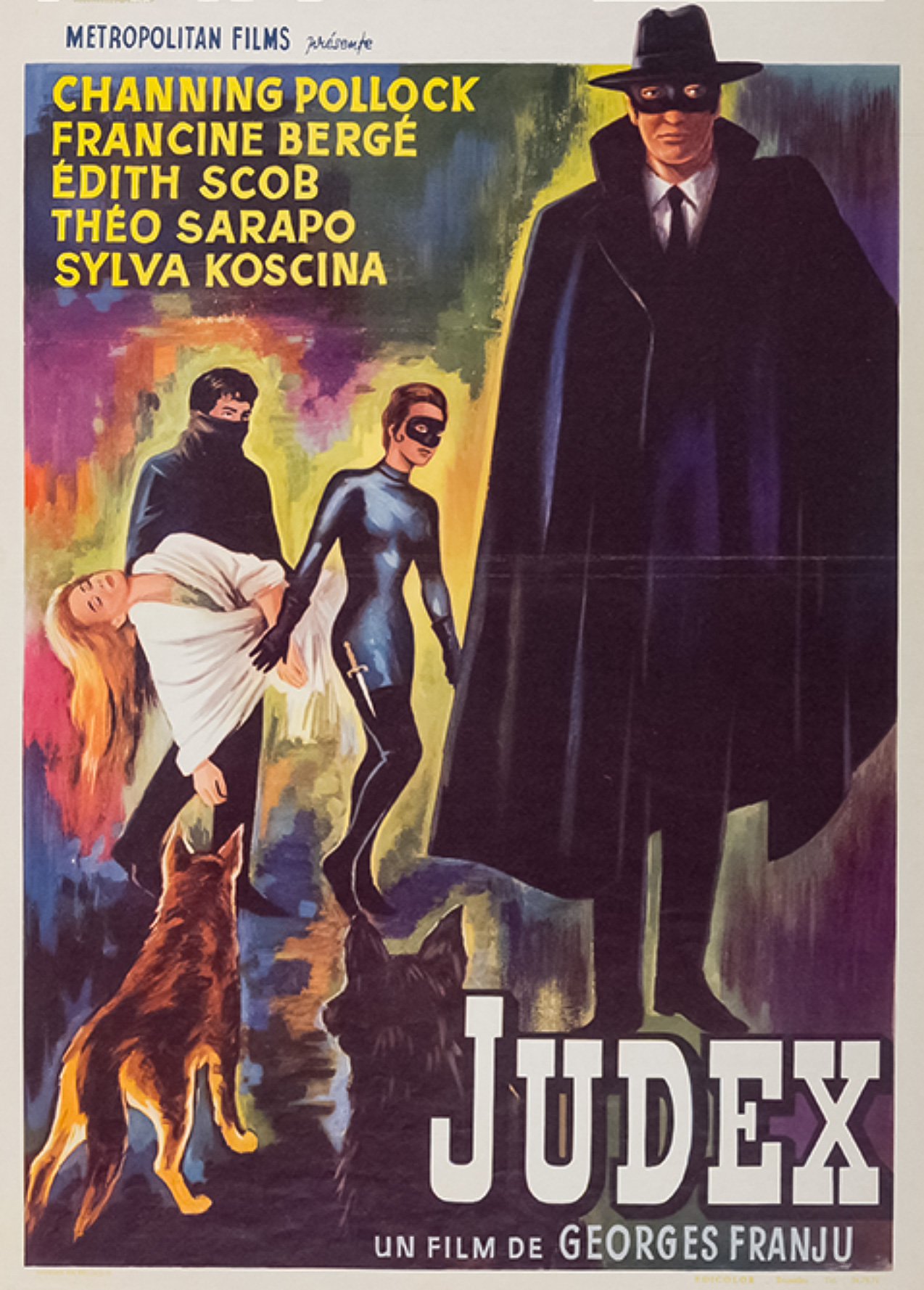
 Whatever it was that compelled Georges Franju to make Judex, it worked out remarkably well, as he put together one of the most fascinating crime films of the 1960s, and a work that still holds up as a remarkable piece of alternative French filmmaking that essentially defined the director’s entire career and made him one of the most interesting voices in mid-century French cinema. An adaptation of the film serial of the same name originally conceived by film director Louis Feuillade and playwright Arthur Bernède, Judex is a rivetting film that journeys through multiple genres, including crime thriller, dark comedy, social satire and even a touch of romance for good measure, in its effort to be a thoroughly entertaining work that keeps the audience on the edge of their seat and always guessing, up until the final moments. With the exception of a slightly weaker third act, and a few minor flaws that come up from time to time, Judex is a near-masterpiece, a wonderfully strange and oddly charming film that manages to find the precise qualities that make these kinds of stories so enduring across generations, and whether it be in the immense simplicity with which Franju adapts the source material, the gorgeous filmmaking employed to bring this story to life, the incredible performances or simply the unique tone brought to this premise, Judex is a complex but thoroughly entertaining work, a seductive and labyrinthine psychological drama that blends every conceivable genre together in its endeavour to stand on its own, divorced from nearly every other similarly-themed film made during this time, but still holding up as one of the finest examples of genre filmmaking in practice, where the brilliance of the story being told is only bolstered by the meticulous attention paid to bringing it to the screen – and for that reason alone, Judex is quite an unforgettable experience.
On the surface, Judex seems like just another crime procedural – looking at it from a modern standpoint (which isn’t always the best method but shouldn’t be actively avoided, since so much of contemporary culture shades in how we feel about certain films), we’ve seen numerous works like this, so there must be something very different about this one for it to stand out, especially over half a century later. Essentially, the character of Judex could be considered the forerunner to the modern superhero – after all, his defining quality is that he is a black-clad vigilante traversing the French countryside to convince greedy bourgeois and their sycophants to atone for their moral transgressions and even more harrowing crimes of the heart. The roots of the vigilante archetype, while not pioneered by this story, can be seen quite significantly here, with Feuillade and Bernède creating a thoroughly compelling character that is just as enigmatic now in this adaptation as he was a century ago when he first manifested on screen, a devilishly charming rogue who grapples the line between social justice and blatant illegality, fighting for what he believes to be right, and is willing to go to absolutely any lengths to defend those who he regards as being the most vulnerable or disadvantaged. What separates Judex from many other procedurals that came about as something of a response to this film can essentially come in what this film is attempting to achieve – Judex could certainly not be considered an easy task to adapt, since the source material consisted of layers of rich material that simply couldn’t be feasibly condensed into a single film like this. There is just far too much in the original plot to be accurately reflected on screen here, especially since this adaptation was nearly four times shorter in length – the fears that Judex simply would lose some of its meaning through inevitable elisions was always a threat.
However, despite the factors working against this film, Franju rises to the task and delivers an astoundingly detailed film that is as thrilling as it is intelligent – and considering how he was a director who had his fair share of rousing successes (Eyes Without a Face) and dismal failures (Spotlight on a Murderer), there was always an inherent risk that his work here wouldn’t be easy to predict, yet through taking this rich material in some very expected directions, he consolidates himself as a director who may not always be good but was at the very least consistent in his ambition, which is in many ways even more admirable. Thematically, there is something quite wonderful about Judex that prevents it from ever being seen as gauche or outdated – mostly, it comes in how the director negotiates the various broad concepts, meticulously adopting certain themes from the original text in a way that pays tribute to what Feuillade and Bernède established, making this one of the few truly unselfish adaptations, whereby the intention isn’t to improve upon the original, but rather pay tribute to it in a way that allows the story to be introduced to newer audiences in a more modern way, without losing the spark of brilliance embedded in the work that inspired it. Franju certainly doesn’t waste a single opportunity to infuse this film with many different ideas, making it a work that sees the director not purporting to his own creative genius, but rather exploring his artistic curiosities, siphoning this simple story through the lens of a few different genres and their indelible qualities, an approach that could either confirm one’s artistic prowess or cause them to fail under the weight of their own ambition. In the case of Judex, the former is absolutely true, to the point where it becomes such a thrilling experience to see where the director is able to take this story, and to which extent he is willing to extend it beyond the confines of expectations.
Something that proved itself to be almost unimpeachably factual is that when Franju hits a peak, its utterly incredible – there are moments of such awe-inspiring beauty scattered throughout Judex (and not necessarily visually) that make even the most well-versed viewers take a few steps back, standing in disbelief that the director was able to make something so beautiful out of such a simple premise. There are images contained in this film that are burned into the mind of the viewer, so unexpected but thoroughly effective in conveying the sensation that this story is set in a recognizable version of our world, one where everything is slightly off-kilter. Whether it be in the masquerade ball, where everyone is wearing masks that are enormous, detailed recreations of the heads of birds, or the thrilling way Franju and cinematographer Marcel Fradetal frame the scenes, there is a certain uneasy elegance to Judex that services it so incredibly well. An entire tome could be written on the stylistic inspirations for this film – taking its cue from film noir, German Expressionism, early postmodernism and even some slight classic romanticism, there is a layered complexity to the visual style employed to bring this film to the screen. The director weaves together such a wonderfully compelling narrative that is only supplemented by the incredible scope he employs to tell the story – without this attention to detail, and the steadfast belief that what he was doing was revolutionary (while still being very much grounded in reality, as a means to prevent it from becoming too self-indulgent) is nothing short of astonishing. Franju’s work here deservedly gains the status of a true spectacle, if not for the unique approach to the story, for the hypnotic ways it is realized through his singular vision.
However, despite being quite notable, Judex is never weighed down by its visual scope – it’s certainly very clear that Franju was attempting to make something striking, but not at the expense of the story (which he perpetually positions as the primary area that he is consistently working to promote), so it only makes sense that every moment of stunning, subversive splendour serviced something in the storyline, even if it was merely supplementary to the overall intentions of the film. The manner in which the director marries style and substance is unprecedented, and it only helps that between these two symbiotic elements are a bevvy of magnificent performances, given by an ensemble who implicitly understand what was required of them in these roles – whether it be magician-turned-actor Channing Pollock in dual roles, or the radiant Édith Scob as the femme fatale (in something of a contrast to her previous iconic performance in the aforementioned Eyes Without a Face), or the scene-stealing brilliance of the beguiling Francine Bergé (who was responsible for two of the most unique villain performances of the 1960s in this and The Nun a few years later), Judex accomplishes something extraordinarily special through the use of its actors, who service the plot in a way that bolsters its message, while not becoming lost in it themselves, as tends to be the case for such enormously ambitious works. Characterization is key to this film – without these believable characters, who grapple the narrow boundary between broad caricatures of different social strata and realistic individuals, Judex simple would not have worked. They’re pivotal to the story since so much of the film relies on the strength of the cast – and even in some relatively minor roles, the actors in this film really enrich it, bringing humour, pathos, tragedy and undeniable humanity to roles that could have so easily been forgettable archetypes that didn’t stand out in any significant way.
Judex is a tremendous film, a daring and complex crime odyssey that manages overcome the intimidation of adapting a classic work of early cinema and repurposing it as something that not only pays tribute to the original but establishes itself as a highly original work in its own right. Franju’s style may not always be for everyone, but somehow he is at his most lucid here, both narratively and visually, and delivers a compelling crime story that feels incredibly authentic while never once neglecting to take the broad liberties afforded to it by the genres it traverses. It’s not a particularly complex work in the traditional sense – it has many of the elements of the classic crime film, including a single plot divided into two different storylines that converge in the end, a predictable plot structure that hits the familiar beats for the most part (but yet somehow never feels dull), and a set of characters that represent broader factions of society. However, where Judex thrives is in how it is intent on surprising us as much as it can without losing sight of the broader plot – twisted and subversive in the best possible way, the film takes us on an unending journey into the heart of a crime that is brimming with a kind of simmering intensity that always keeps us guessing – and the fact that Franju was able to find space in between these moments to stupefy us with his visual prowess is only an additional quality that makes this such a worthwhile film. Ultimately, Judex is a terrific piece of filmmaking, a daring and potent thriller that presents us with a strong story, and gives us the chance to go on this incredible adventure that seems vaguely familiar at the outset, but reveals itself to be something else entirely by the time Franju has accompanied us on this brilliantly deranged voyage into his world defined by a certain kind of wonderful surrealism.
 The Postmodern Pelican