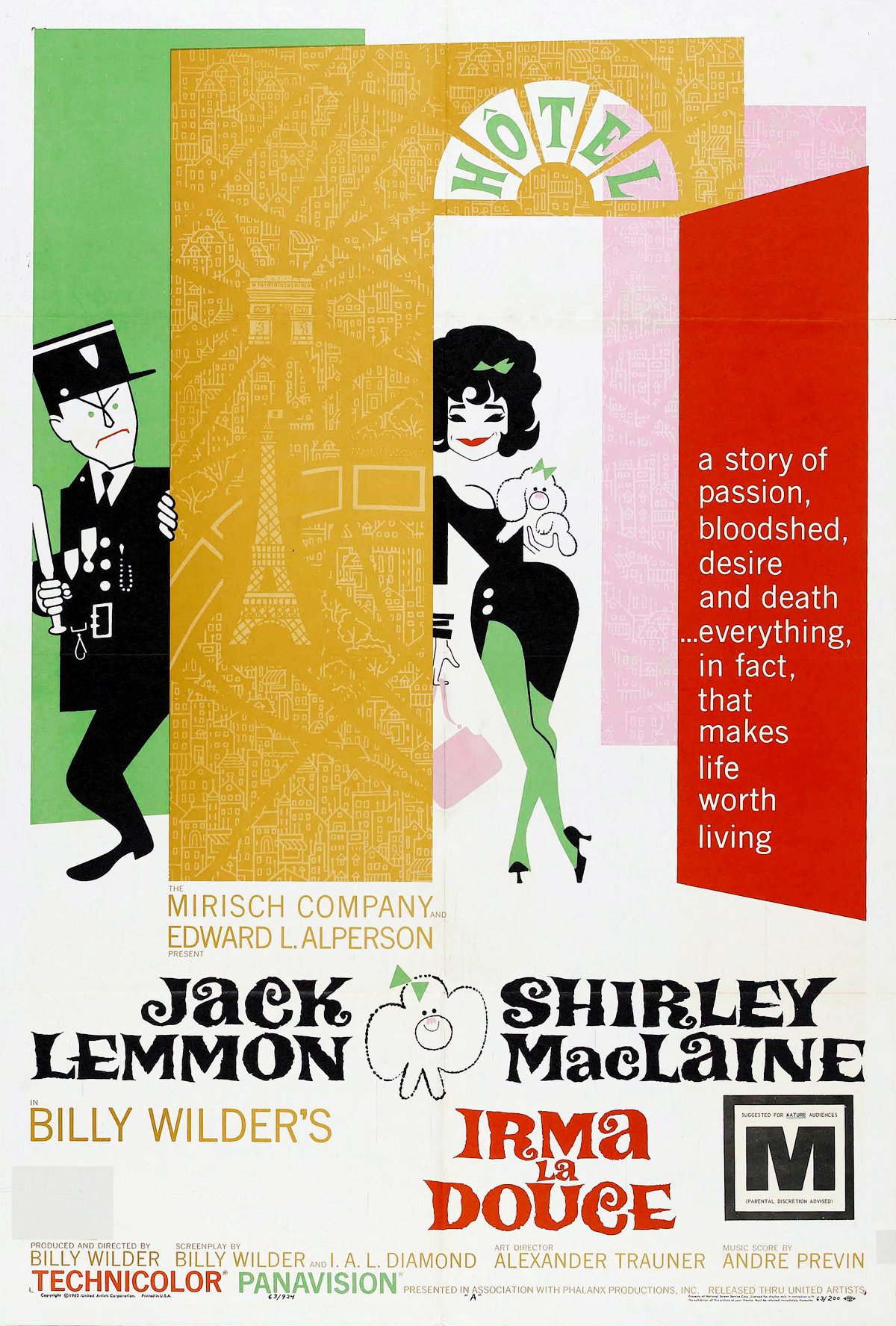
 Billy Wilder could do absolutely anything – his versatility as a director made him a perfect fit for any kind of film. However, despite taking numerous forays into different genres, he did tend to understand where his strengths lay, and while there isn’t a single kind of film that defines him as an artist, some of his best work comes from his ventures into the realm of comedy, where he created some of cinema’s most unforgettable pieces of entertainment. We can always refer to his canonical classics Some Like It Hot and The Apartment as notable entries into his career, but one of his films that is sometimes overlooked, albeit thankfully not too often, is Irma la Douce, his adaptation of a musical by Marguerite Monnot and Alexandre Breffort, which tells the story of a young Parisian prostitute and the honest cop who eventually finds himself falling in love with her and willing to go to any lengths to secure her as his own. There are a few reasons why I’d suspect Irma la Douce, while still having a dedicated legion of admirers, hasn’t been seen as the timeless classic that some of the director’s other work has – it’s overlong (running at an unnecessary 142 minutes), it straddles difficult narrative territory, and it sometimes takes a quite cynical approach. However, these aren’t nearly the shortcomings they appear to be, since Wilder was one of the few filmmakers who could overcome these challenges with his blend of warmth, sardonic humour and meticulous artistry, which elevate Irma la Douce far above the confines of its sometimes unstable plot to become something quite special, and a film ripe for reevaluation, especially since Wilder’s work continues to age extraordinary well, remaining as insightful, funny and heartwarming today as it did half a century ago.
Based on the premise alone, you’d be forgiven for thinking Irma la Douce to be something of a departure for Wilder, who wasn’t a stranger to controversial subjects, but normally explored them in a way that didn’t quite lend itself to the kind of bombastic comedy employed here. Part of this can be attributed to Monnot and Breffort’s original musical, a bawdy and risque revue that took no prisoners and put the audience through the wringer of enticing double entendres and more elegantly indecent material for the sake of entertainment – and even by modern standards, Irma la Douce is something of an anomaly, perhaps not for the subject matter, but rather for how wonderfully flippant it is about, treating it as a matter-of-fact issue that doesn’t waste any time on moralizing or establishing itself as being more ethical than any other film that flirts with the idea of the profession. In a modern context, Irma la Douce is a remarkably resonant piece, especially considering how there is a much-needed move towards the destigmatizing of the escort profession in contemporary society, which makes this particular story one that may not be the definitive word on it, but is a step in the right direction. Neither celebrating nor reviling the work the titular character does, the film instead focuses on developing a particular atmosphere that allows for an unexpectedly deep portrayal of cultural perceptions – perhaps we’re lending too much credence to this aspect of the story, especially since it isn’t likely the intention was to be insightful, but through his delightful approach to the subject matter, and his refusal to lead it down the path of self-righteous preaching, Wilder was able to make a surprisingly meaningful work that pushes boundaries that didn’t even exist fully back then, and while continue to be contentious issues.
Looking too deep into a film like Irma la Douce can definitely unveil some hidden messages that made Wilder’s films so compelling, but they can also cause us to lose sight of what really matters, which in this case is the fact that the director made yet another charming comedy-of-manners (or rather, a comedy-of-no-manners) that centres on interesting characters that at first appear to be thinly-written archetypes, but through dedicated characterization on behalf of the writer and director, and the wonderful work done by the cast, they manage to become fully-formed individuals that appear entirely authentic without losing the spark of eccentricity that made them so endearing in the first place. The charm embedded in Irma la Douce really manifests through the two main performers, who embody these characters with such immense commitment and dedication, elevating it far above the twee, unremarkable spectacle that it could have easily defaulted towards becoming. Jack Lemmon and Shirley MacLaine were definitely not strangers to working with the director – their collaboration with Wilder on The Apartment only a few years before didn’t become a substantial peak in their respective careers, but stands as one of the greatest films ever made. Inarguably, Irma la Douce may not reach such impossible heights, but that doesn’t stop it from trying, and while it naturally pales in comparison, it still remains a funny and insightful work that extracts the exact kind of charming performances from its two leads that we’d expect under the guidance of Wilder. Both are fantastic – they may not be stretching themselves in any significant way, but the roles of Nestor and Irma are so intrinsically dependent on their chemistry, it ultimately doesn’t matter at all that they are merely playing derivations on their most popular characters, rather than being entirely fully formed on their own – although I will say that Lemmon’s dual performance as Nestor and Lord X shows precisely why he’s one of the true masters of his craft, only for the fact that he is able to create two very memorable and incredibly funny characters out of nearly nothing other than a costume and strong script. Lou Jacobi is also worth noting for his scene-stealing work as the aptly-named Moustache (and who is responsible for the first major laugh in this incredibly funny film), as is the cast of solid performers who all turn in remarkably exceptional comedic performances, regardless of the size of their roles.
Wilder was a director who made his own artistic inspirations very well known, and he often spoke highly of Ernst Lubitsch and the proverbial “Lubitsch touch”, which he claimed inspired him, particularly in terms of how the famed Classical Era filmmaker would operate on a certain level of elegance, even when dealing with the more risque subject matter, always leaving it up to implication, but never obscuring the actual message through mere allusion. This is a guideline Wilder uses very well in Irma la Douce, which carries the director’s own unique style, a kind of mid-century comedic restraint that says exactly what it needs to say, never resorting to overt exposition, nor hoping that the audience will be able to make all the necessary inferences. Comedy is a difficult business, and it’s impossible to imagine a film that is essentially centred around a prostitute and her ex-policeman lover who becomes her “handler” would’ve been particularly well-received at the time (and I’d argue that the main intention for setting this film in France, other than being adapted from the stage musical that was originally produced there, was to detach the perceived immorality of this story from the more puritanical American values and associating it more with the libertine luxury of European society, an amusingly misguided approach), but Wilder manages to execute it with such ease, mainly because, despite not censoring the plot or making the proceedings vague, he presents them directly, never concealing the intention but keeping it classy throughout. It’s an appreciated move from a master filmmaker whose effortless ability to infuse any story with his signature style, which was cultivated from a clear and concise understanding of how his heroes made films, make Irma la Douce something incredibly special.
Ultimately, Irma la Douce is just a traditional comedy in the sense that it gives us a simple premise filled with likeable characters from wall to wall (even the villains of the story are lovable in a strange way), and guides us through a couple of hours of misadventure, filled with twists and turns that can be seen a few miles away, but still take us by surprise when they present themselves on screen. Naturally, any film by Wilder is going to be worth watching, even if this isn’t in his top-tier. This is a work of sweltering comedic genius, a hilarious and irreverent journey into the depths of society that feels simultaneously heightened and entirely authentic – and we can only show appreciation to Wilder and his enormous brilliance for giving us such an entertaining film, which provides us with sufficient laughs (and perhaps the funniest scene I’ve seen in a very long time, when the titular character remarks on her little poodle’s tendency to drink, which is such an unexpectedly charming moment, and just one of many brilliant moments of sincere comedic brilliance), but not without losing the heart that makes this such a wonderful piece of filmmaking. Watching a film by Billy Wilder is an unforgettable experience – its a warm embrace, carefully-curated by a masterful storyteller and visual stylist whose flair for the eccentric stood him in good stead for the duration of his prolific career that fashioned him into one of film history’s most indelible voices – and even in something as slight and predictable as Irma la Douce, Wilder shows exactly why he was such a legend, capable of absolutely anything.
 The Postmodern Pelican