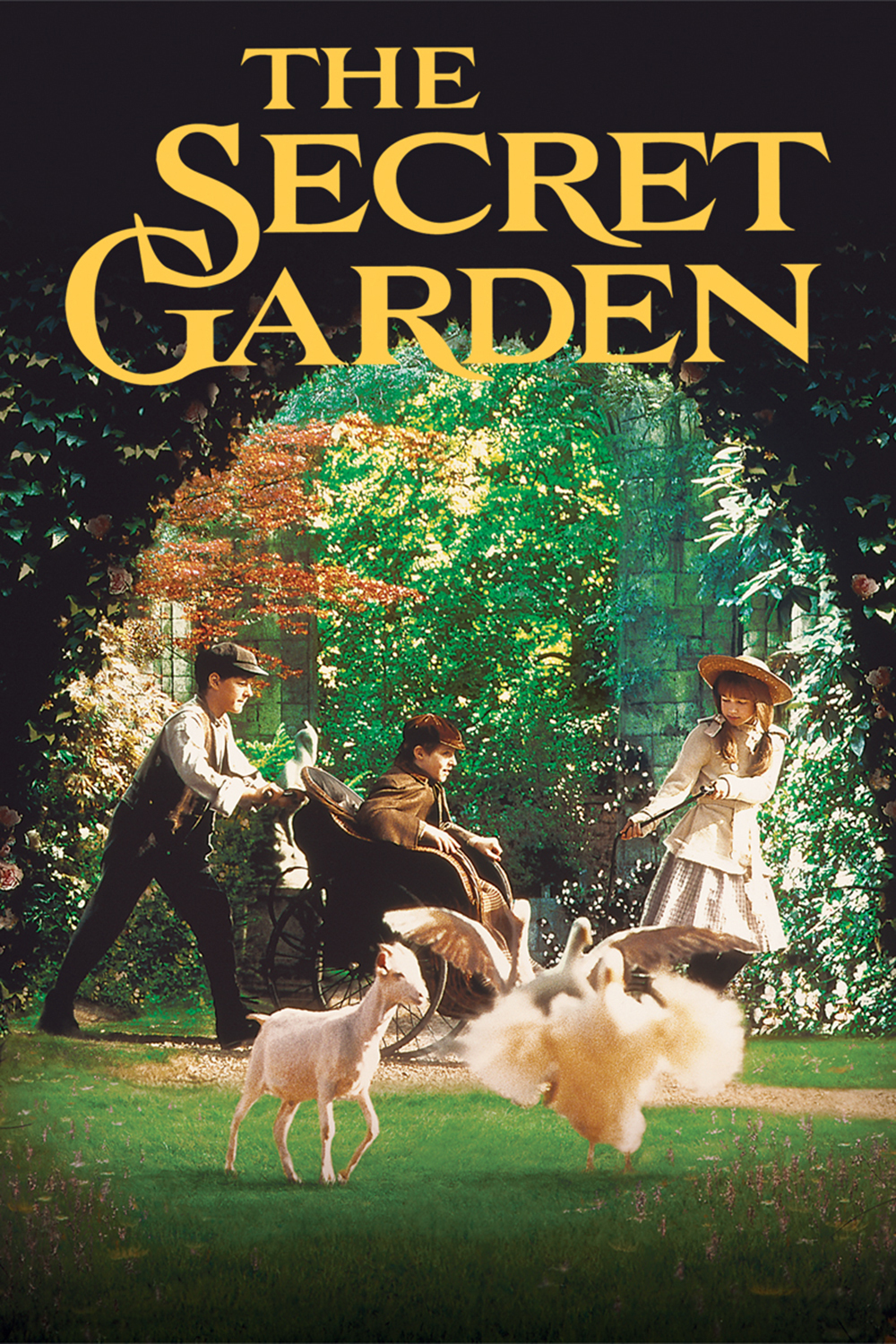
 At the turn of the twentieth century, a young girl named Mary (Kate Maberly) is orphaned when her wealthy Indian colonialist parents are killed in an earthquake. Her last remaining relative is Lord Craven (John Lynch), an aloof nobleman who is still mourning the death of his wife years before. Mary is placed in the enormous manor, where her only interactions are with the dour Mrs Medlock (Dame Maggie Smith), Lord Craven’s housekeeper and trusted confidante, and her lackey, Martha (Laura Crossley), a buoyant young maid who takes a liking to the new addition to the household. Despite finding herself surrounded by luxury, Mary struggles to adapt to this new way of life – there’s no longer the many servants that wait on her hand and foot and satiate her every desire, and she essentially has to find her own methods to pass the time. Her inquisitive nature leads her to the fringe’s of the estate, where she is lead, almost by some celestial force, to a locked door. She discovers that just behind it sits a beautiful but decrepit garden, which she surmises belonged to her late aunt, which has subsequently by closed permanently by the mourning Lord Craven, who refuses to acknowledge anything associated with his dearly departed wife, including their son (Heydon Prowse), a sickly young boy who rivals his cousin in terms of spoiled arrogance. However, over time, Mary comes to develop a fondness for this garden, gradually bringing it back to life, in the hopes that it will lighten the downbeat mood of all who live on the estate, and hopefully bring the joy that everyone so desperately required in order to see that just beneath the cold surroundings, whether physical or mental, there is always hope for some happiness, even in the darkest moments of our lives.
Literary adaptations are not a difficult genre to get right, but they still tend to take a lot of work, especially when it comes to the most beloved works that defined the childhoods of generations of viewers. Agnieszka Holland seemed to be fully aware of this with her adaptation of Frances Hodgson Burnett seminal masterpiece, The Secret Garden. Marketed as a family film, but brooding with a seriousness that elevates it beyond innocuous, child-friendly entertainment, Holland’s The Secret Garden is bordering on a masterpiece of literary adaptation, a film that employs the most simplistic approach in telling the story, coupling it with some of the most stunning cinematic elements, such as exceptional photography by Roger Deakins and Jerzy Zieliński (whose collaboration brought out such graceful beauty in the subdued surroundings), and an astonishing score composed by the woefully underpraised Zbigniew Preisner. It may not be a major work in traditional terms – occasionally a bit more slight than some of the more notable adaptations in the past, and sometimes too lenient on the core of the story, The Secret Garden compensates for these slight weaknesses by being a rousing piece that blends numerous genres – adventure, romance, family drama and even some light smatterings of fantasy, in order to bring Burnett’s iconic novel to the screen for the first time in over half a century, being one of the most elegant but entertaining forays into this world, with an incredible cast and a dedication rarely glimpsed by films attempting to breathe new life into artistic works of intimidating stature.
It’s clear that the importance of The Secret Garden was not lost on Holland when she set out to direct this film. Working alongside screenwriter Caroline Thompson, who undertook the challenge of adapting Burnett’s flowery, evocative novel into a coherent screenplay without losing the beauty that came with the written descriptions of the world that the author so carefully constructed. They worked in tandem to create something memorable, and the result is a worthwhile journey into this enigmatic world that has been a cornerstone of the childhood of so many of us, who were undoubtedly transfixed by the author’s incredible control of form and imagery, which has now been translated to the screen in a truly stunning way. Holland’s work here is very strong, particularly since her career has been defined by very strong work that may not be distinctively her own (thus preventing her from having a particular style), but effective in telling a story well, in a way that is entertaining for the viewer, and always hinting at something more simmering beneath the surface. They had their work cut out for them, and as a result, The Secret Garden can’t be considered anything close to a work of auteurism – rather, it functions as the product of several creative artists working alongside each other to bring this story to life. This gives the film a very rich sense of community, where each component is undeniably strong in playing a part towards bringing this novel to life. Whether it be something as major as the cinematography or the small details contained within the production design, The Secret Garden is a creative and technical marvel, each moving part working extremely well in realizing the depth of this story and preventing it from being either overly-twee or dour, which are real risks that come about when attempting to bring a beloved classic to the screen.
However, what really pushes The Secret Garden over the edge towards something very special are the performances. Holland assembles a cast combined of young newcomers and veterans of the industry, putting them toe-to-toe in a way that allows them to bolster the other’s performance, rather than commanding the screen all on their own. Kate Maberly, despite her young age, is a formidable lead, playing the part of Mary not merely as a one-note child character (which tend to be the trap many of these films fall into, where they position an adorable child as the protagonist without giving them anything significant to do), but rather as a fully-developed individual that undergoes substantial growth, whose ascent from bratty, spoiled child to the heartbreaking heroine of this story is quite wonderful. Laura Crossley is wonderful as the upbeat young maid who always sees the best in every situation, and in many ways acts as something of a contrast to Mary, while Heydon Prowse (who arrives quite late into the film) is very special as the young man who has spent his entire life believing he wasn’t capable of anything, the victim of a father whose distant behaviour is the result of some combination of overprotectiveness and refusal to acknowledge anything that reminds him of his wife. However, the most impressive performance in The Secret Garden unsurprisingly comes on behalf of the incredible Dame Maggie Smith, whose work here is simply extraordinary – made on the precipice of her move into more dowager-esque roles, her performance as Mrs Medlock is a scene-stealing, riotously funny supporting role that actually carries some substance, and whether delivering witty one-liners or an acidic retort or in one of the more introspective moments, Smith is absolutely incredible. Its a testament to her talents that she was able to elevate such a relatively minor character to one of the film’s best parts – and like any of her wonderful supporting performances, Smith manages to make an impression without taking over the screen, a result of her great generosity as a performer, always reliable, but never greedy. The cast of The Secret Garden works really well and breathes even more life into this wonderful, touching film.
Ultimately, The Secret Garden is what you’d expect it to be – a warm, endearing drama that will enchant viewers of all ages, with younger audiences undoubtedly being transfixed by the magical story, while the older generation will certainly see potent reminders of the beauty of childhood innocence reflected on screen. Agnieszka Holland helms a powerful adaptation of an iconic book, elevating it to a level many literary adaptations struggle to attain, mainly since she is not satisfied with settling for merely adequate. Without being overly experimental or breaking from tradition, Holland is able to put together a compelling, faithful version of this story that lifts Burnett’s gorgeous imagery from the page and directly transplants it into the visual medium. This wasn’t done without laborious effort – the work of a myriad of creative individuals went into the making of this film, each one bringing something new to the production, resulting in a charming drama that goes further than many of us would imagine. It may be quite predictable, and doesn’t add anything new to the story – but when it comes to something as beloved as The Secret Garden, the best approach is the one that feels the most authentic, which is the key to the success of this adaptation. Sweet, charming and utterly compelling, The Secret Garden is a truly wonderful piece of gorgeous, unforgettable filmmaking.
 The Postmodern Pelican