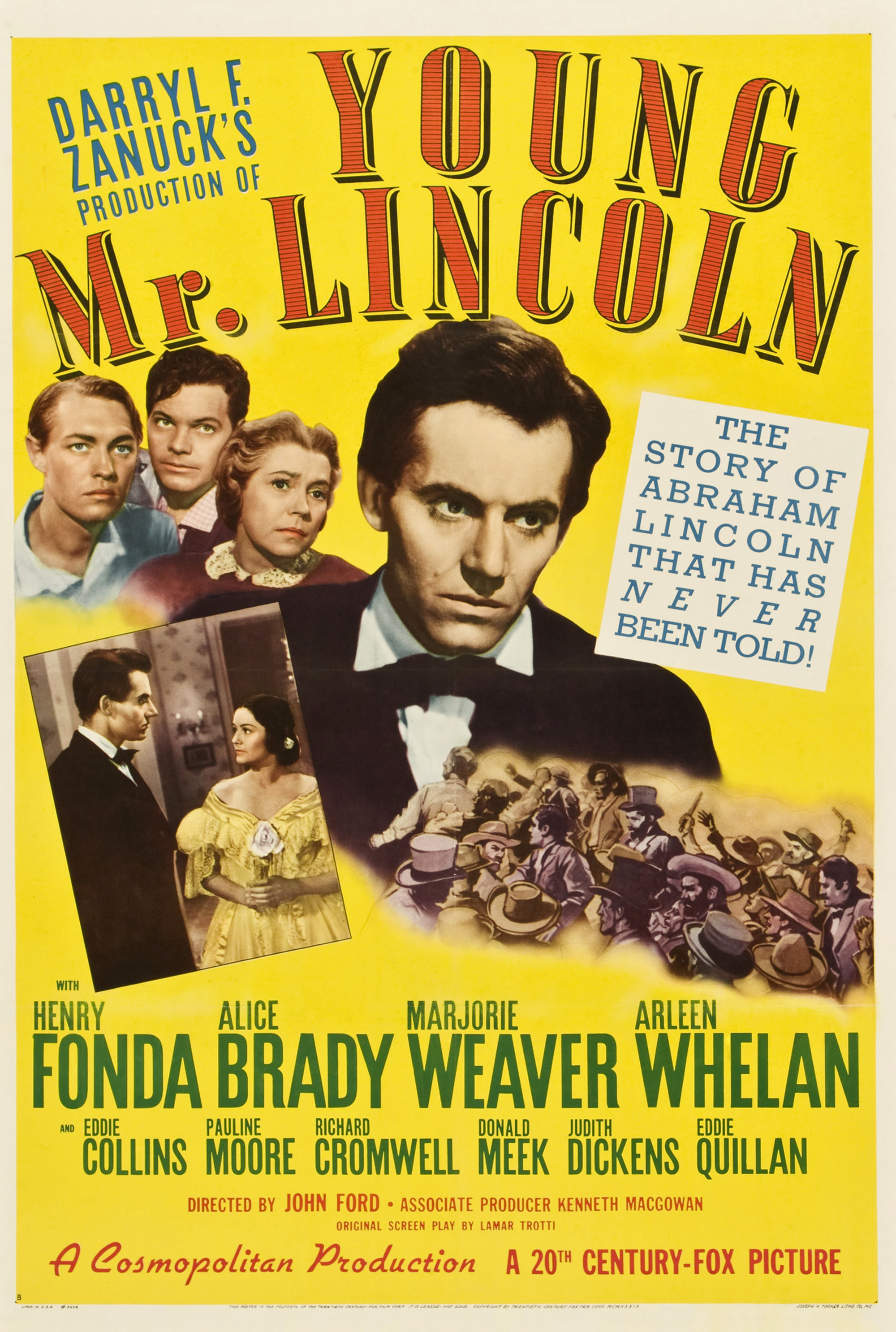
 You can say a great deal about John Ford, but you can’t ever accuse him on not delivering exactly what he promised – when looking into Young Mr. Lincoln, one shouldn’t expect to find anything other than what the title proposes, and for better or worse, Ford’s dramatization of an early chapter in the life of the titular character achieved precisely what it set out to accomplish. Produced long before artists were preoccupied with constructing origin stories for any number of fictional characters, Ford and screenwriter Lamar Trotti put together a piece about the early years of one of America’s most beloved real-life heroes, a chance for audiences to see one of their nation’s most important cultural icons reflected up on the screen in a way that previous versions of his life had never ventured. I’d imagine taking into account the period in which this film was made does play a part in understanding what went into its conception, and the reasons why it is important to view it as a product of its time – made in the harrowing period between the peak of the Great Depression and the USA’s entry into the Second World War, morale was at an all-time low in 1939, so its unsurprising that a film like Young Mr. Lincoln was commissioned. A passive, well-meaning drama built entirely on the valiance of the country’s most iconic leader is the exact kind of binding force that Ford and his collaborators were insistent on – and in this regard, the film is a solid biographical drama, the kind that has some merit, but very little cultural cache, and while it may still be an insightful piece of filmmaking, it isn’t much more than that either.
Abraham Lincoln has had innumerable portrayals in culture, ranging from film, literature, television and stage, always being a figure that several artists have attempted to interpret in their own way, whether through directly exploring his life, or placing him in very different situations in speculative pieces that play on “Honest Abe’s” distinctive qualities. Ford’s film attempts to, as the title suggests, venture into his past, presenting Lincoln not as the wise, all-knowing political figure, but rather as a scrappy young lawyer who worked for everything he achieved, possessing a broad charisma and admirable moral compass that was the envy of all those in his community, and the reason why he became so beloved. You can tell from the first moments of Young Mr. Lincoln that the film is not going to take a particularly objective view – created solely as a platform to show Lincoln as a great leader even when he didn’t have the experience, a dyed-in-the-wool patrician that could do no wrong, even when he did demonstrate some minor flaws. For this reason alone, Young Mr. Lincoln is somewhat dated, since biographical dramas since then have tended to play more on humanizing these figures, rather than being vaguely propagandistic portrayals of their lives through some light fictionalizing of their origins. This certainly doesn’t mean Young Mr. Lincoln is without merit, as it carries its heart on its sleeve, and not once implies itself to be anything more than what it promises. You truly get what you pay for with this film, and as a piece of sensationalist historical fiction (if you can refer to it as such), it works well. In all other areas, however, it doesn’t succeed nearly as comprehensively as you’d hope.
This film is just about as likeable as we can expect from a John Ford story about Lincoln, starring Henry Fonda, in which the narrative epicentre takes place on the Fourth of July – Young Mr. Lincoln is just about as American as any film can be, which could either be a delight for those who want to feel the ethereal patriotism of a group of collaborators coming together to celebrate the early life of a cultural icon and one of the father’s of the nation, or unbearable for those looking for something a bit more insightful. The only audience I can see truly appreciating this film in contemporary times are those with an active interest in Lincoln (since I’d expect even those radically passionate about American history will be left cold by this saccharine glimpse into Lincoln’s life, with the boundaries of truth and sensationalism being far too vague), and even in that regard, there isn’t much to go on, since it offers very little real insight into who Lincoln was as a person, other than being inspired by an early event in his life as a lawyer, loosely being based on the Duff Armstrong case, rather than being a truthful adaptation on that event, the first sign that this film is more than willing to take full artistic liberty. Ford does very well to construct a rousing piece of storytelling that has a lot of heart to it, but the overly-sentimental approach just doesn’t work. Not only does it feel quite flat throughout (with the exception of a handful of moving scenes), Young Mr. Lincoln followed a simple narrative guideline in how it constructed scenes, consisting essentially of two major categories – scenes where Lincoln says something humorous and everyone in the proximity (with the exception of the antagonist) bursts into laughter, or Lincoln says something wise and insightful, evoking applause and cheers from absolutely everyone. It’s entertaining filmmaking, but it’s just about as sensationalist as they come.
Biographical dramas become dangerous when they intend to portray its central character as flawless and infallible, which is perhaps the most significant flaw with Young Mr. Lincoln – not only does it not take any risks, it seems to actively avoid any attempt to show the titular character as anything less than a cultural icon in the making, someone who was practically born without a single flaw, and who went through life buttressed by his unerring, impeccable morality and refusal towards any wrongdoing. Its obviously well-documented that Lincoln was a virtuous man and a leader of great moral scruples – but there’s something quite unsettling about portraying him as faultless as he is here since it amounts to essentially nothing more than lazy storytelling, where avoidance of challenging the status quo is mistaken for rivetting patriotism. To his credit, Henry Fonda does his best in playing the central role, taking on the part with a gusto that demonstrated him as the Golden Age icon he was. Normally, the impressive makeup would’ve been enough, as it successfully transforms him into an uncanny version of Lincoln, right down to the smallest detail (even if there are some moments where its clear the makeup is doing most of the acting, such as in the many moments where the camera lingers on a brooding, wordless Fonda), but he does manage to act through the prosthetic, delivering a compelling, if not unremarkable, portrayal of the titular hero. He does well with the role, giving everything he can to the part, with the only flaws in his performance coming in the fact that the script really doesn’t give him anything significant to do, other than being propelled on the fact that it’s one of this film positions one of this generation’s most dashing young actors in the role of Abraham Lincoln – there really wasn’t much need for any real effort outside of this. It’s a fine performance, but far from the incredible work the actor would do just a few short years later, where he truly came into his own and consolidated his place in film history.
Young Mr. Lincoln is not a failure in any way – it’s a decent work of biographical fiction that tells a compelling story and brings with it all the reliability we can expect from this high-profile, low-effort 1930s drama, but not at all something that will convert anyone to this brand of American history, rather being marketed at those either with an active interest in the subject (but also the good knowledge to know how to separate fact from fiction), or completionists of the work of Fonda or Ford. Other than some moments of inspired, rousing drama, there’s really not much simmering beneath the film, with the exception of its status as one of the more daring attempts to explore the life of its central character, without actually committing itself to much more than that. It is neither the definitive work on the early life of Abraham Lincoln, nor is it the most comprehensive account of this period, but it’s a solid work of thinly-veiled sensationalism that serves its purpose well. It hits all the familiar beats, has the expected moments of hackneyed sentimentality and rousing heroism, and not much else. Young Mr. Lincoln serves a purpose and achieves just that, so anyone considering sitting through this film should be well-aware of these problems, and willing to overlook them in order to find the paltry merit that persists throughout. Not in any way an essential work, but rather a perfectly adequate one, Young Mr. Lincoln is sufficient in telling its story in an innocuous, enjoyable way, without daring to take anything close to a risk, leaving room for later filmmakers to remedy this problem with more worthwhile explorations into the life and legacy of one of history’s most enigmatic leaders.
 The Postmodern Pelican