 Charade has absolutely no business being this brilliant, which seems to be par for the course when looking at the films of Stanley Donen, one of Hollywood’s most exceptional filmmakers who was rarely given the rapturous acclaim he deserved. Most likely the result of the early years of his filmmaking career consisting of contract work rather than allowing him to assert his own unique vision onto the screen. This changed when he co-directed On the Town and Singin’ in the Rain, arguably two of the most joyful musicals ever filmed in the United States, working alongside bona fide cultural icon Gene Kelly, from which point Donen went onto reconfigure himself as someone who could produce a big-budget extravaganza that was always worth the price of admission, and then some. Charade is amongst his best work and came at a time when Donen was no longer seeking to establish himself a powerful directorial force, but someone who was responsible for some of the most beloved musicals and comedies of the 1950s. However, despite being quite a solid filmmaker, he was always passed over due to a perceived slightness in his work – even his magnum opus, the utterly incredible Two for the Road, has only been reappraised as an absolute masterpiece in the decades after its release. Many of the elements that made that film, and by extent his entire career, so fascinating are present in Charade, a genre-bending spectacle that blends romance, comedy, thriller and espionage into one gloriously brilliant package that keeps the viewer entertained, mostly through its rapid pace, masterful technique and charismatic humour that creates an atmosphere of absolute warmth and endearing leisure that makes this such an enthralling work. It also helps that the film is absolutely brilliant, and undeniably one of the most elegant, beautifully-constructed thrillers ever committed to film. In short, Charade is every bit the masterpiece it appears to be, and even more.
It’s not difficult to determine exactly why Charade has stood the test of time so well – this kind of European caper that combines numerous different genres and samples from a wide variety of conventions was a source of great entertainment towards the middle of the century – something about seeing the movie stars we absolutely adore trotting through recognizable but extravagant cities is always something that has been entirely compelling, and when compounded with a rivetting premise that features a well-constructed crime narrative and an abundance of comedy (as well as throwing in some good-natured romance for good measure), there’s no doubt that the viewer will be entirely exhilarated in numerous ways. Charade is a film that simply isn’t made anymore – the majority of modern attempts to capitalize on this highly-successful formula tend to falter when it comes to execution, either being too oblivious or being too self-aware to be the kind of escapism that captivates viewers with such vigour, taking us on a journey that situates us within a resonant world, while abandoning the more thorny details that may weigh something like this down needlessly. The key to the success of a film like Charade is that it doesn’t take itself too seriously – it’s fully cognizant of its status as a bit of mindless escapism, but this doesn’t give it license to be boring or ill-formed. Instead, it’s a way for it to take full advantage of the opportunity to be as outrageous and outwardly absurd as it wants to be, since anything goes in this kind of film, where logic is momentarily suspended in favour of making the experience of working your way through this film entirely compelling and unforgettable. Consider that Donen is aware of this fact, but still manages to keep everything under control by showing remarkable restraint, and you’ll start to understand precisely why Charade has remained such a classic for over half a century, and why it still feels so refreshing, even by modern standards.
Charade has such a rugged charm that seems detached from contemporary art – on both the tonal and aesthetic level, there’s a certain elegance that makes it clear that we’re watching something from a particular era, which may seem like a shortcoming for most films since the intention is that they stand as timely works of art, but when this aura is what gives the film its staying power, it’s difficult to argue against it. Donen executes quite a challenging story with poise, good humour and a massive amount of sincere dedication to not only doing service to the story (which could be derivative at some points, but not to the point where it became unbearable), and infuses a vivacious, wide-eyed optimism into every moment of the film. Some have compared Charade to the work of Hitchcock, particularly in how it blends subversive comedy and suspense, and while it may be wildly inappropriate to put Donen in the same league as Hitchcock, its not all that absurd to consider him as sampling from the great director’s creative arsenal, borrowing certain elements (as well as a collaborator) in order to create something quite effective, which may not be nearly as perfectly-calibrated as what Hitchcock would’ve done with this story, but is radically close to what we could expect from the master. However, Donen does bring his own unique style to the piece, momentarily putting aside his tendency to make more elaborate big-budget movie musicals, and instead putting together something much darker, but not any less entertaining.
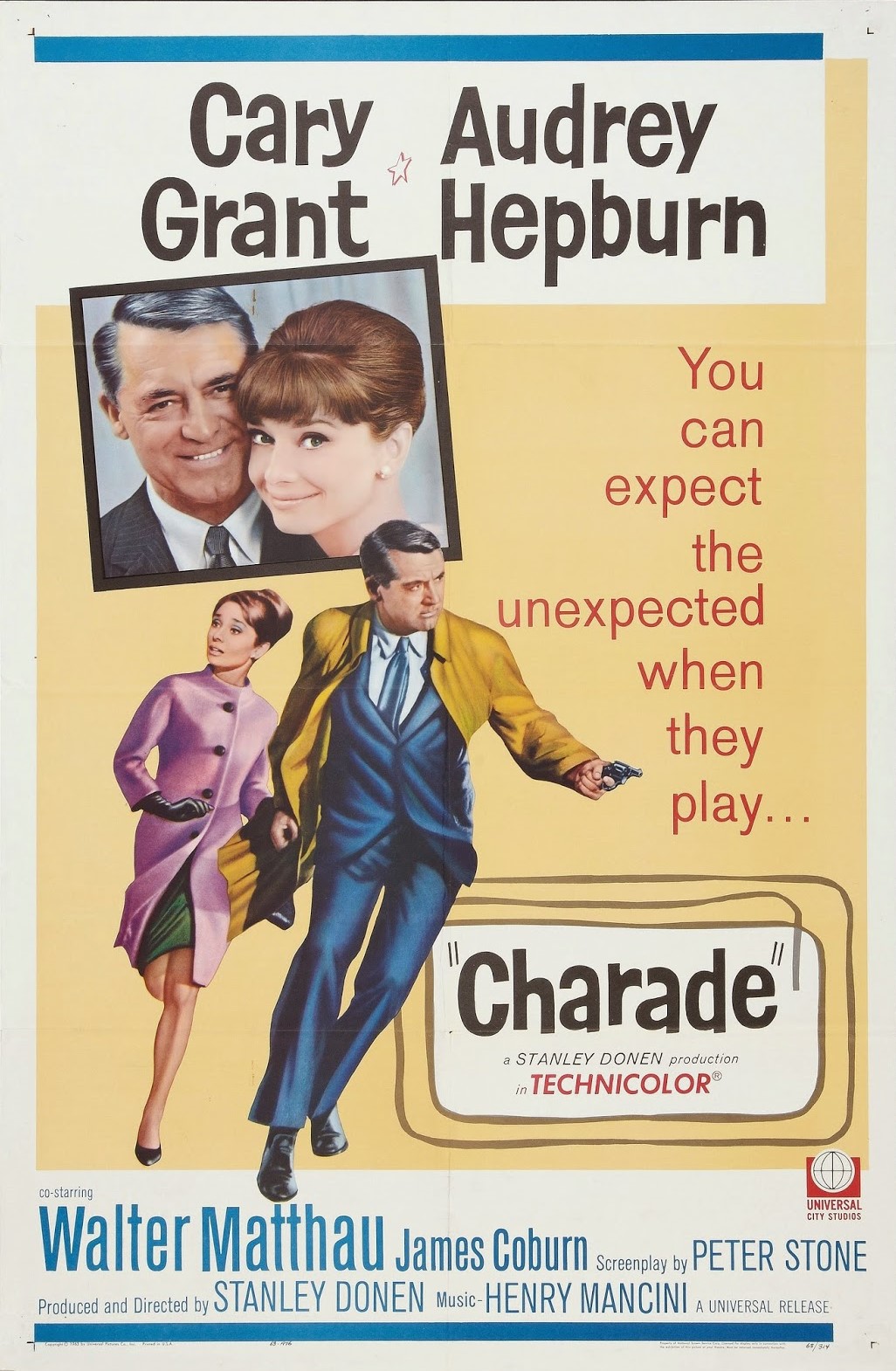
Without any doubt, the one aspect that is brought up most commonly when discussing Charade are the two magnetic icons that occupy the leading roles. A film starring either Cary Grant or Audrey Hepburn is immediately going to be of some interest, so the opportunity to see them together is not something anyone could pass up. Throw in the fact that they’re positioned in such a way where the entire film is built around their perpetual verbal sparring as they fall deeply in love, and you have something that is nothing short of tremendously effective – and it’s astonishing that this was the first and only time the two worked together. Grant was nearing the end of his acting career here, but still had the exact same vigour here as he did at the height of his career – dashing, charismatic and absolutely spellbinding, Charade gives the great actor the chance to once again let loose and play a character built on his natural charm, but still challenging him in ways many Hollywood stars of his stature wouldn’t dare. He’s contrasted wonderfully by Hepburn, whose stark elegance was used to spectacularly well in playing the part of Regina, a recently-widowed socialite thrust into a harrowing game of cat-and-mouse, where nothing is what it seems, everything is made up and the allies don’t matter. The chemistry between the two leads is palpable and simply smouldering, which makes their work together so incredibly effective. Counter this with the terrific work being done by Walter Matthau in a smaller but no less impressive supporting role as the helpful CIA agent who turns out to be the central antagonist, with Matthau’s genial likability serving the smirking evil of the character wonderfully.
Putting value into Charade beyond being a series of outrageous situations that blur the boundaries between psychological thriller, soaring romance and hilarious screwball comedy isn’t something that’s done all that often – the film really exists as two hours of escapism set to the backdrop of 1960s Europe, with the Parisian locales being absolutely stunning – but there is always something lurking beneath the surface of the film, and whether you consider this the result of boisterous filmmaking techniques, a strong script (which may just be the film’s strongest merit, as some of the dialogue in this film is absolutely pitch-perfect and so effective in conveying themes of both great intensity and ethereal levity) or something else, there’s no denying that Charade is a film that quite simply works, whichever way you look at it. It may be escapism, but it’s far from cheap – in fact, there are few films that seem to be as dedicated to creating a rich and varied experience for the viewer than this one, allowing us the opportunity to go on this enthralling adventure that spans an entire city, and gives its charismatic stars the chance to turn in reliable work that may not be their peak, but rather serves as potent reminders of why they are the beloved screen icons they’re also universally considered to be. Hilarious, irreverent and thoroughly compelling in both form and content, Charade isn’t a particularly complex affair, functioning less as a groundbreaking masterpiece and more as a sensible, endearing caper that employs countless different genres in its endeavour to be as enduringly unique as it possibly can, while never losing sight of the ultimate goal. It’s an exceptional work, one that is brimming with warmth and vivacity, leaving a sense of delight in every viewer who takes on the entertaining challenge of venturing into the version of the world Donen is offering us here, creating a sensational and unforgettable experience that may not linger for too long, but remains as pleasant as you could possibly expect from such a film.
 The Postmodern Pelican