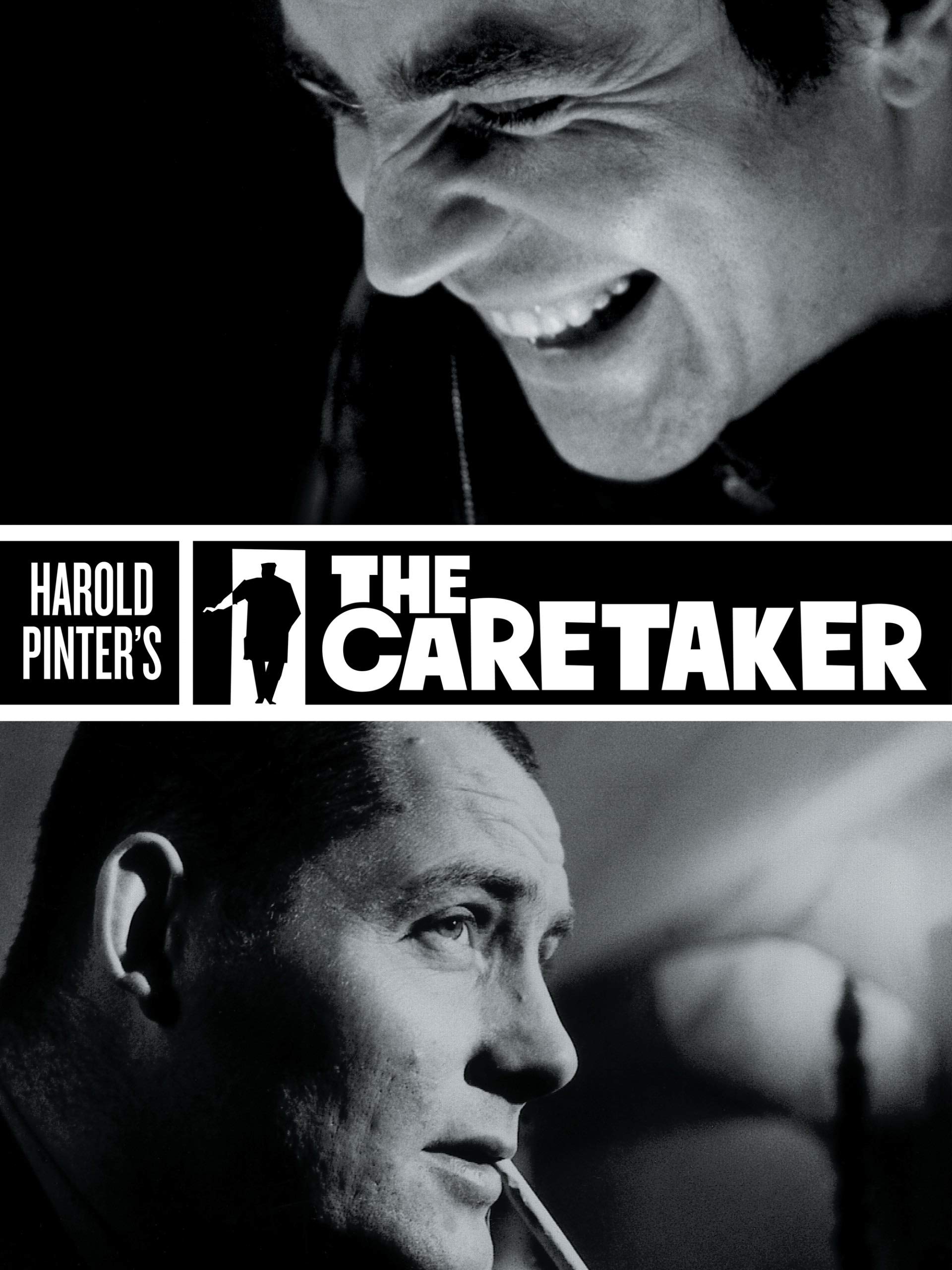
 Somewhere in London, an elderly homeless man, named either Davies or Jenkins (Donald Pleasance) is rescued from a pub-brawl by a quiet, stoic young man named Aston (Robert Shaw), who he takes in for the evening, allowing him to share the attic of his London house. However, they’re not alone – also in the house is Aston’s brother, Mick (Alan Bates), who is quite the opposite of his sibling – instead of being a well-meaning, decent and hard-working man, Mick is far more preoccupied with always having the upper-hand, which includes terrorizing their new visitor, who finds himself drawn into a situation that he never envisioned would become reality when he drunkenly accompanied the young man home the previous night. However, their game of wits turns out to be just what the visitor is looking for, as he is quickly offered the chance to become the caretaker for the house, which the brothers are hoping to renovate and turn into a chic residence for some of London’s swinging youths. Jenkins/Davies goes from mere guest to potential caretaker, an initially very alluring proposal, until the realization dawns on him that this would entail revealing his true identity, which is a closely-guarded secret, and the precise element that draws Mick’s attention, who makes it his own personal mission to find out everything he can about this unwelcome visitor, and assert his own demented vision of what society should be on a man whose relative ignorance harbours something far more sinister than meets the eye.
1963 was a fascinating year for playwright Harold Pinter since it featured his first collaboration with exiled film director Joseph Losey in The Servant, which would come to be seen as one of the most exceptional pieces of acting of the 1960s and a significant moment in the careers of everyone involved. However, it was also the year Pinter’s own play, The Caretaker was produced for the screen. From the outset, its necessary to say there are always going to be parallels drawn between the two films – the very essence of their premises are domestic dark comedies that explore the depths of mid-century masculinity and social inequality. It’s also important to state that this adaptation of The Caretaker (often referred to by its alternative title of The Guest) pales in comparison in nearly every way to The Servant. However, neither of these aspects play any part in critiquing this film, as its an insular work that functions as its own unique bundle of ideas – and whether you are as ambivalent to it as I was, or find it to be an exceptional work of theatrical drama, there’s no denying that there is certainly some value in this film, even if it is somewhat difficult to find. Perhaps not the best introduction to Pinter’s work (and having read the play originally, I was personally bewildered by how director Clive Donner staged some of these scenes, with the tone of the play, while still clear, not being explored particularly well), but still a solid adaptation that does what it needs to do, The Caretaker is perfectly serviceable, even if it doesn’t reach the full potential a more skilled director at the helm of this beautifully demented story could have achieved with a very ambitious premise.
Ultimately, The Caretaker isn’t a film that lends too much credence to the idea of discussing it as a work of cinema, especially since it is essentially just a direct adaptation of Pinter’s play. Like many stage-to-screen adaptations, it doesn’t seem to possess much in terms of a visual style or any intention to extend this story beyond the confines of a single room, in which the play takes place. Other than the opening scene, and a few brief moments in between, The Caretaker is quite limited in its scope, and while a more skilled director would’ve utilized this in a very interesting way (such as developing the claustrophobic paranoia that comes with being restricted to such a small space, which is often a good tool used in this kind of adaptation), it falls flat here and takes on the appearance on being nothing more than a filmed play. Insightful conversations about The Caretaker have permeated the culture, and there’s very little room to disagree with the multitude of deep, fascinating discussions that centre around this story – its intimate view of human interaction, its acidic critique on the class system, its cataclysmic combination of gritty social realism and bizarre absurdity, and a general work of angst-riddled commentary that serves to be a bold indictment on society in general. For all intents and purposes, this is exactly what the film conveys as well, and that’s perfectly adequate, but doesn’t lend us much more space to actually dig deeper into these themes, as Donner unfortunately fails to utilize the intimacy that comes with the medium of film to create a sense of urgent intimacy, with the viewer being a perpetual voyeur stranded on the outskirts, as they would be when watching the stage production. This approach is fine if the same electrifying energy that comes from a live interpretation of this story had been used, which never seems to be the case with a film that genuinely believes a straightforward adaptation makes for good cinema.
For aficionados of the playwright’s work, The Caretaker offers exactly what you’re looking for – a visual recording of a famous play that was still in relative infancy (having only premiered a few years before), and featuring most of the original cast returning, with Robert Shaw replacing Peter Woodthorpe. It’s very clear that Shaw was a replacement, while Donald Pleasance and Alan Bates were incredibly comfortable with these characters, especially through the manner in which they perform. Pleasance, one of the perpetually brilliant character actors who could slip into absolutely any role at the drop of a hat, is incredible in the titular role, playing the mysterious Davies/Jenkins with a blend of upbeat humour and deeply unsettling malice, starting out the story as a vaguely sinister, uncompromisingly strange individual who soon finds himself trapped in what appears to be a friendship he cannot escape from. Pleasance was always fully committed to all of his roles and managed to find an avenue with which to take this character, creating a memorable leading figure that is both terrifying and heartbreakingly real. Alan Bates is a formidable screen-partner, playing the embodiment of perverted evil, where his youthful good looks and devilish charms make him something of an enigmatic villain, whose intentions are never clear, other than the very clear fact that he’s too far gone from reality to be considered anywhere close to likeable. These two performances are very good, which is why Shaw’s performance stands out – the character of Aston is supposed to be a well-meaning young man whose infantile personality hides a darker side that makes his final monologue so striking, where he speaks of his time in a mental institution. Shaw struggles to find anything particularly interesting about the character and seems to think a few odd looks and staggered speech suddenly amount to a great performance. He’s the weak link in a strong cast, and when you consider that there are only three characters in the film overall and that Shaw’s is the most important in terms of the plot progression, it’s not difficult to see why The Caretaker doesn’t work very well.
Taken for what it is, The Caretaker is perfectly adequate, and not much else. Pinter was a supremely talented artist who worked across different media, which only made the relative blandness of the first (and to date, only) cinema adaptation of one of his finest works all the more disappointing. The film has a rugged charm in certain moments, but for the most part is a bit of a bore. Whether this comes from the lacklustre execution (with the director putting in virtually no effort to bring this story to a more artistically-profound place), the imbalance in the performances or the general ineptitude that persists throughout the film, The Caretaker just isn’t all that enthralling, and while it is far from poorly-made or in any way a waste of time, there’s a certain ambivalence one feels towards this interpretation that could have been avoided. The story is absolutely there, and it does so well in certain aspects – but when it comes to something like this, all components need to be working together, which is not the case at all here. Essentially put together to capitalize on the success of an enormous acclaimed play, and give this concept exposure to a much wider audience, there is value in looking at The Caretaker as a film that will be of interest to anyone looking to explore some of Pinter’s work, or see a decently-acted film. As a stage-to-screen adaptation, it’s perfectly sufficient. In all other areas, it fails to reach any discernible point of relevance, so while not offensively bad, Donner’s adaptation is not anything special, and no one should be in any rush to see it, as there are better cinematic examples of Pinter’s incredible work.
 The Postmodern Pelican