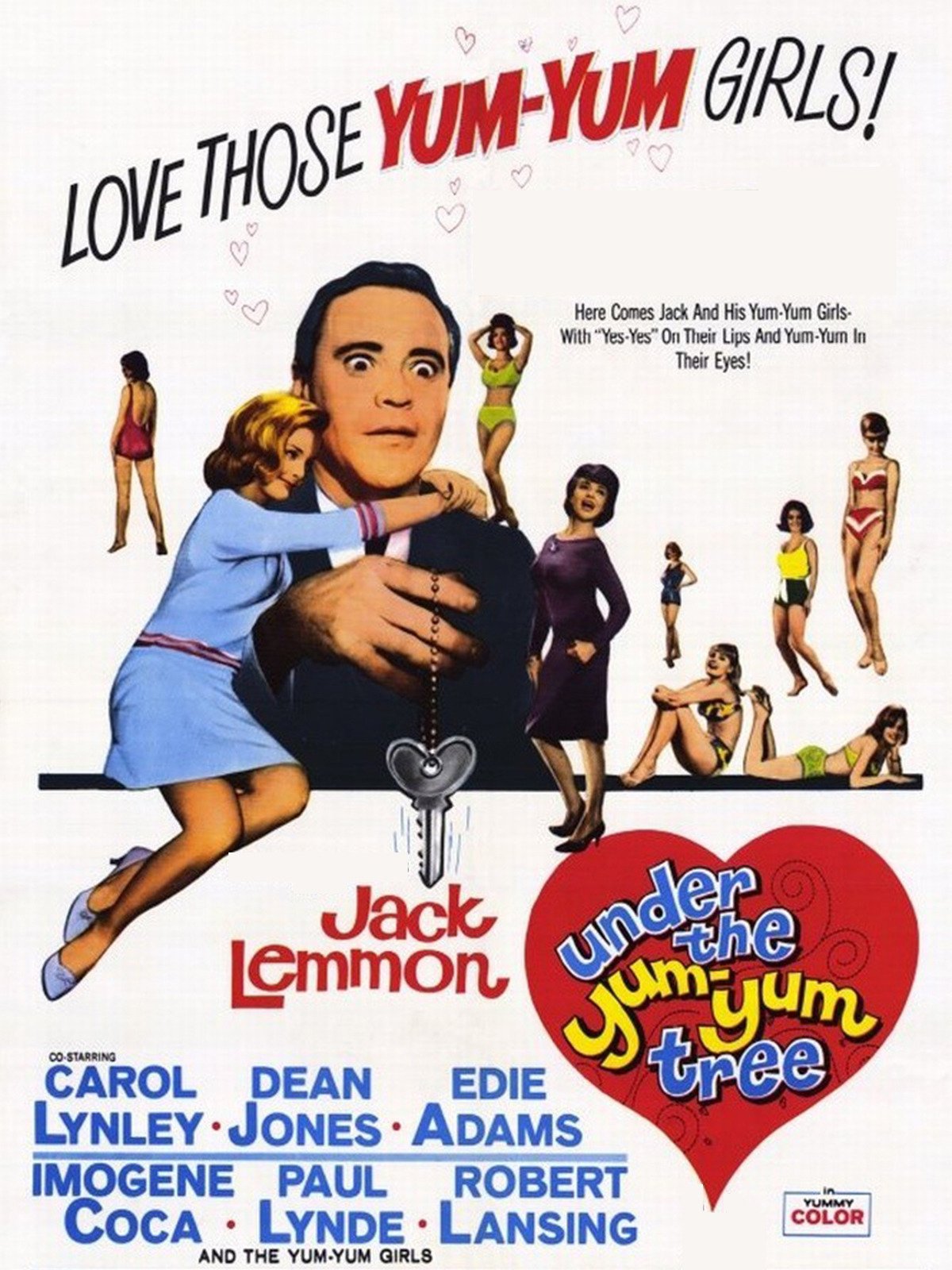
 Robin (Carol Lynley) is a quirky young woman who has been in love with her college sweetheart, David (Dean Jones) for years, with the intention being to marry him, something he is very receptive to. However, she is not one to make hasty decisions, so she implores her intended to undergo something of a social experiment – they will abstain from all intimacy for as long as they can, in order to test their “character compatibility”, which has worked so far, and has brought them closer together. However, Robin intends to take their relationship to the next level by means of seeking out an apartment for them to move into together, much to the chagrin of David, who realizes how the temptation to consummate their relationship will be far too high while living together. They soon move into the now-vacant apartment of Robin’s aunt, Irene (Edie Adams), who left after a bad breakup. The apartment is luxurious and inexpensive – but what neither accounts for is that their new landlord, Hogan (Jack Lemmon) is a scoundrel always looking for an opportunity to either make a buck or seduce an unsuspecting woman, and how immediately sets his sights on Robin, who initially falls victim to his charms, not realizing how this is serial behaviour for a man who simply finds it impossible to keep his hands to himself, although he’s far too intelligent (and some would say principled) to go too far in his efforts by crossing a boundary. Normally only renting to eligible young women, Hogan finds himself presented with the challenge of stealing Robin away from David, whose presence is initially an obstacle, but not one Hogan sees as entirely impossible to overcome. However, the randy landlord soon realizes that he doesn’t always have the upper-hand, and these college students may just be a little bit more cunning than he thought they were, and they just could possibly outsmart him in unexpected ways.
Under the Yum Yum Tree belongs to an elite group of productions whereby the film itself isn’t particularly good but is composed of many great elements that work together in a way that doesn’t elevate the film beyond its clear flaws but prevents it from descending into a mindless sex comedy that has no merit to it. David Swift was a filmmaker whose career was best described as one in which he didn’t have much control, normally working as a hired hand to put together star vehicles and adaptations of popular works, rather than establishing himself as much of an auteur. He made entertaining films that were certainly endearing, but far from the personal affairs driven by passion that were being made by more noted directors at the time. A relatively minor problem, but one that does indicate exactly where Under the Yum Yum Tree could’ve been improved, since there is certainly an enormous amount of potential in this film, even if viewing it from a modern perspective can be something of a challenge, since so much of the content is hopelessly outdated, undoubtedly a remnant of this film being a product of its time. However, like many disposable comedies made during this era, Under the Yum Yum Tree is ripe for rediscovery, a delightfully irreverent film that blends darkly comical satire, bold sex farce and soaring romance into quite a bewildering, but no less hilarious, work of quaint mid-century comedy, in which various cultural beliefs are tested, subverted in favour of a more daring glimpse into an alternative view of what is normally shown to be sacred in these kinds of films. It’s only a few steps above merely adequate, but it would be misguided to not recognize that, beneath the paltry narrative and relatively lacklustre execution, there is something quite effective, even if the film does take quite a long route to get there.
The 1950s were undeniably a watershed moment for the film industry, and one of the most notable moments was the consolidation of the romantic comedy (which had existed for decades, particularly through the peak of the screwball comedy) as a viable means of storytelling without needing to have any kind of additional qualities (or much in terms of artistic integrity or worth), making it a kind of genre that didn’t take itself too seriously, and neither should the audience, who should rather approach these films to be entertained, rather than to learn something or come away with some kind of insightful understanding of the human condition. However, like with any genre, the romantic comedy soon produced a bevvy of imitations and parodies, with many filmmakers attempting to capitalize on this incredibly popular genre by making their own versions of these stories, only adding some additional elements that often went against the principles of its artistic forerunners, if not outright contradicting or mocking them. Under the Yum Yum Tree is one of the more fascinating entries into this sub-genre, particularly because it isn’t necessarily as well-formed as some of the more notable ones, but stands as still a relatively insightful parody of romantic comedy tropes. Hopelessly outdated to the point where there’s very little about this film that gives it any relevance outside of a relic of a different time in the industry, but still so compulsively entertaining in how it essentially means well (and thus deftly avoids overstepping a moral boundary, keeping everything risque but still extremely elegant at its core). As someone under the employment of the Walt Disney Company for much of his career, Swift was clearly interested in tackling darker subject matter without abandoning the style that was essentially his bread and butter in the industry – so the result is a quaint adaptation of an obscure stage production that hasn’t stood the test of time, but still has some merit in how it represents a seismic shift in how films were able to negotiate the boundaries between sexuality and romance, making it a film that oscillates between predictable and incredibly unique at alternating moments.
Carol Lynley and Dean Jones play the two main characters, a couple of college students who are hopelessly in love but decide to go about their romance in a way that will prove their undying devotion, namely through stripping their relationship of some of its most fundamental requirements, leaving only the bare essentials. They’re both very good but are clearly limited actors who give decent performances that are brimming with youthful charm and a lot of bubbly humour that seems ripped directly from the hackneyed teen beach movies and other adjacent works of mindless youth-oriented comedy that this film seems to be commenting on. They’re undeniably very good in the roles, even if neither are challenged to the point where they do anything even vaguely complex. This film really just requires them to bring a buoyancy to a slightly darker story, and play these roles that function as archetypes more than anything else. Lynley and Jones may play the main characters, but someone else is undeniably the star of Under the Yum Yum Tree (and unequivocally the reason to seek this film out). Jack Lemmon was an actor who could do anything, but his best work undeniably came when he was playing ordinary people, with his incredibly grounded charm making him a recognizable figure to generations of viewers, who still remain captivated by him to this very day. However, the early 1960s brought something of a change to Lemmon, insofar as he started to take on slightly darker characters, almost as if he was quietly rebelling against the categorization of himself as the perpetual “nice guy”, an active attempt to sharpen his skill-set and give him a wider range of characters to play, rather than being shoehorned into one particular kind of role.
A character like Hogan in Under the Yum Yum Tree is the definition of despicable – a bawdy bachelor who is constantly on the prowl for his next victim and will go to any lengths to secure a new plaything, he’s not the most pleasant character. It’s a role that could only be played by someone who was usually seen as an upstanding, decent individual – and no one embodied this better than Lemmon. His career was defined by his remarkable charm and adeptness at playing characters who seem plucked directly from reality, average men, whether those who hold some status or the embodiment of the working class. Naturally, he’s exceptional in the film, playing Hogan with the same dynamic physicality and roguish charm that defined most of his career, while adding in shades of villainy that stops just short of making him completely unbearable. Logically, we can’t say that Lemmon necessarily thrived on playing antagonists, since he was far better at playing ordinary folk – but a film like Under the Yum Yum Tree does give him the chance to do something different, and the sinister nature of the character intermingles very well with his everyman sensibilities, making this just another wonderfully unique performance by one of the greatest actors of his generation, who continued to challenge himself, even when it was clear he was heading towards becoming an iconic figure in the history of Hollywood. Under the Yum Yum Tree isn’t a perfect film, but his performance is unquestionably excellent and elevates this relatively serviceable story to pleasant heights.
Under the Yum Yum Tree isn’t perfect, but it’s certainly not as meaningless as its been accused of being over the years. Not particularly memorable beyond a good performance by Lemmon and an unusually abrasive approach to the main tenets of the romantic comedy, the film does have several issues that prevent it from reaching greatness, specifically in its misguided understanding of what makes the kind of films they’re parodying memorable – subverting the genre’s conventions is important, but not to the point where the most fundamental aspects are entirely ignored. It is a well-made film (even if the stage origins are extremely clear – had this film made more effort in working beyond the confines of the apartments and given some attention to extending it further than the limited scope afforded by its original production, there might have been much better results). Ultimately, this film works as a film of its time – its very funny and has several moments of wonderful humour that is alternatively darkly comical or beautifully endearing, which does give it a certain relevance. Under the Yum Yum Tree is not a film that I’d necessarily recommend to someone looking for insightful explorations of the romantic comedy genre – it doesn’t seem to be particularly interested in saying much. However, for those well-versed in this era of comedy, and looking for something a bit more abstract than the usual far, you might find some value in this film. Whether a scholar of Jack Lemmon or simply seeking an alternative view of romance, Under the Yum Yum Tree might be worth your time. For anyone else, don’t expect too much from this film other than what it promises on the outset – but like many romantic comedies, what you see is what you get, so in that regard, it’s a rousing success. In all others, a more flawed work that doesn’t amount to all that much, other than being merely adequate.
 The Postmodern Pelican