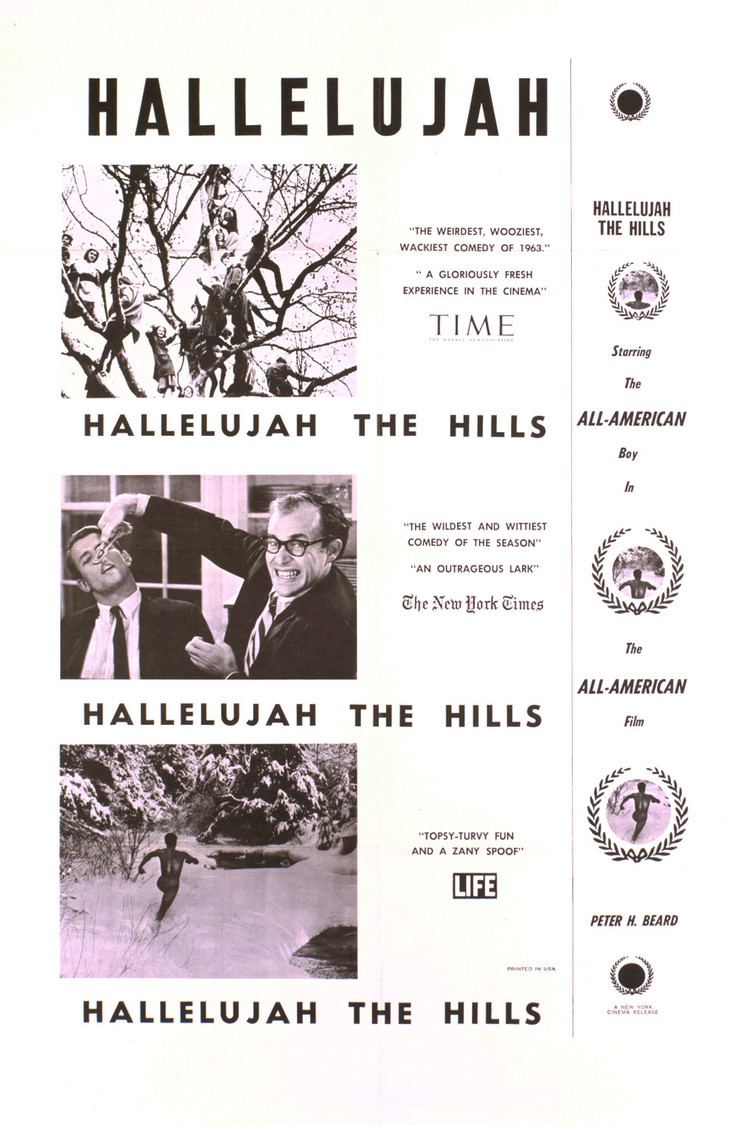
 In 1963, two works of fiction were released that stand independent of each other, but are inextricably linked in numerous ways. The first was V, the debut novel by Thomas Pynchon, who would go on to become one of the late twentieth-century’s most important writers. The second was Hallelujah the Hills, the first major work by Lithuanian-American artist Adolfas Mekas. This name should be familiar to anyone with an interest in alternative cinema, as his older brother was Jonas Mekas, one of the most important figures in mid-century avant-garde cinema. Much like his brother, Adolfas Mekas was an incredibly fascinating figure in the creation of a form of cinema that essentially launched the entire independent film movement, particularly in his work that challenged conventions. This circles us back to the aforementioned novel, whereby Pynchon, whose entire career has been defined by a similarly playful approach to storytelling, frequently made use of absurdist situations that are grounded in an alternative vision of reality, from which he is able to tell stories that would otherwise be impossible through more traditional narrative means. I’ve often used his famous quote of “Why should things be easy to understand?” as a way to introduce novice readers to the basic tenet of this kind of narrative. This has been a regular fixture around here, but no film embodies that spirit quite like Hallelujah the Hills, a film that I am still trying to make sense of. It isn’t entirely clear whether this film is brilliant or bewildering – but when you break it down and consider its fundamental qualities, there’s absolutely no reason why it can’t be a delightful blend of both.
Residing in relative obscurity since its first appearance decades ago, Hallelujah the Hills has recently been resurrected with a gorgeous restoration that has given audiences the chance to sample from Mekas’ deranged vision of the world around him. To begin to understand this film, you need to do recognize the basic concept of all postmodernism (of which this film can be considered a pioneering work), which is to realize that nothing necessarily needs to make sense, so the prospective viewer should actively attempt to abandon all semblance of logic, because not only will it serve entirely useless while being witness to the bizarre ramblings of a director who was setting out to disregard nearly everything his artistic predecessors established as imperative, it might even detract from the overall experience. Hallelujah the Hills is an undeniably polarizing film – an acquired taste if there ever was one, it functions as a work of singular brilliance, which it gains through a complete subversion of everything normally held as sacred when it comes to telling a story. Developing on the modernist tradition of stream-of-consciousness prose, but adding something of a plot to anchor it down, Hallelujah the Hills has a very scant storyline – essentially, two young men, Jack and Leo (Peter Beard and Martin Greenbaum) are both in love with a girl named Vera (Sheila Finn and Peggy Steffans), who changes in appearance depending on the particular perspective the film is focused at that specific moment, but she’s fallen in love with another man named Gideon (Ed Emshwiller). In an attempt to win Vera back, both Jack and Leo decide to take up residence in the woods close to her Vermont home, where they spend the days in an entertaining purgatory, achieving a new level of mischief while waiting for the perfect moment to reassert their love on a young woman who simply has very little time for them, which is essentially the entire plot.
Despite such a loose-form storyline (or what appears to be one, we’re never quite sure of what’s being depicted on screen), Hallelujah the Hills is oddly compelling for a number of reasons. There’s a theory that a masterpiece is normally an artwork that accomplishes something we’ve seen before, just doing it a lot better than most others. However, when it comes to some of the most enduring works, its better to view some masterpieces as being those that simply don’t appear to be close to anything else, idiosyncratic pieces that not only stand as uniquely individual but are too different to ignore. This is essentially the reason why underground cinema (which was undergoing a seismic shift at the same time in which Mekas was making this film) was both reviled by the mainstream and embraced by those with a penchant for the alternative. Built almost entirely out of abstraction, Hallelujah the Hills is an unprecedented work of postmodern fiction, occurring at a time in which such a term wasn’t yet conceived as a viable form of critiquing art. Not only does it help establish this movement, it also becomes something of an opponent to the idea of traditional story structure – not only does it dismantle the idea of metanarratives, it openly eviscerates it, taking on the idea that something needs to flow logically in order to have merit. Naturally, Hallelujah the Hills didn’t become quite as prominent as this film seemed to be suggesting it would (although we can question what Mekas was actually attempting to do with this film – there are few artistic works with murkier thesis statements than this one, which is certainly part of its charm), but when considering this form of non-traditional narrative structure that this film seems to employ, it’s difficult to not see the underlying brilliance that is perpetually demonstrated throughout the film.
Perhaps the best summation for Hallelujah the Hills is to call it “coherent, fluid nonsense”, and it’s all the better for it, since the precise qualities that make it such a success come from the fact that it doesn’t take itself too seriously. Postmodernism is essentially all about playfulness, particularly in its formative years, and while Jonas Mekas (who was working as an assistant director here) made more insightful works that delved deep into very serious issues, his brother instead went another direction, putting together an absurdist masterpiece that doesn’t many an iota of sense, but still manages to be absolutely delightful in every conceivable way. Part of this is because the film didn’t want to be conventional, actively fending off every encroaching element of lucidity in favour of pure, unhinged anarchy. There’s a certain charm to this approach, with the reckless, yet incredibly sincere, manner of allowing this story to unravel without guiding the audience making for truly compelling viewing that should appeal to anyone with an appreciation of more abstract forms of humour. Experimental cinema has always been on the outskirts of the industry, being perceived as noble works of art that belong in museums rather than embraced by audiences at best, and pretentious, rambling representations of self-indulgent fantasies at worst. Hallelujah the Hills is one of the few truly experimental films (insofar as it actually has the mettle to be considered truly provocative and original, rather than simply a sequence of disjointed images set to music, strung together by a faux-narrative that is passed off as some kind of abstract artistry), especially considering it set out to do something entirely unique. Whether the results match what the viewer expected is beside the point, since what we’re witnessing here is more than what meets the eye, and should we find ourselves on the same wavelength as the director, the experience is surely entirely worth the initial bewilderment that we encounter from the very first moment.
Taking its cue from silent cinema, particularly in the use of sporadic intertitles to add extra narrative layers to the film, and the emphasis on the physical aspects of acting, Hallelujah the Hills is a multimodal work that just doesn’t seem like anything we’ve seen before. It’s certainly a far cry from the more brooding experimental films produced concurrently by the likes of Kenneth Anger, Jack Smith and Ken Jacobs, whose films normally defined the idea of underground cinema, being a boisterous and joyful expression of nothing but pure, gleeful narrative anarchy. It just so happens, in the midst of all the surreal shenanigans, that Hallelujah the Hills manages to be one of the finest pieces of Americana ever captured on a film, a work that encompasses the very essence of ordinary, mid-century suburban malaise, not focusing on anything other than the strange actions of a pair of individuals who explore nature and urban terrain with the same mischievous fascination, resulting in quite an eccentric portrayal of ordinary life. Some have referred to Hallelujah the Hills as a realist text, which certainly is an estimation that holds some merit – after all, Mekas is making a film that presents a snapshot of the lives of a group of ordinary individuals. Its what he does with this fundamental story that provides the film with the necessary strengths it needs to overcome a bizarre narrative approach to become something very close to a masterpiece. It doesn’t always work in the way we’d think it would – mostly a result of the fact that its the product of a filmmaker trying something entirely new – but once we’re enveloped by this film, and at the mercy of Mekas’ peculiar brand of surrealist genius, there’s very little denying that Hallelujah the Hills is an exceptional work of formative independent cinema, a quaint but outrageous absurdist comedy that should be revisited more often when it comes to looking at the origins of alternative American cinema, with this film being a work of singular, unprecedented brilliance that is just about as insightful to the human condition as it is disorientingly strange.
 The Postmodern Pelican