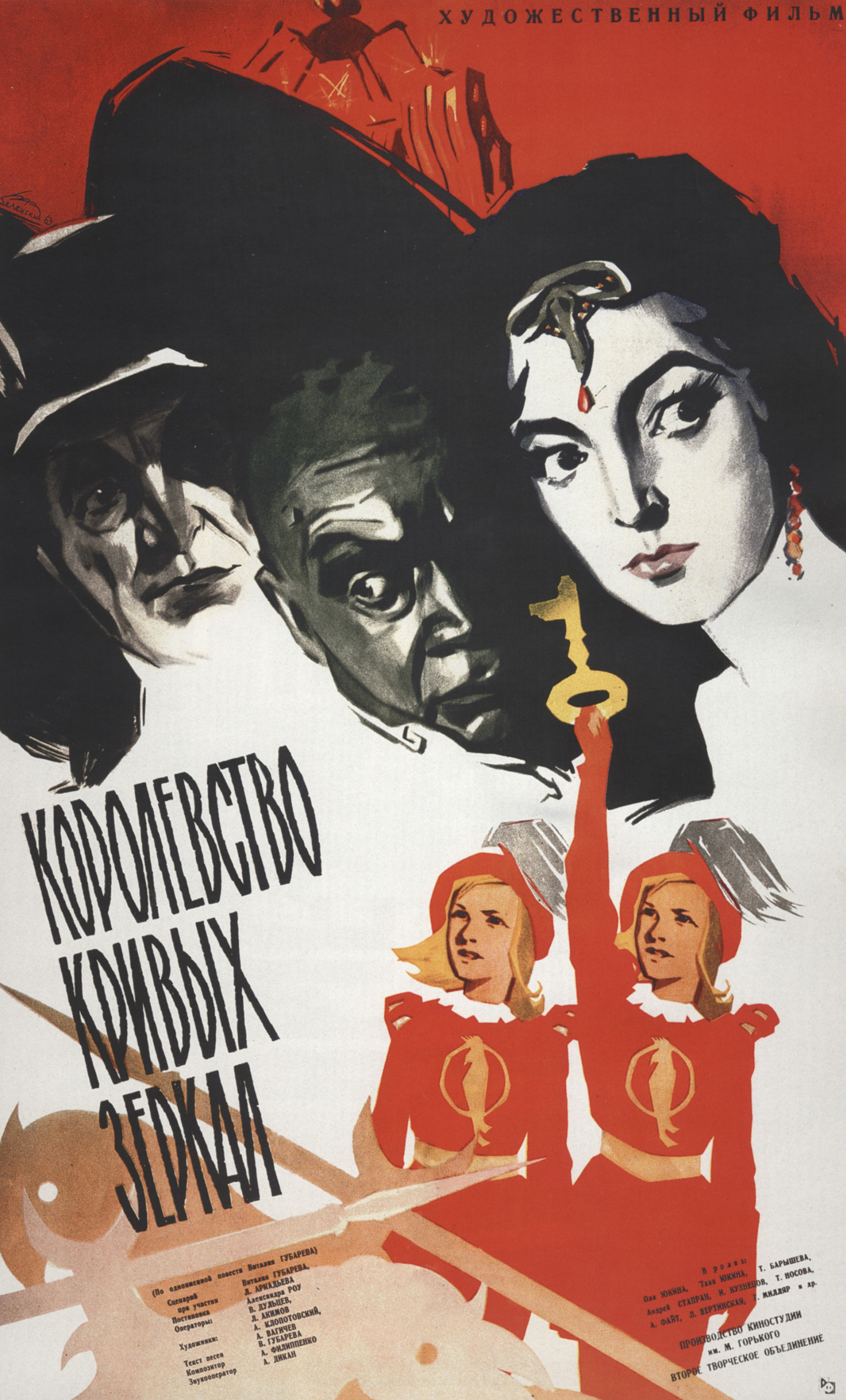
 Olya (Olga Yukina) is a mild-mannered girl living in a big Russian city. She spends her time gallivanting with her motley crew of friends, finding new ways to cause mischief and pass the time. When she’s caught sneaking into the cinema (which was at the time forbidden to anyone under the age of sixteen), she attempts to retreat from the wrath of the adults by escaping – and soon finds herself in presence of Yalo (Tatyana Yukina), who is physically her double, but contrasts her in nearly every other characteristic, essentially being her direct opposite, which initially causes them to clash but turns out to be quite a significant merit. Yalo leads Olya to the Kingdom of Crooked Mirrors, a fantasy land that is governed by the goofy King Yagupop the 77th (Anatoliy Kubatskiy), who is more concerned with mathematical riddles than he is with ruling his kingdom. The power is actually secretly held by a trio of the king’s closest confidantes, consisting of the malicious leader Anidag (Lidiya Vertinskaya), Nushrok (Andrey Fayt) and Abazh (Arkadi Tsinman), who have slowly eroded the king’s power, giving them total control of the kingdom, resulting in a plot to mass-produce mirrors that don’t reflect reality, but rather depict a particular warped version of it, which gives them the upper-hand. Olya and Yalo set off to expose this truth as soon as they find out about it but soon find themselves encountering many unexpected challenges, especially when it becomes clear that the villains are not against annihilating a pair of inconsequential children, particularly those that meddle in their perfectly-calibrated expression of evil. Along the way, the protagonists encounter a range of other characters who all help them accomplish this mission in some way. They don’t have much time, and the antagonists’ suspicions continue to grow by the day – but through working together, Olya and Yalo may just be able to save the kingdom and its people before its too late.
No one makes films quite like Russia – which other country would have the gall to take one of their nation’s most beloved fairytales, and turn it into a pro-communist manifesto, while still retaining some semblance of artistic integrity? I’ve recently been exploring some alternative Russian cinema, and have encountered many delightful works that are either deliciously subversive, or outrageous in how they manage to weasel in some kind of propagandistic message, regardless of how distant the story itself is from being socially-charged. However, it wasn’t until Kingdom of Crooked Mirrors (Russian: Королевство Кривых Зеркал) that I felt like I had reached the apex of the nation’s comedy. Derived by a classic folktale, made popular in the wildly successful novelization by Vitali Gubarev (who also wrote the screenplay), Kingdom of Crooked Mirrors is one of the most deranged films I’ve seen in a while, in the best way possible. Best described as a wildly entertaining acid-trip built from a bilateral foundation of unhinged surrealism and the most absurd socio-political commentary available to those involved in its creation, Alexander Rou’s adaptation of the classic story is nothing short of a remarkable achievement in innumerable ways, a dizzying surrealist masterpiece that carries a hefty meaning, and functions as one of the most insightful glimpses into the Soviet mindset at a time when the propaganda machine was at full-effect. Perhaps not the most thorough texts when it comes to the inner machinations of the social and political climate at the time, Kingdom of Crooked Mirrors is still a terrific piece that should be of interest to anyone who has the same bizarre sense of humour and an insatiable thirst for knowledge that I had going into this bewilderingly brilliant film.
Attempting to understand Kingdom of Crooked Mirrors is a fool’s errand, as is holding onto the hope that there will be some kind of coherency to it. Based on the premise offered above, it’s very clear that Alexander Rou wasn’t attempting to make something difficult or convoluted – the story itself is straightforward and perhaps even paltry. Sources have claimed that Vitali Gubarev was inspired by Lewis Carroll’s Through the Looking Glass, and made use of local Russian traditions in an attempt to write a version of that story that placed emphasis on certain folktales that many had grown up with. In this regard, Kingdom of Crooked Mirrors is extremely successful as an adaptation, not only because it gives outsiders the chance to encounter some classical stories that were previously unavailable to us, but because it is essentially everything that a successful children’s film should be (although it’s almost incomprehensible to imagine children today encountering this and not being profoundly disturbed by the imagery and uncanny representation of very familiar concepts – what is an outdated adaptation of a fairytale from decades ago without unintentional terror?), which it achieved through impressive production design, gorgeous costumes and a general sense of otherworldly fantasy that makes this such a delightfully compelling piece of fantasy fiction that ultimately doesn’t take itself too seriously, while still stating its case as a film that carries more weight than simply an innocuous fairytale. Considering how this film didn’t have much to work with at the outset, it still manages to find quite substantial depth in a story that didn’t offer too much (running at a scant but respectable 74 minutes), which is very impressive for a film targetted at children.
However, we aren’t here to discuss the story, which is essentially just a charming work derived from fiction directed at children. Normally, we look to fairytales as embodiments of our most ethereal fantasies, condensed into the form of a simple narrative that carries some deeper message that will hopefully prepare children for the world ahead of them as they grow up. However, what happens when these simple, human messages are removed and instead replaced with pro-Soviet commentary? Kingdom of Crooked Mirrors isn’t so much a work that seems to be celebrating the Soviet Union and its ideologies so much as it is openly spreading the message in the most overt ways possible. Rou is perfectly aware of what he’s doing, and it’s almost masterful the way the ideology is spread through the film – first starting as subtle, fleeting messages that catch our attention but are far too subliminal for us to take much notice, before gradually growing more steady (such as when one of the characters asks the protagonist what country she comes from, and she simply says “the best one” – keep in mind, up until this point, the concept of nations was entirely absent from the film), and ending in one of the most extraordinarily strange musical sequences ever captured on film, where three children stand atop the highest possible building, and sing a song about Russia and how strong it is. A musical number at the climax of a film is not unbeknownst – but this is the first time I’ve seen it so blatantly hammering in a particular point, we begin to wonder exactly what the intentions of the film actually were.
The most fascinating aspect of all of this is that Kingdom of Crooked Mirrors never feels gaudy, even when its motives are extremely clear. In the midst of all this overt socio-political commentary, it still manages to be exceptionally charming, especially when he put aside all judgment and consider it as the product of its time. The approach the film takes in being a piece of light propaganda is not necessarily as bad as it would seem from a modern perspective – you can tell a great deal from a nation by the art they produce, and if anything, Kingdom of Crooked Mirrors is a fascinating specimen of Soviet-era storytelling that functions as not only a great film, but a wonderful time-capsule of how particular messages that were dispersed through art at a specific time in history. This doesn’t distract from the fact that this is still a very endearing film, one that is far more visually striking than a lot of similar films, as well as taking on certain thematic elements that were profoundly different from what many would have remembered from our own upbringing. For those of us that grew up with a western view of what a story like this should look like, Kingdom of Crooked Mirrors is undeniably going to be quite polarizing – however, it’s still quite an enriching piece to look at in retrospect, and the film’s status as one of the formative works from mid-century Russian cinema is quite fascinating, and a major reason behind the success of this very strange but ultimately incredibly charming piece of otherworldly fiction.
 The Postmodern Pelican