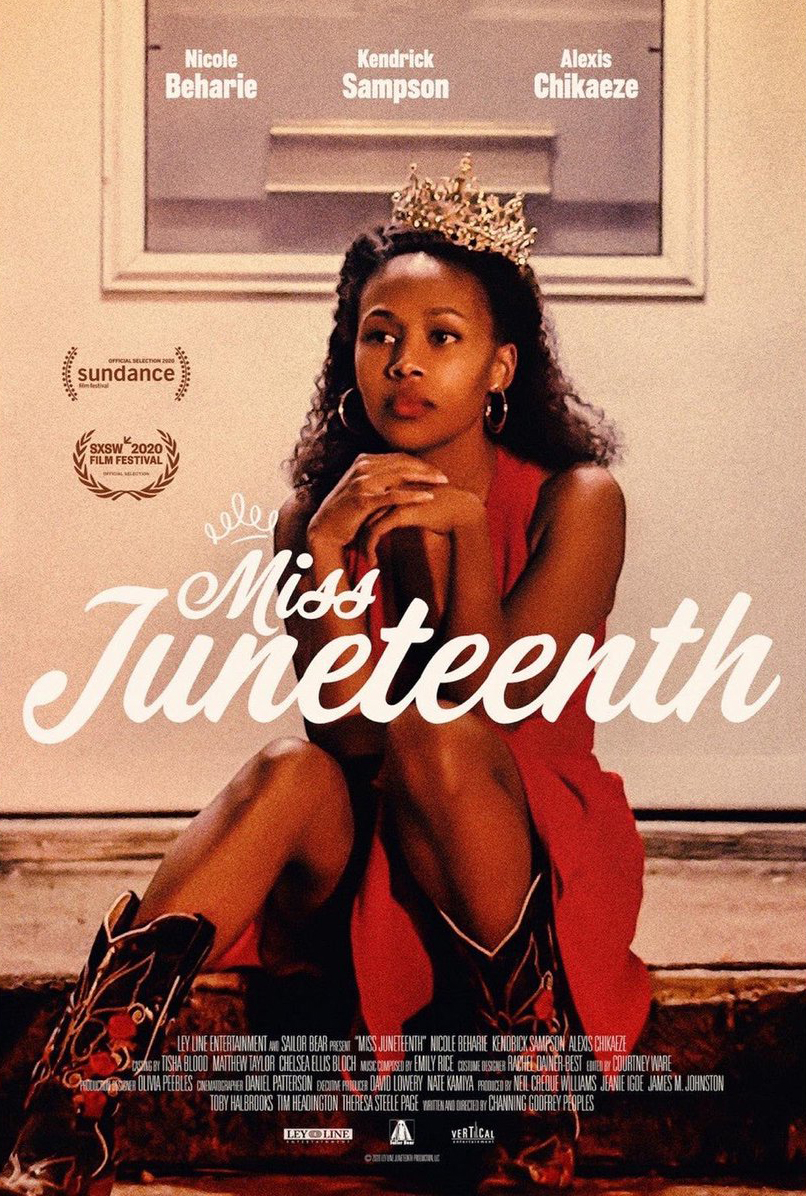
 Nobody has understood the pain of holding onto broken dreams quite like Turquoise Jones (Nicole Beharie), who was well on her way to success during her teenage years, particularly after winning the regional Miss Juneteenth pageant, which is known to afford the winners a full scholarship to the university of their choice, and thus afford them a chance at having a life that would otherwise be difficult for a lot of these people. Turquoise found her path to success diverted when she became pregnant with her daughter while still in college. Fifteen years later, she’s immensely proud of Kai (Alexis Chikaeze), who she encourages to sign up for the upcoming edition of the pageant, in the hopes that she can also go all the way and manage to lead the life her mother was unable to. However, Kai has bigger ambitions than being a beauty pageant queen, and instead wants to pursue a future in music and dance, which her mother greatly disapproves of. While going through the process of signing up for the pageant, mother and daughter find themselves facing unexpected challenges – whether it be the presence of belligerent former contestants that were beaten by Turquoise, or the fact that Kai is only agreeing to be a part of this to appease her mother, or the financial challenges they come about, not realizing how having a legitimate chance of winning such a competition takes a lot of time and money, something Turquoise doesn’t quite have. They decide that they’re going to push through, addressing the challenges as they encounter them and working as hard as they can to give Kai the best shot at taking the crown, and the subsequent higher quality of life that someone in such a position could be afforded.
One of the most striking aspects of Miss Juneteenth is that it’s one of those films that feels important without overtly stating it, which is a result of a piece of work that establishes a firm foundation on vital issues, which it infuses with a deeply human story that avoids all forms of melodrama, choosing to rather take a more simple approach, which is precisely what Channing Godfrey Peoples did with this film, deriving authentic emotion from a genuinely moving story that is not ostentatious, but still makes a bold statement through presenting audiences with an unsettling, but never particularly harrowing, tale of contemporary struggle, and the extents to which overcoming them may be difficult, but they’re far from impossible. One of the year’s most timely works of fiction, Miss Juneteenth is a fascinating portrait of many important issues, as channelled through the perspective of a mother-daughter relationship, which harbours deeper meanings towards real-world situations that aren’t always particularly clear in other works. Peoples immediately establishes herself as one of the emerging new directorial voices, a filmmaker whose vision is so remarkably lucid here, you’d be surprised to find out this is her first directorial outing. Miss Juneteenth is simply an extraordinary achievement – not only is it a vivid, unapologetic independent drama, it somehow manages to be pure humanity distilled into a single dynamic story, which functions as a work somewhere being gritty realism and a series of socially-charged moments that point towards the unflinching sincerity with which Peoples puts this film together, resulting in one of the year’s most wonderful gems.
Miss Juneteenth is a very small film and depends almost entirely on the performances given by the cast, which is precisely where the majority of its success resides. Nicole Beharie has been on the verge of stardom for quite some time now, but this is one of the few works that seems to actually be fully capable of capturing her raw talent in a way that feels meaningful, most certainly due to the fact that the character of Turquoise Jones is one of the best of the year, simply just a complex construction that is the product of an immensely powerful convergence between a strong story and an actress who can carry the role in all of its emotional heft. The camera seems to be so deeply in love with Beharie, with every close-up revealing an aching pain beneath her striking beauty, which contributes to the general message of the film being about the broken dreams that come on the other side of something as superficial as a beauty pageant. Beharie is joined by Alexis Chikaeze, who gives an equally compelling performance as Turquoise’s teenage daughter who is struggling to meet her mother’s high expectations, often resorting to outright rebellion as a response to the channelling of parental dreams into the actions of a young, impressionable woman. Chikaeze is quite subdued for the majority of the film, which is by design – she’s a reserved young woman who internalizes her struggles and uses them as motivation to pursue her dreams, which manifests in the film’s most beautiful moment, a reworking of Maya Angelou’s “Phenomenal Woman” into a dance, which is precisely when the numerous themes employed throughout the film seem to converge into a heartbreakingly beautiful climax. Both actresses are doing some of the best work of the year, giving simple but affecting performances that linger on quite beautifully.
What makes Miss Juneteenth so special is how unassuming it is. It takes on a very simple story and never purports to doing anything more or less with the central premise, but instead delivering exactly what it offers. There’s a certain admirable quality that comes with this approach because it indicates a storyteller who is content with remaining within the confines of a particular subject without needing to go further in order to bolster the plot. Miss Juneteenth is an intersectional film about motherhood and contemporary issues faced by many members of the African-American community – and what Peoples does with these issues, channelling them through a compelling, evocative story of a young woman trying to recapture her youth while convincing her unenthusiastic daughter to be a part of the renewal of her long-dormant ambitions. However, there’s so much more to this film – it is essentially one of the most poignant explorations of the proverbial American Dream, which is outright mentioned as being what the main character is aspiring to, only to be told that such a concept doesn’t apply to people like this – the nation is far too adherent to its institutionalized problems to allow an ordinary person like Turquoise to achieve the fame that she desires, and even something like winning a beauty pageant will always carry some caveat. When the main character responds to the comments that she is wasting her time preparing Kai for something that doesn’t have the meaning she thinks it does, Turquoise heartbreakingly states that she is “trying to make her something we ain’t” – it’s at this moment that the film becomes incredibly clear in saying what it intended to, showing us the shattering reality of many people who hold onto hope, believing that resilience will give them the escape they need.
This is undeniably a simple approach, but one that strips humanity to the bare minimum, exposing its vulnerabilities in an incredibly insightful way. It’s a deeply challenging film that looks head-on at some dire issues without preaching or supplying too much overwrought exposition, instead presenting us with an honest, earnest portrayal of one area of the human condition that isn’t often afforded such authentic discussion, especially not in such a deeply compelling manner. Miss Juneteenth is a very serious film, but it carries itself with a kind of elegance that allows the story to transpire in an achingly beautiful way – this is a distressing portrait of contemporary American issues, making this an extremely timely story that comments on some very real concepts that are deeply rooted in history, and still sadly a reality for many people, who are depicted with genuine, tender honesty. Ultimately, Miss Juneteenth is one of the year’s most vital works of fiction, not only because it’s a great film, but because it’s a vivid, unapologetic independent drama that establishes itself as an essential story of resilience in the face of despair. The cast is exceptional, and it serves as an astonishing debut for Channing Godfrey Peoples, who is already showing great promise as an exciting new voice in the current cinematic landscape. I implore everyone to seek out Miss Juneteenth – whether you are someone who can relate to the issues this film brings about in some way, or someone who would benefit from seeing such a story depicted on screen, Peoples has made a truly worthwhile work of fiction that has its roots firmly in reality, the rare kind of film that can genuinely make some difference, should enough of us seek it out and see exactly why this is one of the year’s most powerful cinematic works.
 The Postmodern Pelican