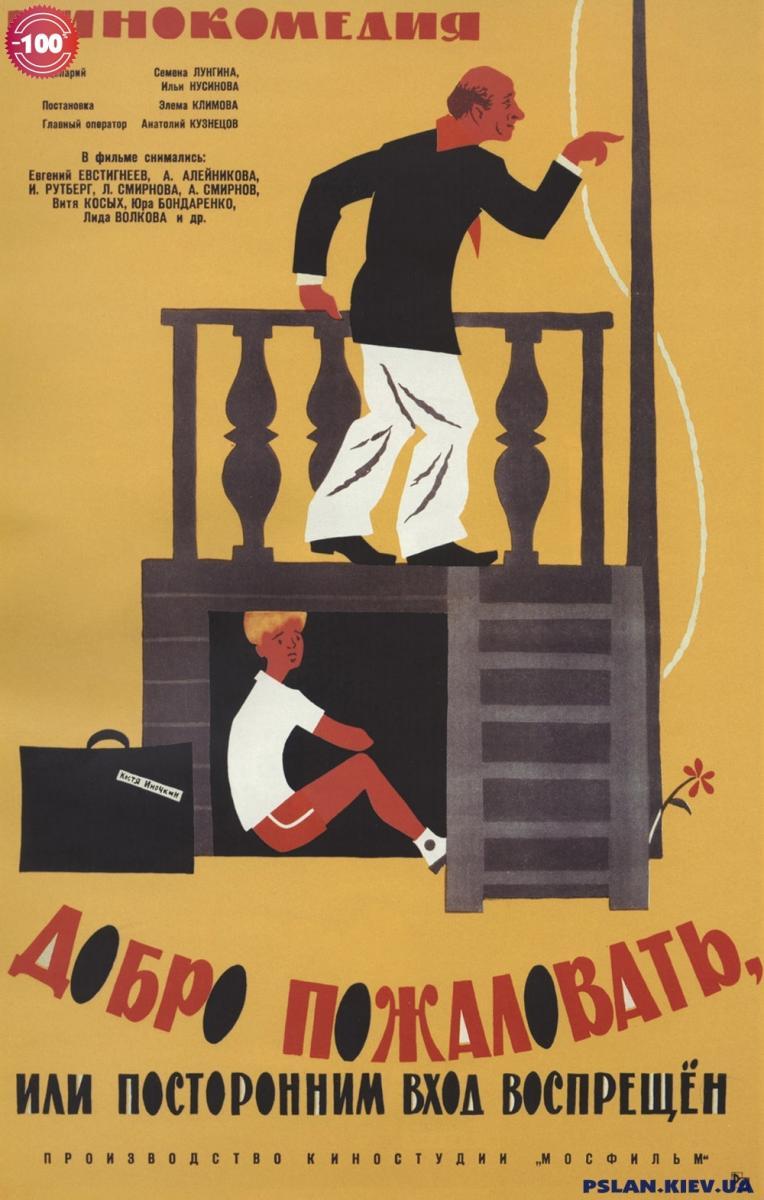
 Kostya (Viktor Kosykh) is a rebellious young boy who finds himself constantly at odds with everyone around him. Presumably to keep him out of trouble, he’s sent to a communist pioneer camp for children, where he gallivants with his fellow campers, much to the chagrin of Comrade Dynin (Yevgeniy Yevstigneyev), the over-strict head counsellor who rules over the establishment with an iron fist, and refuses to afford his temporary wards any freedom, in fear that they will incur some kind of harm, and subsequently blame him for not protecting them well enough. Kostya is far too wild at heart to adhere to these strict rules, and when he swims out of bounds, Dynin shows him no mercy, expelling him from the camp immediately. Realizing how perilous it would be to return to his family so early (and thus indicate that he was forcibly removed from the camp), Kostya hatches a plan to return, finding a safe spot to hide under the platform that Dynin frequently uses to command the children and staff to do his bidding. However, Kostya is soon discovered by a band of fellow pupils, who are entirely sympathetic to his cause, having experienced the stifling restrictions placed on them by their tyrannical leader. They help Kostya survive, bringing him food and making sure he doesn’t find out. This coincides with “Parent’s Day”, the camp’s most important event, where parents and other members of the community flock to the campsite to witness a variety of spectacles, such as a talent show and the centrepiece event, a parade through the camp-grounds. It seems like this pleasurable event is only enjoyed by Dynin himself, so the children use this opportunity to take a cue from Kostya and quietly rebel, with outright hilarity ensuing as they consistently outsmart him and prove that adulthood may bring experience, but it doesn’t always bring wisdom.
From the outset, we are fully aware that Welcome, or No Trespassing (Russian: Добро пожаловать, или Посторонним вход воспрещён) is going to be an exceptionally special film, as the opening words proudly proclaim that “this film is dedicated to adults who once were children, and to children who will surely become adults”. Films that focus on child protagonists were barely untrodden territory for Elem Klimov, whose Come and See, which channelled the Second World War through the eyes of a teenager, is considered one of the most impactful war films ever made. However, decades prior to this groundbreaking work, the director was making substantially less-serious affairs, with Welcome, or No Trespassing quite possibly being the complete antithesis of the powerful war film, even if there are certain similarities in how Klimov looks at broader issues through the perspective of a young hero. This film is an absolute delight, a small and thoroughly quaint affair that takes the audience hostage with its incredible charms, and establishes itself as one of the finest examples of Soviet-era comedy ever made, particularly in terms of how Klimov condenses some incredibly complex content into a single, dynamic package that’s potent commentary, while carefully concealed under the veneer of outrageous comedy, never abates. A masterwork of subtletly, whereby the director is conveying one of the most significant beliefs associated with this era of comedic filmmaking, Welcome, or No Trespassing is a very simple work, keeping everything on the most fundamentally human level and never losing sight of its bolder ambitions, while never wavering from being a straightforward, but entirely entertaining, work of fiction that is as heartwarmingly funny as it is a poignant satire that tackles subject matter far more intimidating than its adorable protagonists.
Like many successful Russian comedies made during this era, Welcome, or No Trespassing doesn’t quite take the form of a direct satire, but rather accomplishes what it intended to say through more subversive means. This film was Klimov’s feature directorial debut, and has often been seen as nothing more than an amusing curio from the beginning of his important but underexplored career. What these friendly dismissals seem to miss is that Welcome, or No Trespassing is one of the most outrageously intelligent satires made during this era, and one of the most sincere embodiments of a director using comedy not only as a means to entertain their audience but as a social tool, there to guide us into thinking a certain way, without forcing us into adopting an entirely different mentality. Witnessing this film in the contemporary era is certainly a very different experience, as it was made to primarily be a satirical look at communism – the film even occupies an ambigious position in terms of Soviet-era censorship, as the Communist Party reneged on one of their trademark bans after Nikita Khruschev saw the film himself and deemed it acceptable (which only bolsters the brilliance of the film – when the exact people you’re attempting to criticize seem to miss the point entirely, success has been achieved). Satire has always been an omnipotent force in the arts, and it was one of the most cherished tools used by artists during the Soviet-era, as nothing seems to bring as much change as comedy, at least artistically speaking – and precisely what makes Welcome, or No Trespassing such an absolute delight from beginning to end, since it has both effervescent humour and real, meaningful depth.
When viewing Welcome, or No Trespassing, the viewer may have to acclimate the precise specifics of what Klimov is trying to convey, particularly if we ourselves had not been privy to the socio-cultural machinations of the era depicted here, or the exact motivations behind the creation of artistic works such as this. Logically, we can’t go into every aspect of Klimov’s politics, but we can comment on how the film looks at broader issues through its small but fascinating use of satire. Set entirely on a pioneer camp (which is essentially a summer camp that comes with the added bonus of massive amounts of pro-Soviet propaganda), the film initially seems to be nothing more than a well-meaning comedy about the hilariously reckless antics of a group of mischievous children who are perpetually up to no good. However, it doesn’t take too long to realize that this pioneer camp is a surrogate for the entire Soviet Union as a whole – “Comrade” Dynin is their malevolent leader, policing them to adhere to his own strict policies, or else risk being exiled. This approach has the perfect balance of making its intentions clear enough for even the most casual viewer to realize this side of the story, but not overwrought enough to alienate the viewer and detract from the enjoyment that comes with witnessing this film. Condensing something as broad as communism at its peak, into a quaint comedy like this is a feat in and of itself, so for it to blossom into one of the most exquisite examples of Soviet-era comedy, where it’s brave enough to take the system on, but not in a way that could be seen as too heavy or inappropriate, Welcome, or No Trespassing becomes quite a special achievement of a film. The decision to situate it in one of the many pioneer programmes that persisted throughout Soviet existence was even more of an ingenious move, as it allowed for the film to take on even more meaning when siphoning its message through a child protagonist, which art has shown us normally results in a unique, thoroughly honest perspective that reveals many of the deeper truths those of us clouded by adulthood don’t always realize are there.
Welcome, or No Trespassing is a pure delight, distilled into 72-minutes of unbridled joy, carefully constructed by a filmmaker whose passion for his craft resounds with such immense sincerity throughout this masterful achievement that proves that some of the best comedy is that which is most simple and unassuming. This is an undeniably small film – even in its country of origin, it is mainly an obscure work that is loved by those who have remembered it from its original release or the select few who have encountered it in later years. Whichever way you want to look at it, Klimov made a film that condenses some potent social and political commentary into a palatable set of scenes that come together beautifully, converging into a creatively chaotic story of pre-adolescent defiance, which directly correlates to the theme of outward rebellion that the director often employed in his work. It may not be the staggering achievement that Come and See was, but Welcome, or No Trespassing is nonetheless an enthralling work, a humble and heartfelt comedy that infuses a pleasant, intentionally foolish story with a satirical edge, resulting in something that manages to make a lingering statement without having to force the audience to abandon the earnest and joyous experience of seeing this film and witnessing its hilariously deranged, but genuinely loving, approach to the follies of youth, with a touch of satire thrown in for the sake of it, only strengthening the astonishingly brilliant work of comedic genius Klimov put together here, paying tribute to our younger, more innocent days of mindless foolishness, while inferring much more than that at the exact same time.
 The Postmodern Pelican