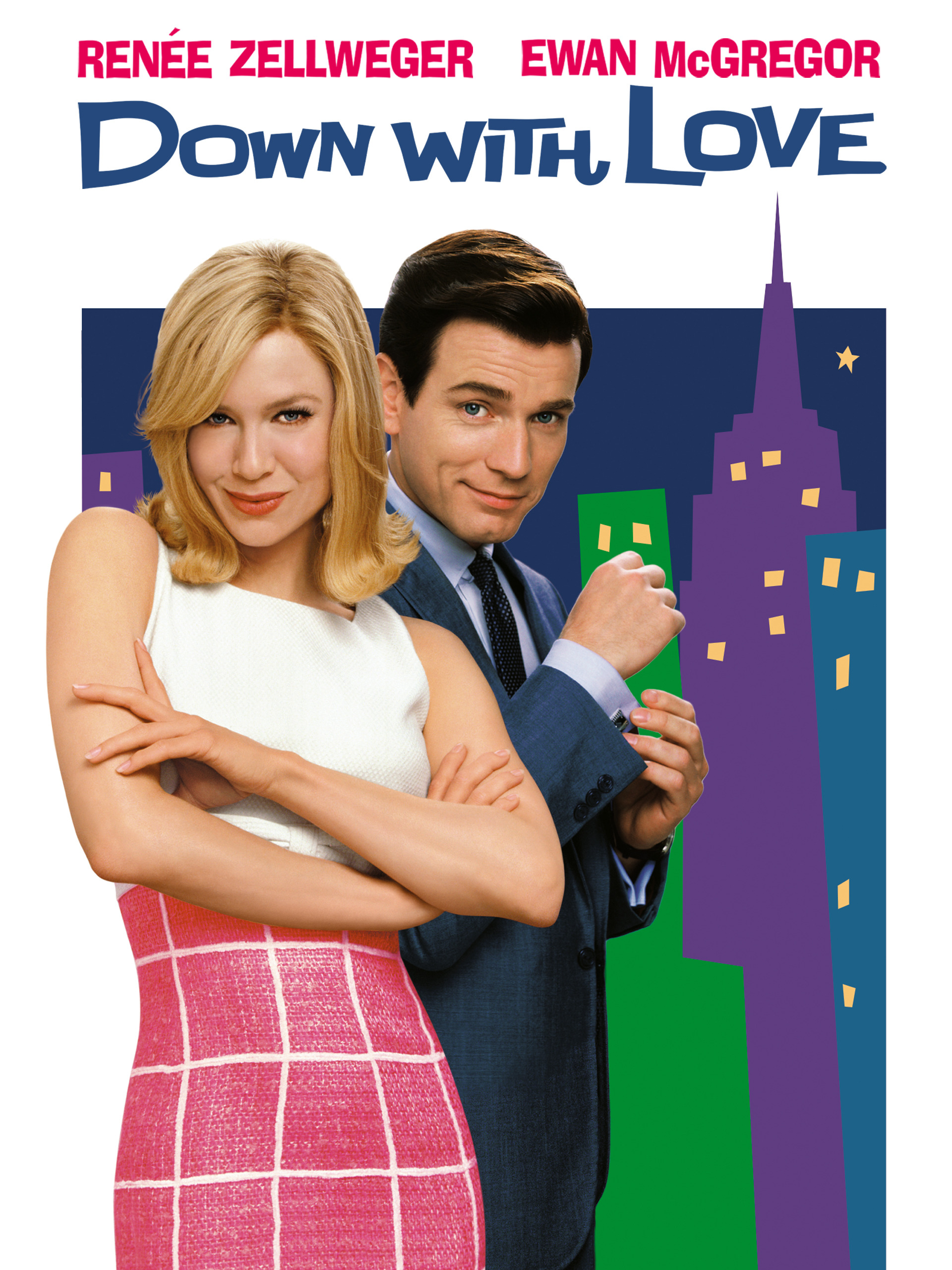
 New York City, 1962 – the Swinging Sixties have yet to make their way across the pond from London, meaning that society was still run by prim and proper, family-style values. The arrival of Barbara Novak (Renée Zellweger) signals quite a significant change. Her humble roots are in Maine, where she gradually put together a book that she believes will take the world by storm – “Down with Love” outlines Barbara’s ideal version of the world, where women don’t need to succumb to the desires of their male counterparts and are worth far more than just the patriarchal objectification that tends to define mainstream society. Needless to say, the book is instantly a cultural phenomenon and Barbara becomes something of an overnight sensation, being lunged into the public eye through being an embodiment of female empowerment and liberation, alongside her editor and friend Vikki (Sarah Paulson), who benefits greatly from this new power afforded to her, especially in an industry where she is often seen as little more than a glorified secretary. One of the few people who is disillusioned by her newfound fame is Catcher Block (Ewan McGregor), a libertine journalist who was, prior to Barbara’s ascent to fame, one of the most desirable men in the city – and now struggles to find a woman willing to be part of his reckless philandering. Along with his boss and best friend, Peter (David Hyde Pierce), Catcher hatches a plan to expose Barbara, and by posing as the naive, effortlessly charming but entirely dim-witted astronaut Zip Martin, he’s able to fool her into falling in love with him – only to realize that he may indeed be falling for her instead. Their romance is built on deception, but they soon discover that there is far more to love than either of them initially realized – turns out, they knew very little to begin with.
Had it not been for the presence of its charismatic cast, I’d have been entirely convinced that Down with Love had been made in the 1960s. There are countless films that serve to be pastiches of past genres, replicating the style and tone of older works, but very few have come as close as Peyton Reed’s masterful send-up of the mid-century romantic comedy. Anyone who is endeared by the slight but charming screen partnerships of the likes of Doris Day and Rock Hudson will undoubtedly appreciate this film, a humble but effortlessly likeable recreation of this genre of filmmaking, capturing every nuance down to the finest detail. However, visual flair doesn’t distract from the fact that Down with Love is a film with a lot of substance, not being defined entirely by the style in any way, rather opting to be a daring attempt to present modern audiences with the same kind of delightful romantic comedy that seemingly went out of fashion in the years after the sexual revolution resulted in more earnest depictions of love and sexuality on screen. Needless to say, there’s something incredibly special about this film, a kind of offbeat charm, a glamour that is derived from the laborious effort that went into the making of the film, and the incredible performances given by a cast that are entirely aligned with this film’s sensibilities. There are many factors that go into making Down with Love an entirely convincing work of fiction, allowing it to operate as both a detailed homage to a bygone era of cinematic storytelling and a compelling romantic comedy in its own right – and considering this was only the sophomore directorial effort from Reed, who was still finding his voice in the industry, it only makes this an even more remarkable achievement.
For some reason, Down with Love has been mostly forgotten, being cherished by a small but dedicated group of supporters that realize how magnificent a film this actually is, and therefore deserves a much wider audience, because not only is this a loving tribute to Golden Age of Hollywood, it’s a terrific screen romance in its own right, the kind of effervescent comedy that just doesn’t come around anymore. There have been many homages to the past in many different forms throughout the year, but this particular film seems to occupy an elite group insofar as it isn’t just an attempt to replicate a time and place, but also has some depth to it. A pastiche isn’t supposed to just be recreation, there needs to be something more, even if its not the main driving factor – a film like this needs to say something and it’s certainly not difficult to see what Reed was trying to achieve with this film. At the time in which this film was made, third-wave feminism was already a ratified movement, and many works were provoking the intersectionality between identity, sexuality and the role of the individual in the broader society. Down with Love is not exactly about this movement, but instead an outrageous throwback to earlier forms of feminism, using the more current perspective as a foundation to build on its ideals that some have called utopian in vision. Grappling the boundaries between different forms of gender politics, Eve Ahlert and Dennis Drake’s story takes on a new meaning when we view it as more than just a buoyant throwback, and as a quietly revolutionary satire that used the lens of a cherished but outdated era of Hollywood to tell a far more subversive story. There’s nuance to Down with Love that isn’t difficult to spot from the very first moments – and it doesn’t take too much work to realize what this film is saying, as it delivers exactly what it promises from the outset, which is to be a lovable feminist odyssey that ensures the audience both gripping romance and thought-provoking comedy, finding a way to comment on the role of women in the workplace, centralizing this premise without losing the intentionally flippant charms that reveal something far more interesting than romance, which is ultimately not all that important to the story by the end – in fact, it’s entirely inconsequential, even if the intentionally hackneyed ending is very charming.
Down with Love is also something of a peak for the actors involved – while strangely never considered as being such, this film is some of the best work done by Renée Zellweger and Ewan McGregor, both of which were at the peak of their stardom, and no strangers to being involved with classical Hollywood throwbacks, having appeared in two of the biggest musicals of the current generation, Chicago and Moulin Rouge! respectively. The one undeniable quality about this film is that both actors are so effortlessly charming, and seem to fit right into the period sensibilities of the film. They take on these roles with gusto, going to great lengths to convincingly play mid-century characters, without losing the mischievous spark that reminds us that they too are in on the joke, rather than just being taken for a ride by a film that could very easily have just used them and their wonderful chemistry as grounding for the more stylish aspects. McGregor, in particular, consolidates his status as one of the early 21-century’s most endearing leading men, being a new kind of star, someone who could play grand romantic heroes without being rugged or mysterious, but rather earnest and lovable, which benefits his performance here massively. Zellweger has always been a chameleon of an actress, taking on numerous fascinating roles throughout her career and being singularly convincing in each one of them, so it’s hardly a surprise that she’d fit perfectly into the role of a feisty heroine who distances herself from decorum, while quietly rebelling against her own self-professed beliefs. It’s also worth mentioning David Hyde Pierce and Sarah Paulson (in one of her first major acting roles), who give memorable supporting performances that are at the heart of the film, being responsible for some of its best moments. Down with Love is built almost entirely on its talented cast, which is why it’s such an enduring work.
It’s still quite bewildering that Down with Love hasn’t gotten that much attention since its initial release – it has all the elements that go into making a cherished comedy, particularly its unique approach to a conventional story, the terrific performances from a talented cast, or the bold style that replicates every detail of the kind of mid-century comedies that the film was honouring. If anything, this film has developed a small cult following amongst those that realize what a gem it actually is – it may appear slight and meaningless, but that there’s something more profound at the centre. Even if we don’t focus on the wonderfully subversive, hilariously satirical story at the core, the pure visual spectacle of this film is quite incredible in and of itself, and more than warrants its place amongst the finest romantic comedies of its era. The fact that it manages to make quite a bold statement that is almost universally resonant is even better, with its sly but incredibly honest attempt to start a conversation, without taking away from the broader experience, being one of the many reasons why we should give this film another chance. There’s never been a better time to reevaluate a film like this, with Down with Love being a potent homage that captures the tone, the look and the heart of a bygone era with class, elegance and effervescent humour, which makes this film a true delight in every possible way.
 The Postmodern Pelican