 Peter (Ladislav Jakim) is an aimless young man who seems to lack any sense of direction. He’s pressured by his parents (Jan Vostrčil and Božena Matušková) to get a job, particularly by his overbearing father, whose belief is that the only person worth any time is a working person and that one can’t truly be a fully-formed citizen unless he or she is contributing to the economic progression of their country. Peter initially wanders around his small Czech town, until coming across a job that he believes would be quite fitting for him. He’s hired as a security guard for a small grocery store, where the frazzled owner (Frantisek Kosina) puts a lot of faith into the young man to prevent theft from occurring, quite a common problem for his business. However, Peter lacks much confidence, and as a result, his reserved nature prevents him from confronting and apprehending a thief, which comes to haunt him as he questions his own abilities. It also doesn’t help his morale that he’s deeply in love with Pavla (Pavla Martínková), a beautiful young woman who he frequently encounters. He does his best to convince her that he is just as dashing and charming as the more traditional bachelors who chase after her and that he possesses an irresistible quality – however, as Pavla soon comes to learn, Peter is a hopelessly goofy young man without any particular path, but that he does have a good heart, which means more to her than any amount of wooing she gets from the local townsfolk who desire her, such as the barbaric Čenda (Vladimír Pucholt), who sees Peter as something of a rival to his ambitions. In the midst of all of this, our hero has to struggle to find his voice in a world where he’s been silent for far too long, encountering many unexpected (and sometimes hilarious) challenges along the way.
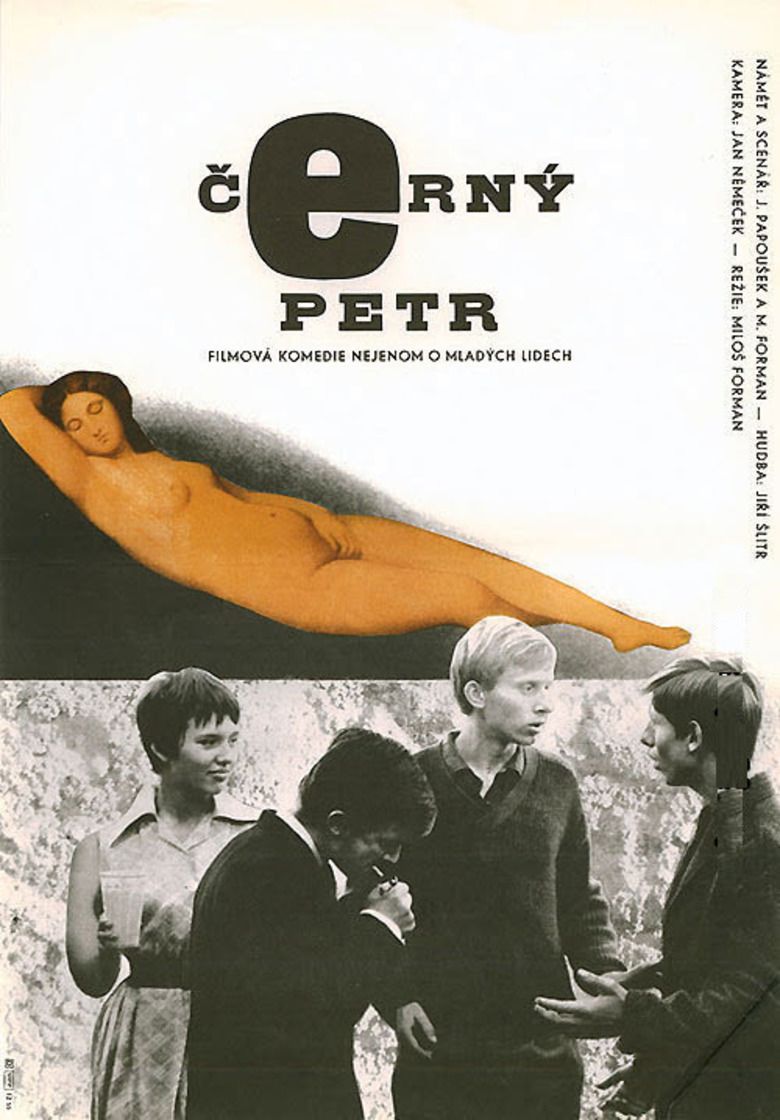
Miloš Forman was a fascinating filmmaker, with his films always being so bewilderingly different to each other, each one a different experiment undertaken by a director whose refusal to pick a particular style eventually became his trademark. However, looking at the origins of his career, you can find many common elements among them which would tie them together and establish him as one of the most interesting directors of his generation. Artistically coming of age during the era of the Czech New Wave, Forman’s earliest films are all very much aligned with many of the principles employed by the movement, while being fundamentally different enough to stand out, becoming works that challenged societal conventions all the same, but never in the same way as some of his contemporaries, making films like The Fireman’s Ball and Loves of a Blonde such enduring classics of Eastern European cinema. His first feature-length directorial effort was Black Peter (Czech: Černý Petr), a charming little comedy that takes on some enormous themes, channelling through an intimate story of human connection and social reality that was somewhat different from the work being done by some of his artistic compatriots during this period. Inarguably, it doesn’t reach the same heights as the work he’d do after this, but it remains a poignant exploration of the human condition that can challenge any of the subsequent work done during the Czech New Wave, particularly in how Forman keeps everything at the fundamentally human level, and never deviates from this simple but affecting story that is unwavering in its commitment to challenging, and sometimes even celebrating, the volatile nature of things as they are.
When looking back at the era of Czech resistance comedy, an offshoot of the nation’s cinematic New Wave, the most common thematic aspect is normally an undercurrent of absurdism, with the majority of the most major works to come out of this period making use of some form of surrealism as a way of commenting on the cultural climate brought on by the political system. Forman was certainly someone who didn’t abide by many rules, and his work under this movement went another direction. Employing aspects of kitchen-sink realism and combining them with something resembling screwball comedy, both of which he had undoubtedly been influenced by during his formative creative years, the director constructed powerful but beautifully simple odes to humanity that were inherently more subtle than some of his contemporaries’ work. A film like Black Peter thrives on a kind of intimacy, being far more descriptive than it was discursive, something that wasn’t all that unprecedented, as there was a faction of the Czech New Wave that did employ a more straightforward method of filmmaking, but still quite unique for the time and place in which it was produced. Black Peter seeks to portray ordinary life, lacking any coherent metanarrative or overriding plot, with the film being propelled almost entirely on its unique structure, which consists of a variety of fragmented vignettes, linked together by virtue of being moments in the life of the titular character. It’s quite a daring approach that could have easily been unsuccessful, but under the careful curation of a filmmaker whose intentions were clearly to just represent a few days in the life of an ordinary person, all the while infusing some underlying socio-cultural commentary into it, Black Peter flourishes into a fantastic example of subversive, darkly comical social realism.
While it may be effervescent and charming on the surface, Black Peter isn’t without depth, harbouring a nuanced set of ideas that manifest in very quiet but noticeable ways. Forman put together something of a coming-of-age comedy in this film, with the main thrust of the story being the titular character’s trials and tribulations as he experiences different aspects of life, caught in the ambigious space between adolescence and adulthood, and facing various challenges associated with both, such as the search for either love or a job, which turn out to be far more incompatible than Peter would have expected. It would be foolish to ignore the communist background to this film, as while Black Peter might not address it completely, Forman was operating from a standpoint of carefully critiquing the socio-political system that had been dominating the region for nearly two decades by this point. Black Peter is often detached from serious discussions of the resistance comedy, mainly because it doesn’t seem to be doing any kind of resisting at all – rather, its taking quite a simple approach to just portraying ordinary life. Yet, this form of storytelling is perhaps the most defiant – presenting us with a protagonist who is neither heroic nor particularly talented in any discernible way, and having him be the representative for an entire group of people (specifically those that were most heavily-favoured as members of the working-class) meant that the illusion of the mighty, powerful Communist worker was dismissed in favour of portraying Peter as a mousy, milquetoast young man. It’s a defiant approach that doesn’t quite sink in until the final moments of the film, the camera lingering on Peter’s disappointed father delivering yet another lecture about success to his son, who sits in quiet resignation: he’s heard it all before, and he’s expecting to hear it all over again, many times. He’s not going to put in the effort, and nor were the multitudes of other young people who just refused to adhere to the socially-mediated standards, set on them by the government.
There’s a lot of Forman in Black Peter, making it an even more poignant exploration of fundamentally human themes. It navigates challenging narrative territory, focusing solely on being descriptive and showing life as it was, rather than presenting it as something unrealistic for the sake of literary appeal. Forman uses his artistic licence very sparingly, which is perfect for a film like Black Peter, which never demands to be anything beyond what we’re presented with at the outset. The film doesn’t say much in terms of a story – we understand Peter to be a likeable young man who is just lost, a product of a tumultuous period that produced just as many fiercely loyal supporters as they did misguided young people who feel lost under a system that positions them as simply another face in the endless crowd. Forman doesn’t many any grand statements with this film, which may be the boldest choice, since the poignancy that comes with the film, while certainly very simple, lends itself to some fascinating discussions that the film is not afraid to avoid inciting in viewers, who will undoubtedly be captivated by its unique approach to a story that seems familiar, but only by virtue of it being a brief, momentary snapshot of human existence, condensed into ninety minutes of quietly charming comedy that finds amusement in life’s smallest coincidences and surprises, while still managing to insert some subversive social commentary into the proceedings, making for thoroughly compelling work that supersedes many expectations of what a realist film can be – misery and misfortune are certainly impactful enough, but sometimes reality is simply a series of quirky moments that come together in a wonderfully simple tapestry of life and its innumerable unexpected surprises, which Forman presents in Black Peter with ease, nuance and incredible sincerity that resounds with heartfelt humour and deep, unflinching authenticity.
 The Postmodern Pelican