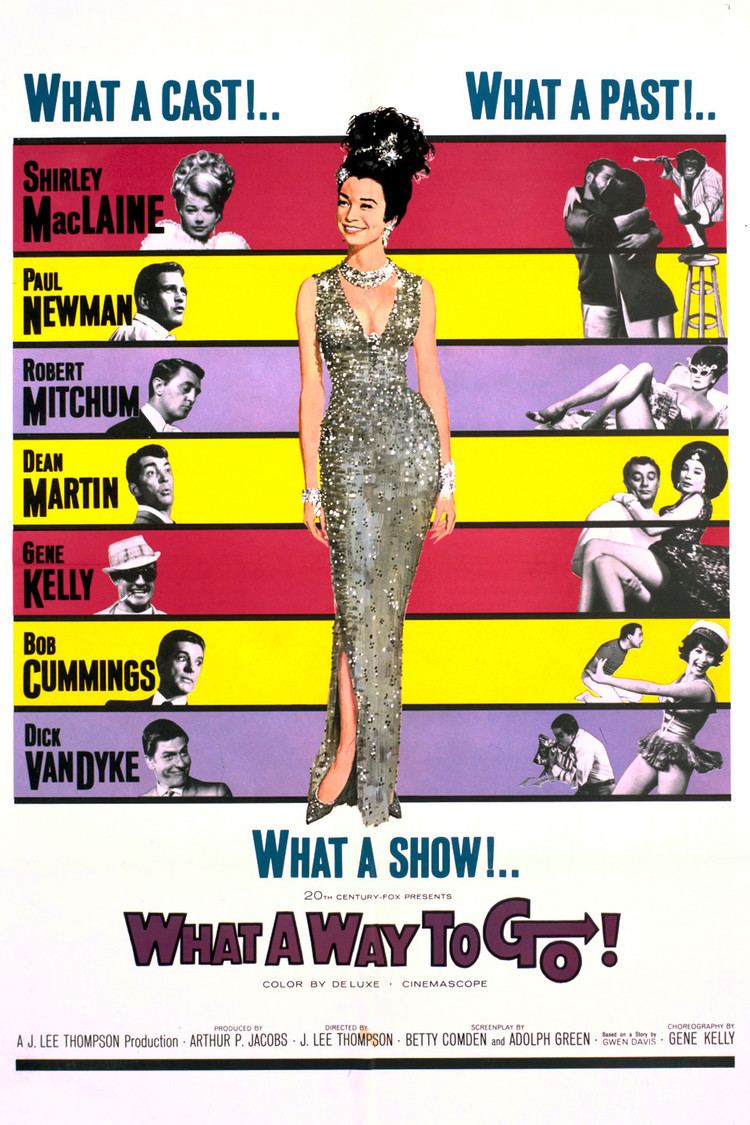
 Louisa (Shirley MacLaine) is the world’s richest woman, she is willing to do absolutely anything to strip herself of that title. She was raised in comfortable poverty, and has always aspired to lead a very simple life, relying on nothing but the bare essentials – but as we see in the first few moments of the film, Louisa hasn’t been able to achieve such a life, having amassed an enormous fortune that she is trying desperately to get rid of. Forced into seeing a psychologist to assess whether she is mentally unstable, Louisa relays the story of how she managed to acquire her fortune over the course of her adult life. It turns out, Louisa has rotten luck – somehow, she always falls in love with men who manage to become incredibly rich. This would normally be delightful for any ordinary person, but with her dreams of a simple, pastoral life continuing to evade her, Louisa finds herself at the receiving end of privilege, luxury and glamour, when all she wants is a house on a small farm somewhere. Luckily for her, each of her husbands meets a gruesome end at the hands of their own selfish, money-driven desires, opening up yet another opportunity for Louisa to continue on her path to simplicity – but every time she believes herself to be free, she stumbles upon another prospective beau who sweeps her off her feet and presents her with a life she cannot deny – only to have it entirely dismantled when they accidentally become even richer than they ever believed. Amongst them are a humble literature-loving farmer (Dick van Dyke), a bohemian artist (Paul Newman), a tycoon looking for a simple life as well (Robert Mitchum) and a charming dance-hall entertainer (Gene Kelly) – and she inadvertently puts her “witches’ spell” on each one of them, where they amass an enormous fortune and suffer unfortunate accidents, which only puts more money in Louisa’s name and sets her further apart from her ambitions.
What a Way to Go! is a film that I’m entirely shocked exists – it is neither controversial or a poorly-made work in any regard, but rather something so bizarre and abstract, the fact that it was made in the first place is truly astonishing and indicative of some unhinged genius being at play. What is even more anomalous is that it resides in relative obscurity – the idea that a film directed by J. Lee Thompson (who was at his peak here, and seemingly on his way to becoming of the industry’s most respected filmmakers, only to lose his way in subsequent decades), featuring a cast of some of Hollywood’s most beloved stars across every genre, costumes by Edith Head, choreography by Gene Kelly, cinematography by Leon Shamroy and music by Nelson Riddle, has not been celebrated as one of the most defining works of the 1960s in terms of pure, unadulterated entertainment, is bewildering and is only worsened by the fact that What a Way to Go! is an excellent film to boot. Twisted in all the right ways, and made with the audacity that would only come to be appreciated in later decades, Thompson’s wonderfully bizarre dark comedy is a work of brilliance in so many ways. Derived from the wonderfully unique minds of comedic duo Betty Comden and Adolph Green (who are responsible for the timeless classic Singin’ in the Rain), the film is a rollicking journey through different genres, touching on many of the industry’s most sacrosanct conventions and subverting them in wonderfully unpredictable ways, culminating in a true hidden gem, a film that seeks to entertain and enthral audiences everywhere, and endures as an unexpectedly effective work of comedy that satirizes far too many different areas of life and art to explore each in detail. It’s a film anxiously awaiting a reappraisal, as there’s no doubt its worth another look.
The concept of a film traversing multiple different genres, whether satirizing perceptions or challenging conventions, has been one that has existed for quite a while and has been the product of many fascinating attempts to piece together subversions of form and content for the sake of paying tribute and gently parodying the genres that have defined the industry. What a Way to Go! is one of the more fascinating specimens in this sub-genre, being a wonderfully potent satire that takes its cue from many different areas of filmmaking and employs them wonderfully in this postmodern pastiche of Hollywood, never abating in its intentions to pay tribute to the past, while working towards defining a new form of storytelling. Thompson, who was something of a strange choice to helm this film, since his most notable productions at the time were more gritty, harrowing thrillers and war dramas takes on the challenge of putting together one of the most endearing comedic romps of its era, one that should be definitive of an era in comic filmmaking, had it only persisted beyond the confines of its particular period. Looking back at the film, it’s somewhat surprising this wasn’t embraced more, since it features all the components that normally make up a successful film – dazzling visuals, a fantastic cast that can rival any other star-studded ensemble in history, and most importantly, a well-written story that is unwavering in its comedic commitments, being a nuanced exploration of deeply human themes, channelled through a fundamentally entertaining premise that is both glaringly simple and wonderfully unique, a product of a kind of subversive satire that actually paid attention to what they were parodying, rather than simply taking cheap shots for the sake of it. Brilliance exudes from nearly every frame of What a Way to Go!, which isn’t always something one can say about mid-century comedies that appear to be as derivative as this film – and as we learn throughout, there’s nothing wrong with taking inspiration and paying tribute, as long as there’s something there to support it.
A conversation about What a Way to Go! simply can’t work without acknowledging the cast, with Thompson wrangling an astonishingly impressive roster of stars to take roles in this ensemble. The film is led by Shirley MacLaine, who was in her peak at the time in which this film was made. Taking on a role intended for Marilyn Monroe prior to her passing, MacLaine makes the part of Louisa May Foster-Hopper-Flint-Anderson-Benson-Crawley her own (and how could you not, when playing a character with such a wonderfully unique name?), finding the depth in a role that could have simply just been a surrogate for the narrative madness that ensued throughout this film. Louisa is far more of a complex character than we’d expect from a film like this, which is equally due to the screenwriters for conceiving the character in such a way, and MacLaine for rising to the occasion throughout, being willing to take on any of the challenges presented to her in playing the part. She navigates many different personalities and traits – she demonstrates humility and grace in some parts, sycophantic hedonism in others, and remains consistently charming throughout. Had MacLaine not already established herself as one of the defining young actresses of her generation only about a decade prior to this film, I’d argue that What a Way to Go! is the kind of role intended to make a star out of someone. Yet, MacLaine manages to use her own experience garnered in the industry, whether it be in the command of character or the ability to work with actors of any personality type (no doubt a remnant from her unofficial grouping with the Rat Pack), she elevates Louisa above mere comedic protagonist and instead leaves an unforgettable impression in what may not be her most challenging work, but is one of the most indicative examples of why she’s so deeply revered as one of Hollywood’s most beloved stars today.
Thompson puts together a fantastic ensemble to support MacLaine, and presents us with something of a delightful conundrum – when confronted with a bevvy of actors at the peak of their stardom, how do you possibly choose one as a standout, especially when each one of them hails from a different part of the industry? The answer is, you simply can’t, and the best way to deal with such a wonderful problem is to just celebrate them all. No expense was spared in casting the roles of Louisa’s various husbands, with Thompson choosing some of the greatest performers to work in the medium to play these parts. Dick van Dyke (who had been commanding television while concurrently making his name known as a film star in various films around this time) employs the same unique duality he has shown throughout his career, where he’s able to play a lovable goof in one scene, followed by a more morally-ambigious character in another, without losing the spark of humour and glimmer of charm that is perpetually twinkling in his eyes, plays Louisa’s first husband, who is constantly at odds with her intended, played by Dean Martin who was at his most despicably charming here, and who is unexpectedly the emotional hinge of the film, appearing again at the very end and allowing the story to come full-circle. Their contest is eventually followed by the arrival of Paul Newman in a spoof of European arthouse romances, playing a tortured artist who unfortunately suffers the worst form of public ridicule: he’s recognized and celebrated for his work while in his peak. Newman didn’t do many straight comedies at the time, which is why his performance here works, since he’s playing it completely straight and allowing the absurdity of the film around him to bolster the humour. The same could be said for Robert Mitchum, who possessed an acidic, caustic wit that often contrasted with his more enigmatic bravado, making him a strangely endearing figure, even when he wasn’t supposed to be – and his performance here is just as impressive, working within the confines of the comedy while never surrendering the exact qualities that made him such a perfect choice for the role. The film culminates in the arrival of its (at the time) biggest star, Gene Kelly, who still proves to be one of the screen’s most magnetic presences, commanding every frame like no actor has ever been able to do since.
What a Way to Go! employs these actors in relatively small roles, putting them at service of MacLaine’s character for the sake of the fascinating oscillation between genres that persisted throughout the film. One of the most fascinating elements of the film is how it works through many different genres in each of these romances, with fantasy sequences positioning them as individual vignettes in the wider storyline. Various popular genres were employed as narrative tools, both in the past and at that time – silent slapstick comedy (Van Dyke and Martin), intimate European romance (Newman), lavish Hollywood blockbuster (Mitchum) and extravagant musical (Kelly), each one being tailor-made to suit the story and the actors used in those particular moments. It’s precisely what makes What a Way to Go! so effective – very few films manage to demonstrate such each when working within so many different genres, and considering this is essentially a comedic romp that was working from the idea of sampling from different sources years before the advent of postmodernism, where it became a regular practice, is quite impressive in hindsight, and makes a retrospective exploration of the film all the more worthwhile. Not only is What a Way to Go! able to capture the spirit of the genres they were paying homage to, they replicated their visual style better than most films ever could – when watching each of these sequences, you’re instantly taken back to that particular period, enveloped in the specific genre being explored. This is a testament to a production run by many artists fully-devoted to their specific area, with an enormous amount of detail being put into every moment – and even if the film can sometimes be slight, its impossible to deny the effort put into this production, which sometimes stands as the most impressive part of the film as a whole and a further reason why it should be thoroughly celebrated.
What a Way to Go! is a fantastic film – it is a lavish pastiche of many different genres, guided by a reliable director whose work in different areas of the industry made him an unexpectedly brilliant choice to helm this film and elevate it above simply being a mindless romp. There are so many wonderful aspects to the film which make it such a pleasure to experience, an assault on the senses in the best way possible. Anchored by dynamic performances from a star-studded cast, executed with sincerity and audacity, the kind that we very rarely see employed in contemporary filmmaking (where derivative spectacle replaces originality most of the time), What a Way to Go! is a terrific achievement – it may not be entirely well-known now, most likely a result of the fact that it was seen as enjoyable but otherwise forgettable entertainment at the time – but in an artistic landscape where we are constantly looking back to find inspiration, there aren’t many films that work better in showing the limitless bounds to which a story can go in order to be refreshing and unique. It’s a terrific film, one that astounds with its scope and style, even by today’s standards, and remains one of the more refreshing works of comedy of any era, a charming homage to Hollywood and the many artists that passed through its hallowed halls throughout its legendary history, and momentarily managing to capture the very spark of why movies themselves are so special. What a Way to Go! deserves another look for many reasons, but its sheer commitment to celebrating cinema is perhaps the most significant factor towards proclaiming this a worthwhile endeavour for anyone looking for something thought-provoking and special in equal measure.
 The Postmodern Pelican