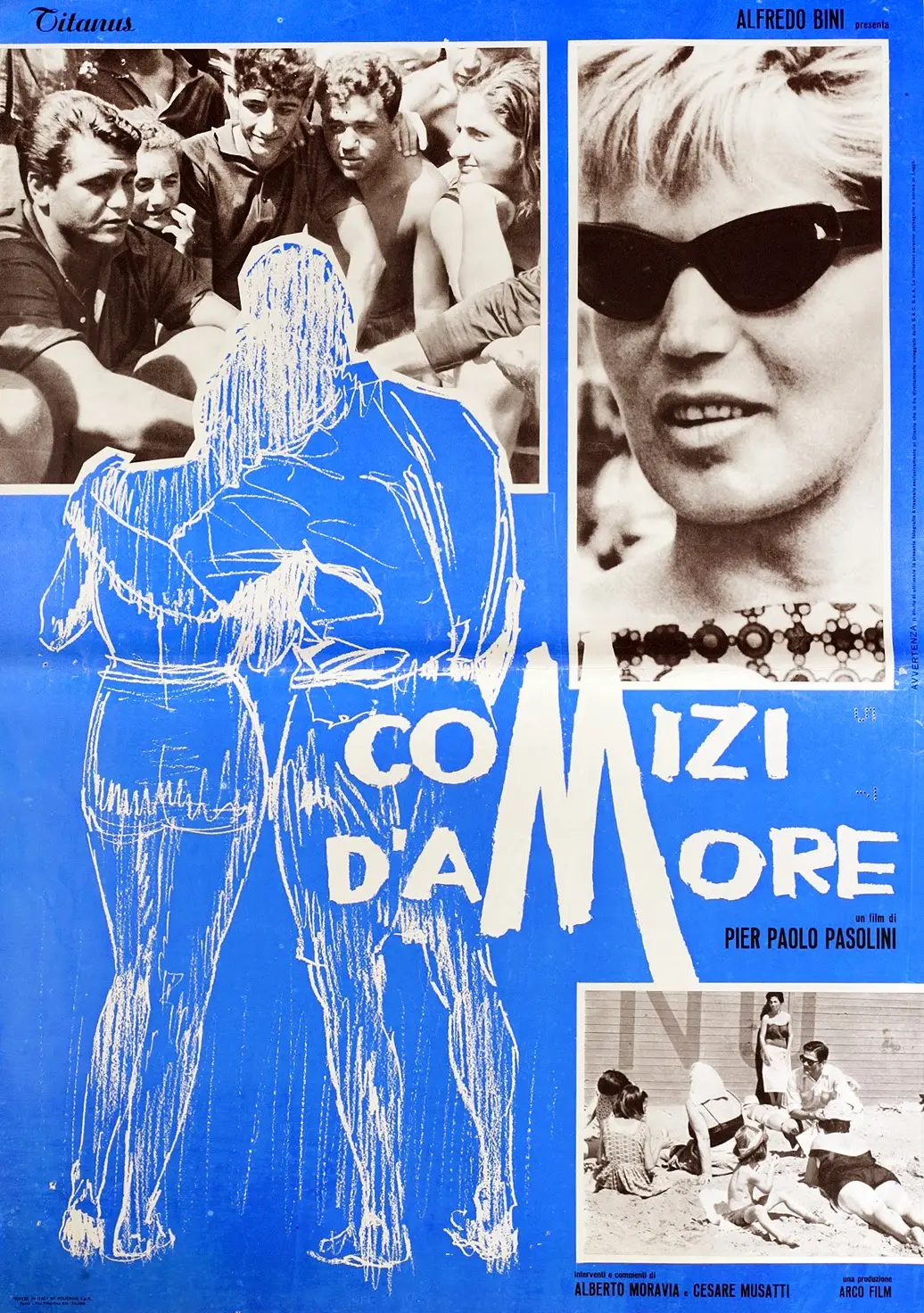
 What is love? This is a question that has challenged philosophers and artists for about as love as we’ve been sentient – the movement away from procreation for necessity towards putting value into interpersonal relationships has been one that has provoked countless individuals and produced so many fascinating interpretations. Pier Paolo Pasolini was a multi-hyphenate artist whose work always reflected various kind of messages, with love often finding its way into the themes he explored throughout his career. His films were perhaps the best insights into his unique perspective on these issues, and none of them quite as effective as Love Meetings (Italian: Comizi d’amore), an intimate documentary that sees Pasolini adopting a very simple thesis of investigating different perceptions of love, and venturing off into various regions of his native Italy, interviewing anyone he came across in his metaphysical, academic voyage, taking on the role of both filmmaker and investigative journalist as he weasels his way into the public consciousness. Taking on the timeless them of love and its many forms is not an easy task, but with a set of provocative questions and a willingness to get to the core of the human phenomena that is romance (and the occasional lack of it), Pasolini is able to extract some insightful commentary that isn’t only a fantastic glimpse into different interpretations to the question posed at the beginning of this review, but a poignant, moving look into the human condition from the perspective of an artist venturing to find the truth, and acquiring much more than that along the way.
Despite playing the primary role of a journalist in Love Meeting, Pasolini does not avoid employing his own artistic touch to this production, looking at the subject matter in a highly original way. Love Meetings is a wonderfully authentic documentary that thrives on its honesty and simplicity, but Pasolini makes it very clear at the outset that this is not merely a work of objective investigation – like anyone exploring a particular subject, he’s going about this film with a sense of direction, which reflects his intentions as not being entirely objective (which is true of every filmmaker endeavouring to make a documentary – no one is entirely neutral to a particular issue), and in taking on the role of on-screen interviewer, he does deviate slightly from standards of the archetypal documentary and challenges the idea that a film like this should be descriptive rather than discursive, Pasolini puts together a mesmerizing and incredibly complex portrayal of the general issues that he took on when conceiving of this film. His ultimate intention is to focus on love, and more specifically sexuality, as a social and psychological tool, a common concept that has woven its way into the lives of each one of us in some way. Divided into various chapters, each one revolving around a different issue related to the broader concept of love, Love Meetings is a daring but effortlessly simple demonstration of varying perceptions, made in such a way that the vox populi guides the loose discursive threads and creates cohesion in what is otherwise a very broad topic, giving it some kind of structure, which seems to have been the aim all along, and a significant reason behind the mesmerizing success of the film.
Using the concept of love as a starting-point, Pasolini focuses on many themes that still remain highly-contentious and debated, even by today’s standards. Never one to avoid more controversial subjects, the director forms Love Meetings around a few central themes related to love and sexuality – the discussions on homosexuality, divorce and prostitution are the cornerstones of the film, because not only did they contribute the most significantly different interpretations amongst different participants in the survey that grounds the film, they were still incredibly contentious themes, as shown by the surprise many respondents express when asked these questions. Love Meetings was borne out of the director’s belief that demystifying such issues can only be done through frank and honest conversation, which was the impetus for the film. He is not content to just reduce love to an ethereal concept that embodies purity and innocence (as evident by the prologue, in which Pasolini asks various children about where babies come from, with the general consensus being “the stork” or “God”), but instead acknowledges the importance of addressing more serious ideas directly. Through this approach, Love Meetings is manages to comment on deeper issues such as social structure, existential philosophy, identity and politics, all through employing a series of very simple conversations about sexuality, where each one of these underlying themes come to the fore through discussions on the most rudimentary concepts of love and desire.
There’s a wonderful vivacity to the random style with which Pasolini makes Love Meetings, with its bare, straightforward style being extremely simple but nonetheless incredibly effective, both in terms of documentary filmmaking, and the depth of ideas it is exploring throughout. The use of real, ordinary people is certainly expected for a documentary like this, but it works unusually well as a structural tool as well. Pasolini is going in search of something deeper, and by undergoing various rendezvous with the embodiment of the proletariat, he is able to create a vivid tapestry of Italian society, using the one common theme that binds nearly every person in some way, commenting on powerful themes that are so simple yet so effortlessly poignant. Even when working in the realm of non-fiction, Pasolini employs fascinating methods to convey the underlying message he is seeking to explore – this is best described early in the film, when one of the subjects (an academic who the director goes to in order to frame the general themes of the film) remarks on two notable cinematic movements that had become prominent in the preceding decades in European filmmaking – cinéma vérité, descending from pre-Nouvelle Vague France, and neo-realism, which had gained popularity in Italy just after the Second World War. Pasolini makes use of both, finding a compatibility between them that is quite remarkable, sampling from them in a way that gives Love Meetings depth and nuance, beyond simply being a series of loose discussions with ordinary people. The role of Pasolini in this regard wasn’t simply an interviewer, but also a shepherd for the broad socio-cultural perceptions that infiltrate and shape the film, creating a unique sensation of complete, unhinged authenticity, which is quite radical, even for a documentary.
Love Meetings is a terrific film, solely due to the fascinating approach Pasolini takes to such a straightforward concept. The idea of a making a film all about love is both wonderfully simple and also somewhat convoluted – how does one possibly try and make something that attempts to condense thousands of years of discourse into a mere ninety minutes? Pasolini comes very close through a thoroughly detailed whistle-stop tour of the different areas of love and sexuality, provoking many ideas that were simply not spoken about in “decent” society at the time, and remain areas in which different sides are still contending, fighting for their own interpretation to become the party line. Throughout the film, we encounter many different opinions, and the viewpoints expressed may be somewhat outdated, relics of a time in the past that we have seemingly overcome – but the questions that extract these thoughts are timeless, still being very relevant in a modern context. Love Meetings is a fascinating piece of non-fiction filmmaking that represents something of a defining moment in Pasolini’s non-narrative career, and while he may be remembered for his more notable films (some of them thrusting him into indelible infamy), working within the realm of reality allows us to understand the extent to which his vision conveyed a keen sense of more humanistic issues – and as evident by this film, he can drive around Italy and ask people about sex, and still keep us thoroughly captivated. That, and other reasons outlined above, more than warrant Love Meetings as a fascinating work of documentary filmmaking.
 The Postmodern Pelican