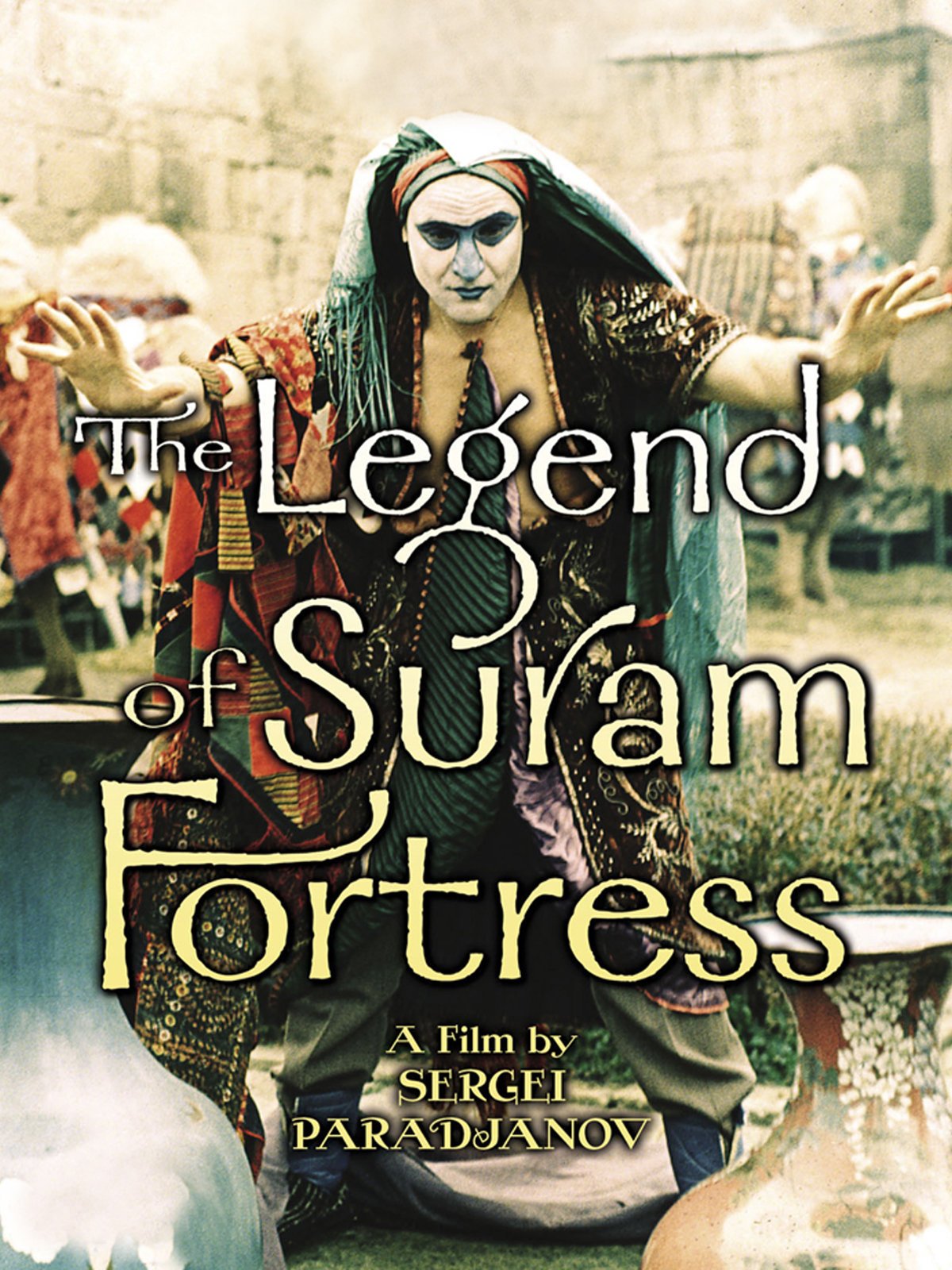
 Sergei Parajanov was truly one of the greatest artists across any medium. His films reflect so much deep understanding for life, always being poignant celebrations of the fragility of existence, channelled through some of the most gorgeous imagery ever committed to film. His penultimate completed film was The Legend of Suram Fortress (Georgian: ამბავი სურამის ციხისა), a gorgeously poetic cinematic manifestation of an archaic Georgian folktale. The film gave Parajanov yet another opportunity to explore the fascinating intersections between visual and narrative, with the director putting together a complex series of tableaux that are more than just strikingly beautiful, but carry emotional heft, embedded deep within the beautifully-realized cinematic tapestry, derived from the mind of one of film’s most abstract thinkers, a filmmaker whose entire career was defined by a quiet resilience, a masterful control of form that many have attempted to replicate or imitate (citing it as “paying homage”), but very few have managed to actually match, whether in scope or style. The Legend of Suram Fortress is simply a gorgeous film, a disquieting historical odyssey that feels simultaneously intimate and epic, giving audiences the chance to encounter the myths and legends of a particular time and place, guided through this powerful historical fable through the vision of a director that can be called nothing less than beautifully unconventional, and he is in dire need of reappraisal – he’s far more than just a fascinating footnote on Soviet art or visually-driven cinema, but rather a director who launched an entire generation of filmmakers who have tried in vain to follow in his style, and rarely ever succeeded because when it comes down to something like The Legend of Suram Fortress or any of his other films, it is singularly impossible to replicate such striking, authentic beauty.
As per convention for the director, The Legend of Suram Fortress carries something of a discernible storyline, but one that isn’t all that important to the intentions of the film, serving to establish a grounded foundation, an anchor from which the director is able to build his story – its almost poetic justice for us to be talking about this process through the lens of this particular film, as so much of it has to do with the interweavings of physical and metaphorical construction and composure. Parajanov takes inspiration from an ancient folk legend of Georgia, in which a group of Christians in the antiquity are under threat by invading Muslims, who are looking to take over their region. The Christians attempt to defend their land by building a stronghold (the titular Surami Fortress), but which can never reach completion, crumbling just before construction finishes. Over the course of the story, time and place weave together to form a decades-spanning odyssey of the region, where mysticism and religion intersect to solve this problem – in order for the fortress to stand, someone has to be buried alive in the walls, the ultimate sacrifice to defend the land and keep the faith of the region alive, preventing it from being taken over by another hostile population. This falls to a young prince, who has gallantly served his people, and now is confronted with the choice – does he continue to lead them to greatness, or does he sacrifice himself for the sake of his people, giving himself to the land so that they may remain on it, safe and liberated from the perpetual threats by those looking to take over. However, there is far more than just what we see presented to us at the outset, with the ulterior motives of certain individuals playing a part in the ultimate faith of the region.
The Legend of Suram Fortress came about nearly two decades after Parajanov’s defining masterpieces Shadows of Forgotten Ancestors and The Color of Pomegranates – initially, you’d be led to believe he was on an artistic sabbatical, but further insights into the director’s life shows how he spent nearly a decade in a gulag, imprisoned by the communist government for his work. He was an artist who paid the consequences for merely expressing himself and seeking to explore the history of the region through achingly beautiful visual portraits, which were far too defiant for the taste of his captors, who saw him as a fundamentally dangerous individual. From their perspective, it is understandable – cinema had never seen someone like Parajanov. His films were bold, ambitious and far too layered to simply be historical dramas. These were unique works of artistry that were too detailed to be fully understood at the time – outside of his native country, Parajanov was celebrated, but within it, he was reviled and criticized. His return in the form of this film was undoubtedly a monumental achievement, because even having been imprisoned for his art, he persisted in telling these stories in the same way as he had before. The Legend of Suram Fortress is a beautifully-poetic work executed with the same dazzling style as his previous films, but with the added maturity and weathered experience of having seen the other side of the system he was criticizing. He constructed one of the most achingly gorgeous explorations of humanity, channelling it through a profoundly moving folk tale that is bolstered less on the story and more on the ways in which Parajanov explores these various themes through his stark, inimitable style.
What is something I’ve noticed about Parajanov is that he is probably the greatest director who is nearly impossible to write or speak about, a result of the challenge that comes in trying to translate his visual style into coherent words. He was a director whose films featured a visual language that superseded any coherent thought, bypassing anything logical and navigating directly to the soul – watching a film by Parajanov is a visceral experience like no other, and even when operating from something with a narrative structure such as The Legend of Suram Fortress, he still employed an uncompromisingly different approach, one that doesn’t lend itself to explanation. Some may use this as an excuse for not understanding what he was attempting to say with his films – to watch a Parajanov film and not fully understand is impossible, since these stories are so beautifully simple, they don’t lend themselves to overanalysis. Instead, the realization that he is presenting us with something that simply cannot be comprehended through the lens of what we believe cinema to be is what makes it such a challenge – and there have been many who have tried and failed to capture exactly what his films mean. Taking it from the most fundamental point, the best place to start with this film is to look at it less as an overarching history of Georgian culture, and rather a visual fable, a work derived from legends that have swelled and been altered over time, and are now routed through the unique perspective of one of the most visually-driven directors to ever work in the medium. From there, the fascinating glimpse into ancient traditions and the intersections between faith and mysticism become very easy to follow, resulting in a beautifully unique piece of cultural history.
The Legend of Suram Fortress is often considered to be Parajanov’s masterpiece by those who align themselves with the belief that his time in the gulag gave him insight and maturity that worked their way into his style, giving them more depth and being borne from a place of genuine experience, as if his time torn from the industry incited even more artistic rebellion in the director. Either way, this film is a truly incredible piece of cinema, a provocative combination of style and substance that oscillates with a sincerity that has yet to be found in the work of any other filmmaker who endeavours to paint images with the camera (as many of his most ardent devotees have claimed he does, which certainly isn’t difficult to agree with) with the ferocity that Parajanov does here, and an unforgettable work that is not satisfied to simply tell a story, it needs to provide the viewer with a sumptuous experience, one filled with striking imagery, labyrinthine storytelling that gives insight into aspects of a culture many of us were unaware of, and a poignancy that comes from a director fully in command of his craft. The danger with looking at any film by Parajanov is that so much of his work is tied to his personal and artistic vision, so we’re always looking at them through the lens of his life – but he’s perhaps one of the few directors that work can be considered in isolation, or through an in-depth analysis of his own unique vision and still remain just as impactful and powerful today as it did during his artistic career. The Legend of Suram Fortress is a powerful, beautifully-composed film that has depth, humour and detail accompanying the striking imagery that is legitimately some of the most gorgeous in the history of cinema. Parajanov changed filmmaking, and this film is just one of the many examples that prove it, with every moment qualifying as a work of undeniable artistry.
 The Postmodern Pelican