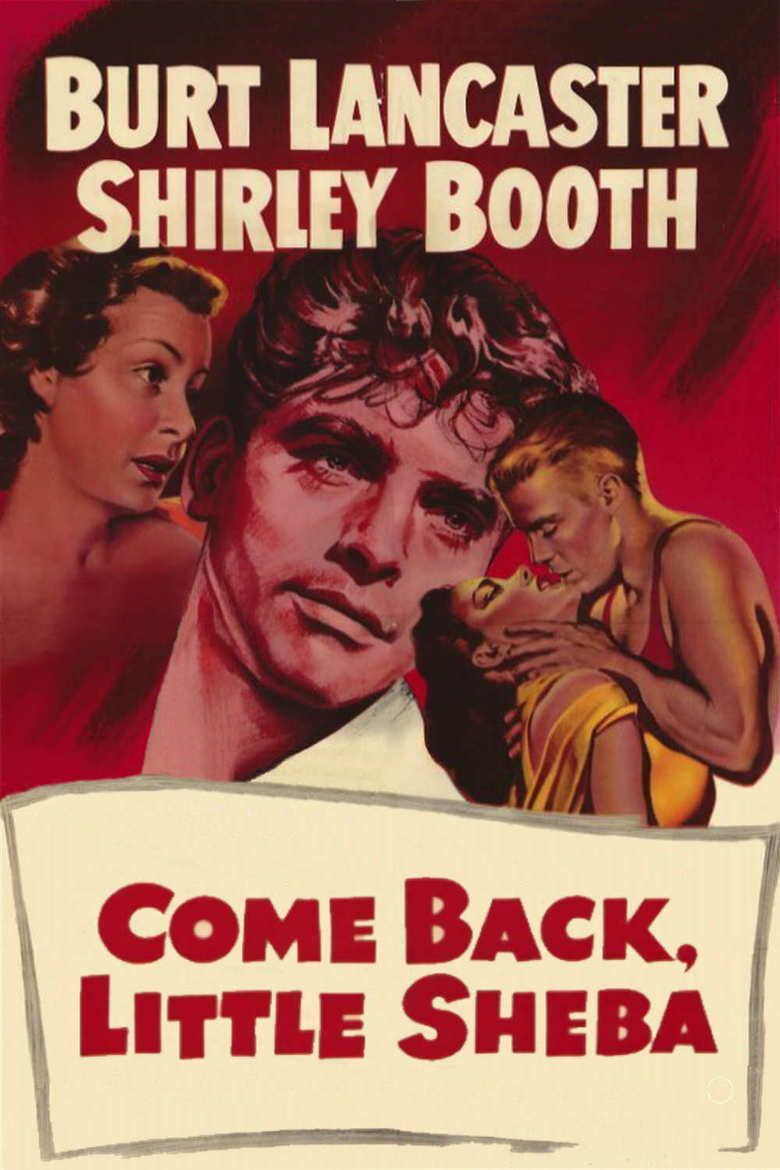
 Doc Delaney (Burt Lancaster) and his wife Lola (Shirley Booth) are a middle-aged couple that have been married for over twenty years. They’re a seemingly idyllic couple – they live in a quaint suburban home and lead a remarkably simple life. Doc is a chiropractor who is beloved by the community, and Lola is a charming housewife who always has a sunny disposition and refuses to budge from her perch of infectious cheerfulness, regardless of whatever challenges she has to face. Marie (Terry Moore) is a young university student who moves into their house, renting one of their spare rooms, which delights Lola, as she is happy to have another person in the house, especially someone younger, as she constantly yearns for her more reckless days of youth. However, Marie turns out to be the catalyst for the couple’s marriage slowly falling apart, the result of a deep-seated hostility they have left unaddressed for the duration of their marriage, and Marie’s presence reminds them of the past. Lola sees her as a surrogate daughter, revealing that she has been unable to have children since her previous pregnancy decades before resulted in a miscarriage, while Doc sees her as an object of desire, a reminder of his own younger days when he would woo young woman through his status as an eligible young medical student, which eventually dissipated as a result of the miscarriage thrusting him deep into self-destructive alcoholism. Lola and Doc work earnestly to remedy these surface-level challenges – Doc has been sober for over a year and has finally started to amass the reputation he had before his addiction drove many of his clients way, and Lola has been nothing but supportive. However, these attempts to rectify the flaws in their marriage only worsen with every day, the growing animosity between them pushing the spouses apart, forcing them to re-evaluate exactly what it is they want out of this seemingly-doomed marriage that neither one is all that invested in, for reasons outside of their control.
In looking at American filmmaking from the 1950s (which some would argue was the peak of the industry), I’m consistently surprised to see Come Back, Little Sheba constantly elided from discussions of the best films produced during that era, particularly in terms of those that carried considerably important messages. Daniel Mann’s achingly beautiful exploration of a disintegrating marriage isn’t just a showcase for its magnetic stars, but also one of the most fiercely complex glimpses into the trials and tribulations of ordinary people, which was an area that many films around this time were concerned with, in the years after the end of the Second World War, where domestic dramas were produced through the intersections of two different concepts: The first was the realization that the American Dream was inherently flawed, and no longer something to be celebrated. The second was the rise of cinematic realism, undoubtedly the result of the encroaching influence of Italian Neo-Realist cinema, which gave countless filmmakers the permission to not employ overarching narratives, but rather develop stories along with more authentic concepts. These two separate themes come together in Come Back, Little Sheba, one of the most heartbreakingly beautiful films produced during this era, and one that is defined almost entirely by its undeniable humanity, which Mann employs with such sincerity. Neither extravagant nor excessive, the film takes on a set of ideas that were not unprecedented for the time, but rather a result of more attention being paid to the lives of ordinary folk, making this one of the most quintessential fables of the Golden Age of Hollywood.
It goes without saying the end of the Second World War changed many aspects of life, especially in the socio-cultural sphere, and cinema was not spared from this seismic shift in how stories were told. Come Back, Little Sheba is a film that was produced at a time when art was not only used for entertainment but also a way of commenting on the societal issues around them. Mann and screenwriter Ketti Frings, in adapting a popular play by William Inge, puts together a compelling story of a marriage falling apart, mostly due to the inability to the couple to conceive a child and the eventual psychological fallout that occurs decades later, when they finally have to confront the past and address this difficult issue, amongst others. This line of narrative questioning immediately goes against the principle outlined by the Rockwell-esque concept of the ideal nuclear family, where this is the ultimate reward given to those who adhere to the socially-mediated beliefs of behaviour. The film challenges these ideas, going in search of something far more profound, which is done through an unflinchingly bleak portrayal of the marriage slowly falling apart, never sparing any detail without becoming exploitative, Mann ensuring that it navigates the extremely narrow boundary between heartbreaking and overwrought. Come Back, Little Sheba is not a happy film, but it has a rugged charm that makes it compulsively endearing, providing the audience with a fascinating glimpse into an ordinary family who are undergoing separate crises, and failing to resolve their own inner issues while genuinely believing that they can help the other. There’s an authenticity to this film that could only come from the unguarded belief in portraying reality as it is, rather than resorting to any kind of sensationalism, something that this film does extremely well.
What is most interesting about Come Back, Little Sheba is that it doesn’t start out as being a hard-hitting social drama in any way – at the beginning, we are led to believe Mann is showing us a very quaint story about a couple who have to overcome some small challenges, giving us a delightfully cheerful set of protagonists who are the epitome of the lovable middle-aged couple everyone should aspire to be. However, this veneer gradually unravels, as we watch this seemingly-ideal marriage unravel as a result of many factors – trauma, alcoholism, infidelity and other social misdeeds that were rarely spoken about in such frank terms before this, normally being restricted to disconcerting social fables that served to be cautionary more than they would harbour any sense of artistic or narrative merit – essentially, they were more concerned with the message than they were focused on giving audiences something more worth their time, especially for those not interested in self-indulgent musing. Come Back, Little Sheba is by no means the first impactful drama to look at any of these ideas – but it certainly was one of the most effective, coming at a time where a film like this, starring a revered stage actress and one of the finest actors of his (or any) generation at his peak, could tell such a heartwrenching story and not feel compelled to justify any of these actions. Its approach is unquestionably effective, and carefully grapples the line between uncompromising honesty and tense moralizing, resulting in an earnest investigation into the lives of two deeply damaged individuals working to pick up the fragments that remain, hoping to rebuild each other while failing to work on themselves.
In this regard, Come Back, Little Sheba is one of the best character-driven films of the 1950s, mainly because it manages to condense an immense amount of social commentary into the film entirely through a cast of only three principal characters. Burt Lancaster was already one of the nation’s great cinematic idols and proved that even when he was still at the height of his stardom, he actively pursued roles that would challenge him in ways many of his contemporaries outright rejected. Lancaster brought a different kind of masculinity to the screen, the kind that allowed him access to the set of conventions normally associated with what an ideal male figure should be, which he utilized in fascinating ways. Lancaster was not afraid to be unlikable – and through his deft ability to disappear into these roles, while never fully losing the quintessential, All-American charm that made him a star in the first place, is precisely why he’s one of the finest actors to ever work in the medium. Doc Delaney is a man weighed down by his flaws – he’s a recovering alcoholic who has yet to fully accept his addiction as being a problem, and who slowly undergoes a fall from grace that sees him abandoning his elegance and surrendering all the goodwill he has worked so hard to amass. Lancaster extracts every bit of nuance from the character and makes Doc a truly fascinating character that is far more than a tragic anti-hero, but rather a fully-formed individual. However, it is Shirley Booth who commands the screen – Come Back, Little Sheba serves to be her film debut, after a long career of treading the boards of various national theatres, and earning her place in the canon of great stage actresses, one of her most famous performances being the original production of this very story. Booth is just exceptional – she’s chipper and alert, and tender in her sincerity, which slowly gives way to a heartbreaking vulnerability that shows her as being someone who has failed to work through her own trauma, and has become hopelessly oblivious to reality. Booth is simply astonishing, giving a performance that is gradually a shattering experience, leading the viewers on an emotional journey that we can truly be invested in. Booth’s performance here is truly something to behold, a beautifully tender portrayal of an ordinary woman from an actress who manages to get under her skin in unexpectedly profound ways.
What stands out most is that Come Back, Little Sheba is a film about flawed people who are derided for their shortcomings, but rather the focus of a tender but honest study of the various obstacles they have to face, the film consistently refusing to villainize them or show them as anything other than ordinary people who have fallen on hard times, even if only psychologically. Neither Doc or Lola are all that likeable, having very different problems that cause them to be social outcasts – Doc is a miserable man on the verge of breaking down because of his failure to achieve anything and waste his life away, and Lola is a delusional woman who seeks to please everyone, being unconsciously stubborn to undergo some kind of introspection. They deal with their trauma in different ways – for Doc, it’s resorting to excessive drinking, which he blames for his failures, celebrates for his achievements. Lola deals with her losses and insecurities through channelling the past into her frequent cries for “Little Sheba”, her dog that went missing years before. This the heartbreaking emotional undercurrent of the film – the dog is a constant motif that persists throughout, being an embodiment of the past, haunting Lola and putting her on the verge of a breakdown, as she fails to work through the trauma, instead choosing to live in the false hope that everything will go back to normal eventually. Come Back, Little Sheba is not only an impactful drama but a poignant character piece that delves deep into the minds of its protagonists, who are complex case studies for trauma, with Mann deftly avoiding the archetypal exploitation that would normally be used to criticize such characters. The film takes a remarkably respectful approach, never being compelled into taking on a derisory tone, and even when they are at their lowest, the film seeks to infuse these characters with some chance of hope – this balance between tone and intention is precisely what makes the climax so terrifying, and the final moments so melancholic.
Come Back, Little Sheba is an exceptionally powerful film, a heartwrenching social drama that presents us with a very simple story, which it navigates with deft ease and unflinching honesty, a remnant of a time when the industry was no longer afraid to make films revolving around a particular message. There’s a poignancy to this film that truly encapsulates a particular period in artistic history but still remains incredibly resonant to the present moment. Bare, honest and unwaveringly human, Daniel Mann put together a quietly rebellious story of a crumbling marriage, not being afraid to present audiences with the stark, challenging truth, but also not abandoning the fact that there is always a chance for hope, and that cautious optimism, as difficult as it may be, is always worth holding onto. Beautifully-composed and interpreted with wonderful sincerity by Burt Lancaster and Shirley Booth, both of whom are utterly spellbinding, Come Back, Little Sheba is an incredible achievement in many ways. It is rarely ostentatious, and frequently truthful to the point where it becomes somewhat disconcerting, this is truly a film worth celebrating, and one that I’m readily proclaiming a masterpiece of Hollywood realism, a movement that has rarely been given the respect or attention it warrants. Poetic, brimming with emotion and soaringly beautiful in a multitude of ways, Come Back, Little Sheba is an exceptional work of the Golden Age, and one of the most honest films produced during this era.
 The Postmodern Pelican
Only nine actors have won an Oscar for the screen adaptation of their Tony winning performance. More interestingly it was a phenomenon that primarily occurred in Broadway’s Golden Era. In a quarter century (1947 – 1973), eight of the nine actors pulled off the feat. Shirley Booth was the first woman. After playing 190 performances of William Inge’s domestic drama of spousal abuse and alcoholism, Booth landed the Tony for Best Actress in 1950 and the Best Actress Oscar in 1953.
The celebrated, over 50 year old actress made her film debut after the producers first approached Bette Davis who declined the role of slovenly housewife Lola Delaney. Lola squanders her day in her modest house while her alcoholic husband works as a chiropractor. To generate extra income, Lola decides to rent a room to a local co-ed. Booth has played 190 performances on Broadway and was comfortable in the slack robe that sagged and gaped, revealing her lumpy body. This was not a glamorous role, but it was a tour de force for the actress.
When Booth landed the role, producers didn’t trust her stage costar and fellow Tony winner Sidney Blackmer. They sought a big name costar to assure a larger box office. The honchos foolishly settled on the popular star, 38 year old Burt Lancaster. Wally Westmore, of the famed family of six brothers who all became noted Hollywood make artists, streaked white into Lancaster’s shiny black hair while Edith Head dressed the actor in baggy clothing in a foolhardy effort to mask his athletic frame. Critics and audiences were not fooled. Most noted how badly he was miscast and unable to play believably the markedly older husband of Booth. In a remarkable example of concentration, Booth simply ignored Lancaster. She played the role of Lola as movingly and vividly as she had on stage despite her scene partner’s inadequacies. Critics threw their hats in the air and Booth won the wealth of film acting prizes for the year.
How does one judge a virtuoso performance opposite a badly played role? Clearly some suspension of disbelief is lost in such a situation. For me, it reduces the effectiveness of Booth’s work. Of course, Booth’s triumphant work suffers further in comparison with later, better cast productions. Joanne Woodward played Lola opposite Lord Laurence Olivier in a television film. Broadway revivals starred the great Shirley Knight as well as a more recent revival with the noted African American actress S. Epatha Merkerson.