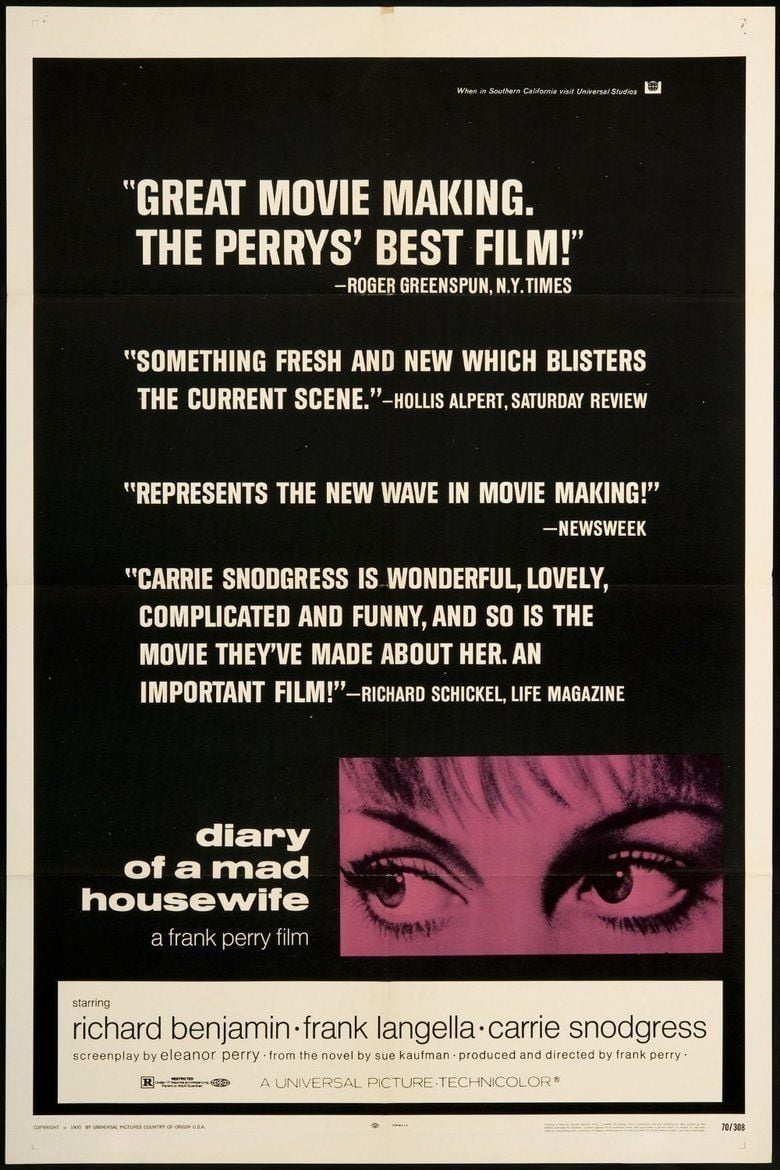
 Tina (Carrie Snodgress) is a mild-mannered New York housewife who dotes over her husband, Jonathan (Richard Benjamin), who returns her nothing but abusive “tough love” for her minor foibles, and constantly pushes her to be the ideal woman, rather than taking into account her own individual feelings, which he clearly sees as secondary to his own self-indulgent needs. At first, Tina is complacent, adhering to Jonathan’s demands like a good wife – however, this all changes when she meets George (Frank Langella), a young writer who makes up for his callousness with an intense passion that Tina simply cannot ignore. They begin a torrid love affair, becoming intertwined into each other’s lives, while still staying at a distance, keeping their romance (or rather, what Tina sees as a romance) far from public view, as they both lead lives that would be considerably changed should they let the rest of the world know their secret activities. However, this is one a small step towards Tina’s liberation – she gradually unravels, becoming a very different woman, for better or worse. She is finally able to stand up to Jonathan’s abuse by staking her own claim in the marriage, and begins to see the world in a radically different way – her repression has embedded a sense of fury in her that she never realized was there, and serves to be the catalyst for her decision to unleash quiet havoc on a world that has pushed her down one too many times – and like all of those around her that expected only the best, Tina is adamantly refusing to take any rejection or malicious criticism, especially not from the very people who demeaned her in the first place.
Frank Perry’s mind was an unusual place, as evident by his various masterpieces that grapple the fine line between the pioneering days of American independent filmmaking and New Hollywood, two artistic movements that owe a great deal to Perry, but rarely dare to pay him the tribute he deserves. As was the case for many of the director’s work during this time, credit is also shared with his wife, Eleanor Perry, a screenwriter who was often the mind behind some of his greatest work. Diary of a Mad Housewife is one of their most significant collaborations (as well as their last), not least because it was one of the first in a string of 1970s films about female rebellion against the patriarchy, at a time when such subjects were not new to the artistic zeitgeist, but far from as noticeable as they would become in the coming decades, inextricably linked to the rise of second-wave feminism. Unquestionably a film made for the primary purpose of starting a conversation, Diary of a Mad Housewife has divided audiences for fifty years now and continues to be one of the most polarizing looks into heteronormativity ever put on film. The Perrys made something so beautifully deranged, a series of provocations of form and content that work to question seemingly sacrosanct on numerous different levels, and managed to be outrageously entertaining amidst the deeply serious commentary it presents. Not always as potent as it thinks itself to be, but noteworthy as both a piece of early feminist filmmaking (despite being directed by a male filmmaker) and as a remnant of an era where such artistic rebellion was starting to become a prominent part of Hollywood at the time, Diary of a Mad Housewife is a compelling work that is as shockingly perverse as it is outrageously irreverent, which is always a winning combination for such immensely interesting satires.
Diary of a Mad Housewife takes the form of a fascinating melodrama with an acidic edge, employing a wry sense of humour to a very bleak story, which may seem commonplace in an artistic landscape that has films like The Stepford Wives and Jeanne Dielman, 23, Quai du Commerce, 1080 Bruxelles – but its important to note that one of the pioneering works into this field of delivering a certain social message through a much wider platform was the present film, with Eleanor Perry writing one of the most subversively dark satires about domestic rebellion produced in the 1970s, a decade where such issues began to be embraced. Naturally, this isn’t the right platform to go into a deep discussion into the various fascinating crevices of feminism during this time, particularly because the idea of praising a film like Diary of a Mad Housewife is not the right place. However, we can easily note that Frank Perry did exceptionally well in realizing the vision his wife established in her remarkable screenplay, itself an adaptation of a novel by Sue Kaufman, and through the fiercely committed execution of some bold ideas, the Perrys managed to make one of the most profoundly moving films of its kind, a work of unbridled, darkly comical despair that functions as a massively successful foray into the hearts and minds of a woman who, quite frankly, has had enough with being at the bottom of the cultural ladder, and is anxiously awaiting the chance to inch closer to the top, overcoming the challenges put there by both those in her immediate circle, whether her own family or the various peripheral figures in her life that consistently push her downwards. Like we’d logically come to expect, Diary of a Mad Housewife is mostly focused on her internal crises as she attempts to work her way out of her position of being socially objectified, but with some added nuance that could only come from filmmakers who always had something to say – which is perhaps the best way to describe Eleanor and Frank Perry and their cinematic careers.
Carrie Snodgress was an actress who worked in relative obscurity for the majority of her career, with Diary of a Mad Housewife being her first role of significance, other than a brief uncredited appearance in Easy Rider and a few disposable supporting roles on television, and thus was intended to be a performance that would allow her to break through into the mainstream – and judging by the quality of her performance, she certainly deserved it. However, while she didn’t manage to use this film as much of a platform to bolster herself to the status of the next major star, Snodgress was able to establish herself as a character actress capable of a level of complexity missing in many starlets around this time – New Hollywood did offer women better opportunities, but very rarely did we get films told from the woman’s point of view unless they were characters of note. An entire film about a housewife defying her privileged suburban life and going in search of deeper meaning despite living an apparently ideal life is still a subject that persists as being quite radical, especially when the story hinges on her own inner quandaries, rather than anything tangibly difficult. This is exactly what makes Diary of a Mad Housewife such a successful film since everything about it seems to pertain to a lot of what the Perrys did when it came to female characters in many of their films – they presented them as ordinary individuals that didn’t need to live challenging existences in order to warrant being the focus of a film like this. Snodgress does so well in working within the confines of the character, always bursting with either enthusiastic devotion or unhinged madness wrought from her realization that there is a world beyond their apartment, waiting for her to explore. It’s not surprising that her performance is cited as one of the defining moments in feminist cinema, as even when the film itself is somewhat uneven, Snodgress pulls through with a truly compelling, heartbreaking portrayal of a woman who yearns for something more, and will go to any lengths to get it, no matter the cost or consequences involved in pursuing a better life.
Following on from their astonishing coming-of-age drama Last Summer, which took an insightful but harrowing look into the lives of privileged young people exploring their sexuality, the Perrys ventured into different territory, providing us with an equally dark tale of suburban malaise, told from the perspective of a woman who is tired of her position in life. This results in an achingly funny film that carries an immense amount of depth, which would be difficult to convey without defaulting into either overwrought melodrama or flippant dark comedy. Interestingly, instead of avoiding these polarities, Diary of a Mad Housewife embraces them and employs both qualities into their gloriously deranged voyage into the mind of an unstable woman looking for a better place in life, both physically and emotionally. The filmmakers don’t spare any expense in terms of realizing their vision – and Snodgress benefits from having a small but dedicated supporting cast to bolster the story and give her more to work with. Richard Benjamin plays one of the most despicable characters of the 1970s, the rare villain who is abhorrent not through evil deeds but rather based on his general ambivalence to anyone other than himself. Sharply contrasted with Frank Langella, who is incredible as the tortured writer seeking his own salvation from his own banal existence, believing that an affair with a married housewife will inspire him enough to satisfy his need for artistic validation and inspire him to be more than just a peddler of verbose misery. There’s a complexity to this film that doesn’t come around all that often, but which is evoked with such sincerity, being the product of the collaboration between a writer who is able to infuse a screenplay with a meaningful story that transcends boundaries of fiction, and a director with a very particular vision to realize these ideas.
Diary of a Mad Housewife is a very layered film with an immense amount of nuance brought to it by two creative individuals who saw their collaborations resulting in some memorable forays into the mind of complex characters. While it may not be Perry’s finest work, and only notable for its astoundingly successful leading performance from the extraordinary Carrie Snodgress, Diary of a Mad Housewife is an undeniably potent satire that feels entirely authentic, even at its most melodramatic, where the heightened emotions are restrained enough to not envelop the entirety of the film. Its a wonderfully buoyant film that feels far more complex than others produced during this era, being made at the precipice of a movement that would define artistic representations of women in the mainstream. There had been countless filmmakers across the world that had been advocating for this kind of inclusion and insightful discussion, and while it may not be the most flawless of them, Diary of a Mad Housewife is certainly one that incites a fascinating conversation into gender roles, during a period in which this kind of commentary was extremely timely, persisting in various forms to this day. The Perrys made a truly compelling feminist manifesto that isn’t weighed down by its shortcomings, whether it be tonal inconsistencies or rushed storytelling at some moments, and thrives on its fierce independence, anchored by one of the most ferociously compelling performances of the 1970s in Snodgress, who gives everything to a character that could have easily been nothing more than a flimsy archetype. Diary of a Mad Housewife is a fantastically compelling film, and worthy of every bit of effusive praise it has developed, albeit in much smaller circles. If there is any film worthy of rediscovery for modern audiences, there is very little doubt that it is this one.
 The Postmodern Pelican