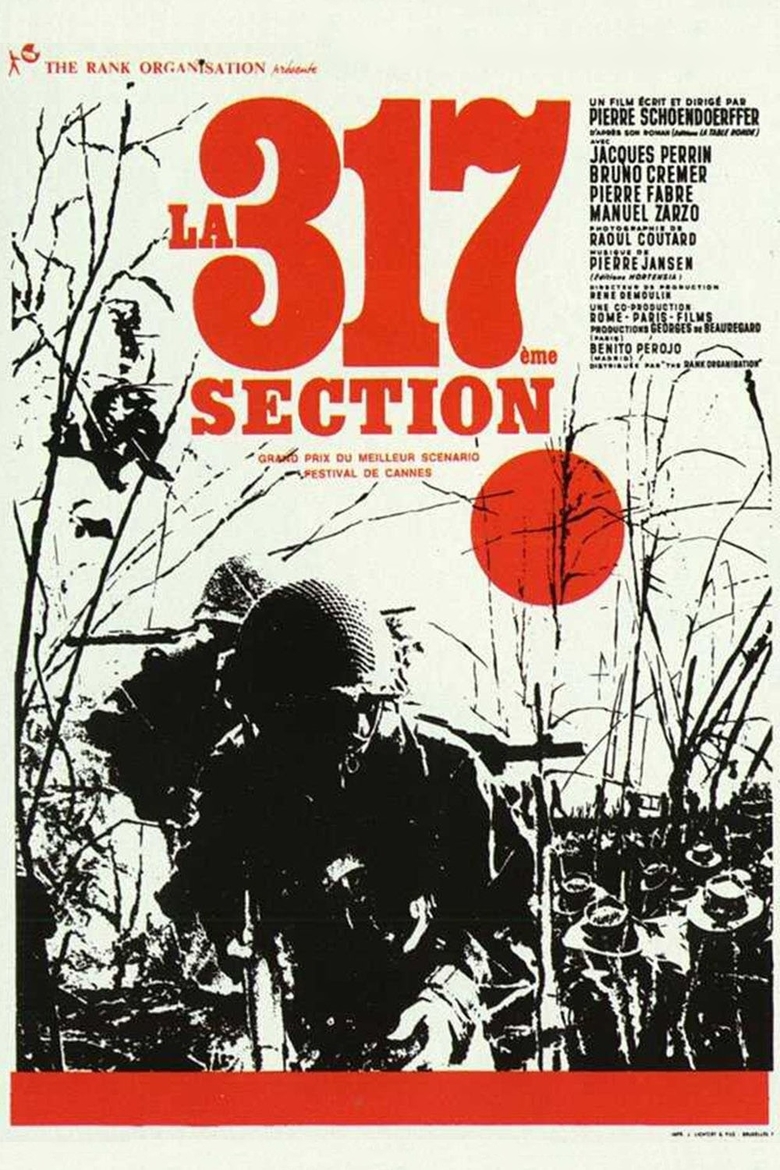
 When commenting on the process of making The 317th Platoon (French: La 317ème section), writer and director Pierre Schoendoerffer mentioned how he intentionally set out to create a brutal atmosphere, as “a war film should not be made in comfort”. At first, it appears to be somewhat egomaniacal for a director to impose such a strict regime on his cast and crew in the process of making art – but the approach gains credibility when we realize how Schoendoerffer was working from a place of experience. Adapting his own novel of the same title, which was in turn a literary elegy of his time fighting in the conflict between France and Indochina in the 1950s, where he was a prisoner of war, and witness to the various atrocities committed by both sides of the conflict. Films about war are often a dime-a-dozen, but there are occasionally those that capture something truly special, even when they aren’t particularly pleasant. The 317th Platoon tells the story of a renegade group of French soldiers who are tasked with venturing to safety across the Vietminh territory, finding themselves meeting many obstacles, some of them expected, others coming as great surprises. Schoendoerffer was clearly operating from a place of immense understanding of the ravages of war, and as a result puts together one of the most powerfully simple explorations of armed conflict ever committed to film, the kind normally hailing from someone who had the knowledge or experience to make these stories work, and the willingness to go to any lengths to portray them with honesty, never falling victim to the tendency for the war film to be overwrought, indulgent affairs, and instead keeping everything remarkably simple, which means more than anything else in portraying the truths of war.
The 317th Platoon may be a challenging film, but its certainly one of the better entries into the war genre, which has often struggled with a variety of narrative and stylistic problems – overwrought use of emotion, an emphasis on the spectacle, and often treacly approaches to the subject matter. Schoendoerffer overcomes these challenges with this film by putting together something truly compelling, while still quite remarkable in its lucidity and simplicity, which automatically sets it apart from many other war films that aren’t nearly as worthwhile as this. It is not a film that gives the viewer much to work with from the outset – a bare, gritty war drama with an absence of a score (other than the chirping of crickets and the rustling leaves in the jungle wind), and filmed entirely in black-and-white (which gives it a very bleak appearance), The 317th Platoon is quite an austere affair, but one that does prove to be entirely worth the patience, as there are moments of unprecedented beauty that occur between sequences of unhinged terror, and which deserve to be noted as some of the most fascinating insights into the horrors of war, told from the perspective of someone conveying his own experiences, putting together a thrilling story of bravado, courage and working through the immense pressure of not knowing what lurks just out of sight. There is something about the way Schoendoerffer composes this story, gradually moving away from the insincerity that many bolder war films tend to demonstrate in exchange for the spectacle of portraying what many believe war to be like, and instead finding a more earnest approach that works spectacularly well, especially when we realize how immensely successful this method of telling a bare, stark story is when we are fully engrossed in its remarkable vision, and where the discomfort of witnessing such a difficult portrayal of wartime travail becomes entirely worthwhile when we take into account how sincerely the director attempted to create something authentic.
The 317th Platoon is a very effective film, which it mainly accomplishes by the means in which Schoendoerffer keeps everything at the fundamentally human level. The film doesn’t possess a very complex story – a group of soldiers venturing across hostile territory and encountering a number of challenges is hardly revolutionary, yet through the director’s unique vision and understanding of what such an experience would be like, it becomes entirely enrapturing, a dark and brooding tale of war, which demonstrates that there are no heroes or villains on either side – war has victories, but lacks victors. The wounds of war are permanent – some will find themselves perishing in the humid jungles, whether from their injuries, disease or starvation, while others will carry an immense emotional load that is not easy for anyone to bear, especially not the young people forced into a war they don’t agree with. Far from a “message film” in the traditional sense, The 317th Platoon is a very bleak film that carries a truly simple story, never attempting to be anything more than what it promises at the start, and remaining true to its particular vision throughout, being earnest and simple, but also challenging many of the themes it upholds in a way that prevents it from being either dour or flippant about the issues. Its a film about survival more than it is about winning, which tends to become conflated in the minds of soldiers, the ultimate message of the film. For many people, simply making it from one day to the next is an immense victory, which Schoendoerffer portrays with such sincerity, never wavering from the earnest roots of his fascinating character-study that just so happens to take the form of a war film.
The authenticity of The 317th Platoon is what makes it so thoroughly effective. Produced on a shoestring budget, without necessarily demonstrating its constraints, the film is rooted in social realism, being one of the most harrowing portrayals of war, which is interesting considering how it tends to avoid violence for the most part, using it when it is necessary, and as a tool to communicate a particular message, rather than building the entire story around scenes of combat. Executed with documentary-style realism, the film feels entirely authentic, which is mostly derived from Schoendoerffer’s decision to not glamourise his experiences, but rather emphasize what he endured, providing immensely powerful insights to a film that entirely benefitted from such a fascinating approach. There’s an intimacy to this film as if Schoendoerffer’s intentions were to give us unfettered insights into the mind of a set of complex characters who are navigating difficult terrain and simply attempting to survive. Their inner quandaries, normally revealing themselves at moments of quiet vulnerability, convey a sense of psychological nuance that are often missing from even the most sincere war films. Ultimately, the film works best when it is at its most straightforward, which is mercifully a regular occurrence throughout, with the director constantly opting for something that compensates its smaller scope with genuine emotion.
Making something personal is always a major merit for any director, so for Schoendoerffer to produce The 317th Platoon with such honesty is enough to warrant this film’s entry into the canon of great wartime films – and considering it was produced in the middle of the war in Vietnam, there’s an added element of reality brought to it by a director whose insights are simply too immense to ignore. One can view this film in many different ways – as a gritty masterpiece that stays very close to the reality of the situation it depicts, as a wonderfully unique work of social commentary that is more concerned with capturing a particular set of ideas, rather than being a broad spectacle, or simply as a testament to a harrowing time in the world’s history, built from the foundation of a director conveying his own invaluable experiences, sewing them together in a beautifully sincere and honest way, while managing to leave a lasting impression based on the might of the story. Some have referred to The 317th Platoon as something of an instructional text to the horrors of war – and while it may not be as haunting as films like Come and See and The Ascent, it certainly makes an equal impact in its honesty and quiet ferocity, which could only be derived from someone who was imparting his own first-hand account of the themes the film depicts. Its a truly mesmerizing work, executed at a measured but compelling pace, and one of the most enduring war films made during this era. There’s a lot of meaning to be unpacked in The 317th Platoon, and while it certainly may not appeal to everyone, it does manage to be as authentic as possible, and even if one doesn’t particularly enjoy war films, this one goes very far in stating the case for these kinds of films as effective social and cultural statements in their own right.
 The Postmodern Pelican