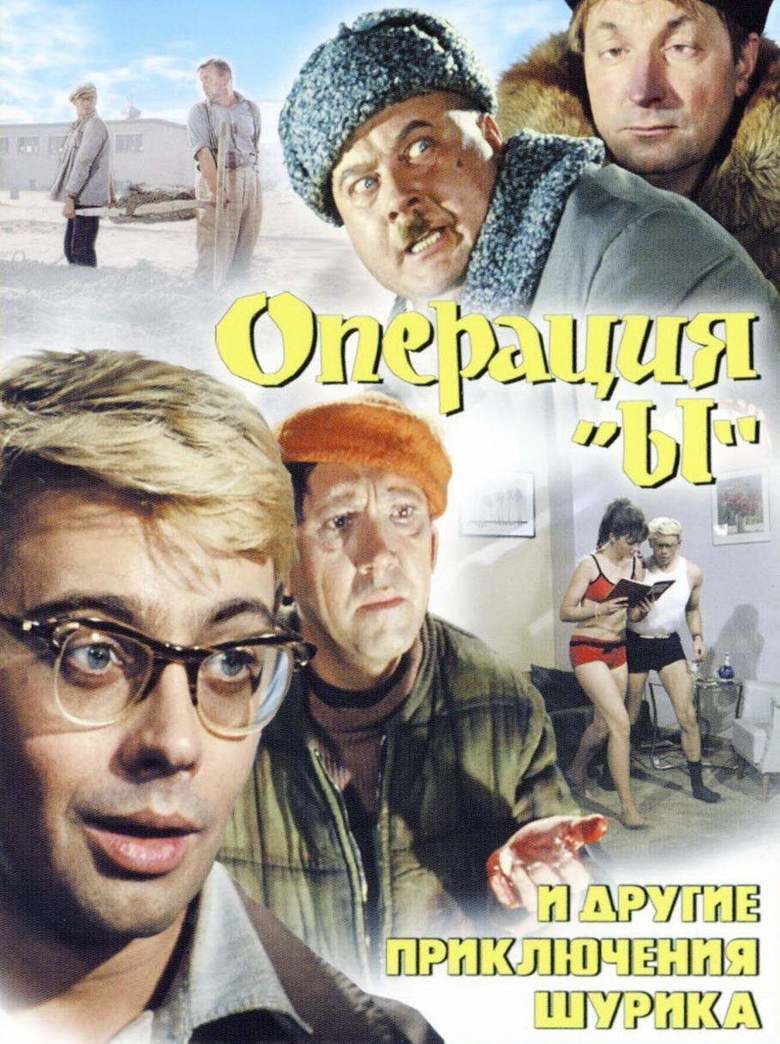
 There’s something quite wonderful about Operation Y and Shurik’s Other Adventures (Russian: Операция „Ы“ и другие приключения Шурика), a quality that appeals to my interests a lot more than I thought it would. I’ve been gradually exploring the depths of Soviet comedy over the past few years, finding a balance between the many defining masterpieces and hidden gems that were produced during the height of the socio-cultural conflict across the union during this period, with the 1960s bringing out some of the most potent commentaries in twentieth-century art. Recently, I’ve looked beyond the comedy of rebellion and defiance, and began exploring comedy from the other perspective, the films produced and endorsed by the authorities, rather than those banned and subjected to rousing calls to be banned. Perhaps not pro-communist in the way some may believe them to be, films like Operation Y and Shurik’s Other Adventures are marvellous forays into investigating the period from the perspective of the artists who were encouraged to portray life in the Soviet Union in positive, exciting ways, rather than the dour and bleak landscape that many believed it to be, particularly those suffering under the social system. Films like this have cultural relevance, even if we just view them as partially propagandic remnants of a bygone era – so imagine the joy at discovering that not only was Operation Y and Shurik’s Other Adventures a fascinating attempt to capture the apparently positive aspects of the era, but also a thoroughly delightful comedy that is outrageously funny, wonderfully-constructed and an incredibly potent piece of Soviet-era humour that transcends the intentions and remains one of the most refreshingly funniest films I’ve seen in quite a while.
Operation Y and Shurik’s Other Adventures is composed of three short stories or “novels”, all centred around the character of Shurik (Aleksandr Demyanenko), a well-meaning, but meagre, young man of numerous professions and interests. At one point, he’s a manual labourer at a construction site who is the victim of a brutish bully (Aleksei Smirnov) who is out to make him pay for his indiscretions brought on in a moment of chivalry, and in the next a student who can’t decide between his priorities, having to choose between passing his final examination or starting a relationship with a mysterious girl (Natalya Seleznyova) who is equally as beguiled by his idiosyncratic charms, but who is also in pursuit of a passing grade. Somehow, Shurik shows himself to be both a meek nebbish who runs away from danger, and a dashing hero who actively pursues it, and whether fighting against a vulgar boor, a gang of criminals (Yuri Nikulin, Georgy Vitsin and Yevgeny Morgunov), he finds himself taking on the responsibility of saving the day, especially when it is clear no one else is willing to. In the midst of all of these misadventures that he inadvertently finds himself thrust into, whether by his own absent-minded nature or the insistence of other characters who aren’t aware of the chaos they are close to inciting, Shurik continues to pursue the simple life he envisions, one where he can live happily ever after – but the various comical situations he finds himself involved in a radically different story.
There are several aspects that set Operation Y and Shurik’s Other Adventures apart from other similarly-themed Soviet comedies, one of them being the approach to the humour, and the ways in which it was employed to tell the story. The film was directed by Leonid Gaidai, who previously made the incredibly funny Ivan Vasilievich Changes Profession, a buoyant science fiction comedy that blended hilarity with subversive social commentary in a way that didn’t make its political leanings a subject of the story in any way. The same could be said for this film, whereby Gaidai, in adapting several fragments of literature he encountered over the years, made something riotously funny without being compelled to lead the viewer in one particular direction. At first, you’d be led to believe that a film like this exists as a means of convincing viewers that life was not nearly as bad as it was perceived in the Soviet Union, but as the layers of Operation Y and Shurik’s Other Adventures begin to unravel, we see how this is simply a work of unmitigated entertainment, a distraction of a film that carries very few, if any, ulterior motives other than attempting to provide audiences with homegrown comedy that is authentic and enthralling, without needing to resort to commenting outright on the merits of the political system. Gaidai’s ability to avoid the pratfalls that come with satire, and instead deliver something that can stand independently of any cultural context, is perhaps the reason why Operation Y and Shurik’s Other Adventures is such a rousing success – and not only is it entertaining, its quite revolutionary, especially when hailing from a country that is rarely celebrated for its unique approach to comedy. Gaidai achieved something very special with this film, and even if we detach the more serious elements that surround it, we can find a tender, funny comedy that is truly captivating in so many different ways, particularly in how it manages to be so much bolder than a lot of other films produced during this time.
Something that has been made abundantly clear throughout my exploration of comedy across different genres, eras and cultural contextual is that we can divide humour into so many different forms, but one that remains timeless and overcomes every boundary is that of physical comedy, which is unsurprisingly where film started, with some of the earliest examples of beloved entertainment hailing from the silent-era work of the likes of Buster Keaton, Charlie Chaplin and Harold Lloyd, amongst many others that incited a genre that would become one of the most beloved in history. Slapstick comedy is timeless – the experience of seeing foolish heroes and cartoonish villains in well-meaning conflict is something that everyone can relate to in some way, and which is the precise reason why it’s not out of the realm of possibility to call the work of Gadai some of the most influential in European cinema. A director who realized the merit of physical comedy, he crafted some truly memorable pieces of cinema that may have been made over half a century ago, but are just as breathtakingly funny today as they were back then. Whether it be in the cross-cultural merits of wordless interactions, or the simplicity with which these films seem to be executed (which often conceals the fact that putting together such films are an immensely difficult experience – it takes a lot of hard work for something to appear this silly). Operation Y and Shurik’s Other Adventures is wonderful for many reasons, but the fact that it seems to be able to not only capture the effectiveness of physical comedy in binding groups (which many of the more on-the-nose Soviet satires understandably dismissed in favour of something more complex), but also condense it into smaller, more manageable segments is exactly why it works so well, and allows it to remain incredibly potent, not showing any of the traditional signs of ageing in the way the majority of comedies produced around this time tend to display.
While most Soviet-era comedies attempted to capture the zeitgeist of the period and present it in a way that makes a statement, some of the most powerful ones, in this case Operation Y and Shurik’s Other Adventures, were those that approached more common subjects in a way that didn’t limit themselves to that particular moment. The challenge with making satire is that it ages instantly, and while this kind of art tends to be fascinating when considering them as relics of the past, and can evoke many insightful discussions into expression during the era, they don’t hold much credence when it comes to entertainment on its own, which is where this particular film really does stand out. At first, it’s almost bewildering that a film that’s entire plot can be summarized as “the misadventures of a shy young student” managed to be as charming as this, but as we gradually find ourselves ensconced in Gadai’s wonderfully quaint vision of Russian society, as channelled through the escapades of a lovable protagonist, it makes perfect sense. Taking into consideration how this film could’ve easily faltered, whether it be through lazy attempts at humour (even at is most absurd, there’s a certain elegance to how Gadai realizes the vision) or general incompetence with telling a story, there’s even more cause to celebrate Operation Y and Shurik’s Other Adventures as a bona fide masterpiece.
This doesn’t mean that there isn’t depth to the film – something that becomes increasingly clear the further one ventures into comedy from different periods and locations is that no genre represents a culture like comedy. You can tell a lot about a country by the methods they used to make their people laugh – and as seen through the lasting impression made by this film, Gadai managed to make something. Operation Y and Shurik’s Other Adventures is a lighthearted romp that possesses one of the most admirable qualities that any comedy could have: it doesn’t take itself too seriously, while still endeavouring to give the audience an enrapturing experience along the way, being composed with poise and skilful nuance, which makes for a truly compelling experience. Its a very simple film, and functions as little more than a series of entertaining vignettes that are defined less by their coherency, and more by their general intention of being as fun as possible, which is ultimately worth more than anything else. The heart that Gadai brought to this film, combined with the technical mastery that went into the making of it (there are some sequences in this film that may not be particularly innovative by today’s standards, but are still quite ambitious, particularly in the comical choreography applied to the story), makes Operation Y and Shurik’s Other Adventures one of the funniest films of its kind, and a true delight in every way.
 The Postmodern Pelican