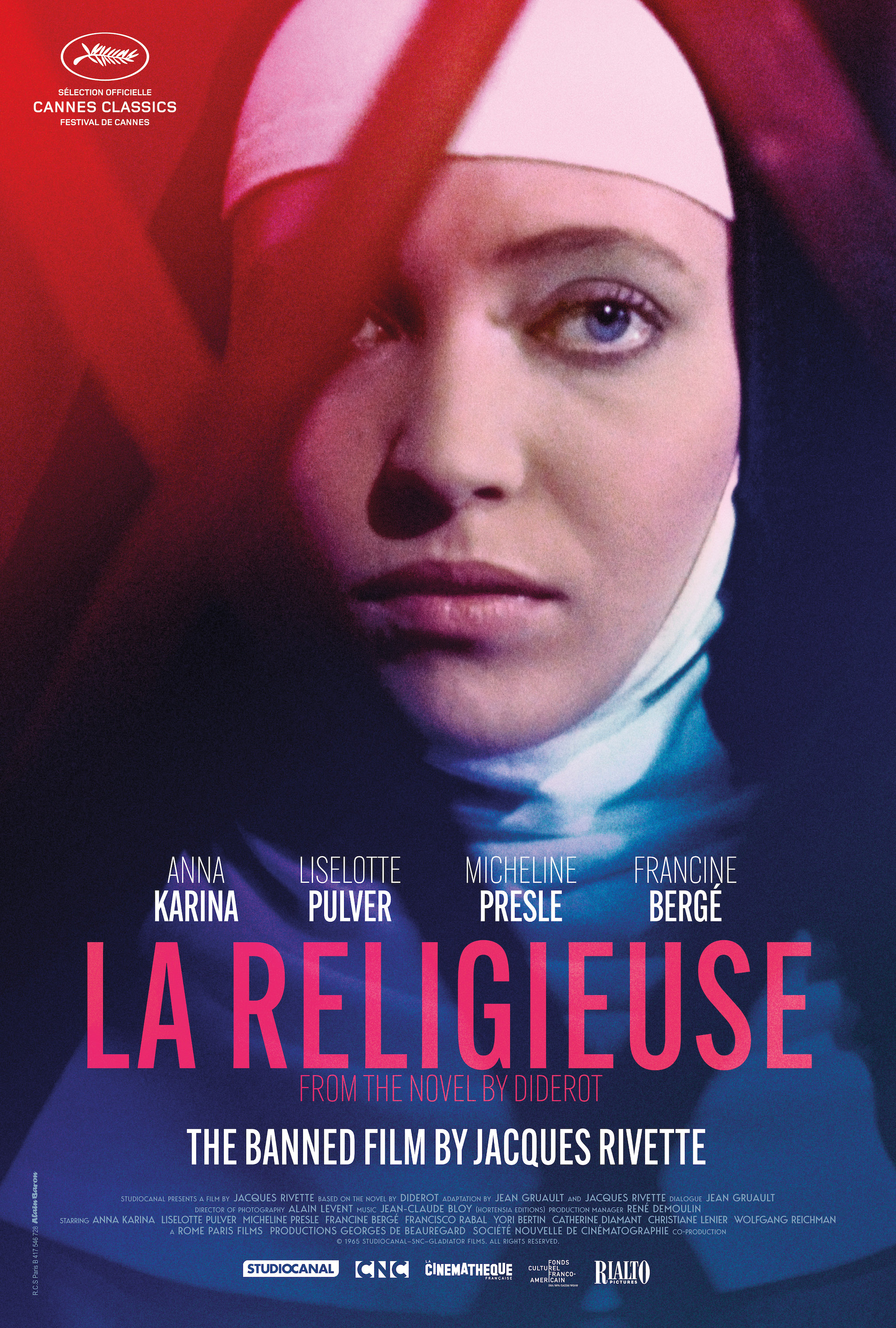
 In the mid 18th century, Suzanne Simonin (Anna Karina) is a mild-mannered young woman from an affluent French family is forced into the nunnery after her mother reveals that she was not conceived by the wealthy man she has been led to believe is her father, but rather an anonymous man of lower status who has since died, and it is only a matter of time before her infidelity is found out. Her mother, fearing that the truth will be revealed eventually and dismantle the family’s reputation, decides that a convent is the only place where her daughter (or more importantly, the secret she carries) will be safely guarded from the rest of the world. Fiercely defiant in her refusal to enter into a life of religious obedience, Suzanne makes it known how this is against her will – initially, the Mother Superior, Madame de Moni (Micheline Presle), is sympathetic and helps the young woman make the best of the situation. However, the abesses’ eventual death soon after prompts the rise of another Mother Superior, Sister Sainte-Christine (Francine Bergé), a vicious older nun who is not nearly as pitiful of Suzanne’s plight, choosing to rather assert her dominance, which begins with a gradual degradation of the young woman’s dignity, removing the few comforts she has, and eventually turning the entire convent against her, leading them all to believe that she is possessed by unholy spirits. Escape is impossible for Suzanne, who appeals to anyone who will listen – and while her tenacity does pay off, and she manages to acquire a transfer to another convent, she finds that she’s confronted by a new set of problems, particularly on behalf of her new superior, Madame de Chelles (Liselotte Pulver), whose friendliness is eventually revealed to be motivated by ulterior motives.
The story of Suzanne Simonin, as told by Denis Diderot, is one of the more tragic tales in 18th-century literature. His influential novel was turned into a compelling film by Jacques Rivette, carrying the same simple but evocative title of The Nun (French: La Religieuse), who was making only his second film with this adaptation. It’s important to note from the outset that The Nun is certainly not a film without its flaws, especially when considering its hailing from a director who would go on to define arthouse cinema in his own unique way, with films like Celine and Julie Go Boating and Duelle being films that rekindled in me a unique sense of artistic wonder that very few works are able to do, which is certainly applicable to many devotees to one of the finest filmmakers to ever work in the medium. However, while it is not his most revered work, The Nun is a film that carries an immense amount of merit, both for its unique approach to a narrative (with Rivette proving that he was the master of metafictional filmmaking) and its gorgeous visual style, which converge into a thoroughly memorable religious drama that may not always overcome some of its minor problems, but is just as fascinating as anything the iconoclastic director did subsequently. The film is an elegant, character-driven drama that carried broad overtures of psychological thriller and claustrophobic horror, but Rivette keeps everything in order, to the point where the film doesn’t become a victim of a genre that often lends itself to lurid explorations of desire, being a sophisticated, but incredibly riveting, tale of despair and religious strife that comes together to form one of the more haunting looks into Catholic dogma, from a fundamentally subversive, and often highly inventive, directorial perspective.
Rivette had a talent for many different aspects of filmmaking, but one area that he was truly dominant in was extracting memorable performances from his cast, especially his actresses, who he always gave the most fascinating material, making his films quietly revolutionary in how they approached female characters as far more than just the objects of desire that were often predominant during this era. The Nun is a text that facilitates some interesting character work in terms of the major figures in the story – and the director puts together a remarkable ensemble that interprets the novel with depth and integrity, managing to be entirely compelling. It could be said that one of the few aspects of the film that doesn’t falter in any way are the performances, which is certainly very true, particularly in regards to the central role of Suzanne Simonin, who is played by one of cinema’s most magnificently enigmatic stars, Anna Karina. The character is one that needs to run the gamut of emotions – from rebellious to filled with despair, and eventually hesitant ease as she resigns to her fate, while never quite abandoning her inner conviction to fight against those who are forcing her into the position of subservience. Karina embodied all the elements of an actress capable of this complex work – her incredible expressivity, coupled with her deft ability to navigate any particular range of emotions with what appears to be complete ease made her the perfect candidate to bring Suzanne to life. She’s a victim, but not necessarily a complacent one, and even when the character is at her lowest, Karina employs a visceral tenacity that is unwavering and lingers with her until the chilling final moments.
Contrasting Karina throughout the film are the three women playing the various Mothers Superior she encounters in her time as a nun – Micheline Presle is the spirit of candour as the sympathetic Madame de Moni who takes in the young woman and helps her assimilate into the culture of the convent, knowing that she can’t help her escape by allowing her vows to be absolved, but can at the very least make her journey towards what she hopes will be an eventual religious awakening somewhat bearable. Her death is one of the film’s most heartwrenching moments, and the last glimmer of hope in what is an exceptionally bleak work. This is until Liselotte Pulver makes her entrance at the beginning of the third act, serving as the film’s sole source of comedic relief – someone who does not confine herself simply to the strict standards of religious life, but prioritizes the human aspect of what is shown to be a vocation in which one’s individuality is disregarded, her Madame de Chelles brings a lot of heart into the film. This is until she reveals herself to have ulterior motives, asserting dominance over Suzanne as a way of hopefully convincing her to engage in temptations of the flesh with her. However, it is Francine Bergé who leaves the most lasting impression – taking the largest portion of the film for herself, she stands toe-to-toe with Karina as the malicious Sister Ste. Christine, who forces her way into power, and chooses the newest addition to their order as her exemplifying victim, a demonstration of her strict beliefs that border on unhinged madness. There’s a simmering malice underpinning Bergé’s performance, but one that doesn’t convey her as a villainous caricature – she’s uncompromisingly human, and the moments in which her depth is shown are some of the film’s most effective. While focused on Suzanne, Sister Ste. Christine is the film’s most interesting character, and the actress brings her to life with incredible effectiveness, embodying the institution in a terrifying, but inextricably human, way.
Religion is often a very challenging topic to bring to a film, particularly when you’re working from a text written hundreds of years prior, where the socio-cultural mentality was radically different, and religion played a fundamentally different role in the lives of the general public. Rivette had the difficult task of not only venturing into Diderot’s complex text, but also to extract the tone and atmosphere evoked in the novel, and bring it to the screen in such a way that the audience is fully aware of the gravity of the story its telling. The director laboriously works to construct a powerful exploration of Catholicism in the 18th century, from the perspective of one of the most marginalized groups of faith-based individuals during this period, without making an overwrought melodrama, nor a flippant indictment on the regularly unsettling nature of religious dogma at the time. Diderot’s work was always characterized by beautiful, but dense, prose that touched in numerous complex philosophical quandaries, and in putting together a story of religious despair, he had the additional challenge of looking into one of the most divisive topics in human existence. Rivette takes on these challenges and adapts The Nun into one of the most thrilling excursions into religion of its era – intense but far from inaccessible, the film looks into the inner machinations of a convent, which it carefully distances from being considered to be an inauthentic representation, by providing a disclaimer that it does not purport to be an entirely genuine investigation, but rather a provocative look at some dominant themes, structured around a familiar, but endlessly compelling, story of a young woman’s difficult journey to overcoming the culturally-conditioned despair she is faced with. Rivette takes on thousands of years of Catholic doctrine, evoking many difficult themes while still creating something entirely worthwhile, which doesn’t rest solely on the thematic underpinnings, but also goes further into challenging these apparent ideals, rather than exploiting them, or even worse, representing them with complete complacency, not challenging them in any way.
The Nun has indelible flaws – it runs for about twenty minutes too long, and spends far too much time on unnecessary exposition, causing the conclusion of the film (which harbours some of its most interesting social commentary) feels extremely rushed, which is starkly contrastive to the previous two hours of paced, carefully-plotted drama. The film also suffers from attempting to comment on far too much, becoming somewhat derivative towards the middle, only picking up some momentum towards the beginning of the third act, where the characters return to have some complexity, rather than just being binary representations of morality and virtue. However, there are several moments of genius scattered throughout the film – the interactions between Suzanne and Sister Ste. Christine, the confession scenes that incite the final (and most rivetting) narrative conflict, and the brief but memorable moments of levity, such as a scene where Suzanne and the new superfluity of nuns that she has joined, joyfully sing “Plaisir D’Amour”, when the protagonist momentarily believes herself to be liberated from the harsh religious order she’s been forced into. Stylistically, the film is impressive – Rivette doesn’t overindulge in the period setting, rather focusing on simple but effective evocations of the era, filming in beautiful locations, with the production design being intentionally sparse, with the use of space itself being a tool to compound the theme of arid isolation that persists throughout the narrative. Ultimately, The Nun is a solid effort from Rivette, who was certainly still working from a relatively novice set of directorial ideas, which are impressive on their own in terms of their intention, but perhaps too ambitious for a film that adapts as intimidating a text as Diderot’s novel. The roots of the director’s wonderful idiosyncrasies can be easily found throughout this film, which serves the purpose well enough to become a fascinating and insightful look into one side of the human condition, and while some of the ideas don’t manifest as well as others, its overcome by a general audacity that proves The Nun to still be an impressive achievement on its own unique terms.
 The Postmodern Pelican