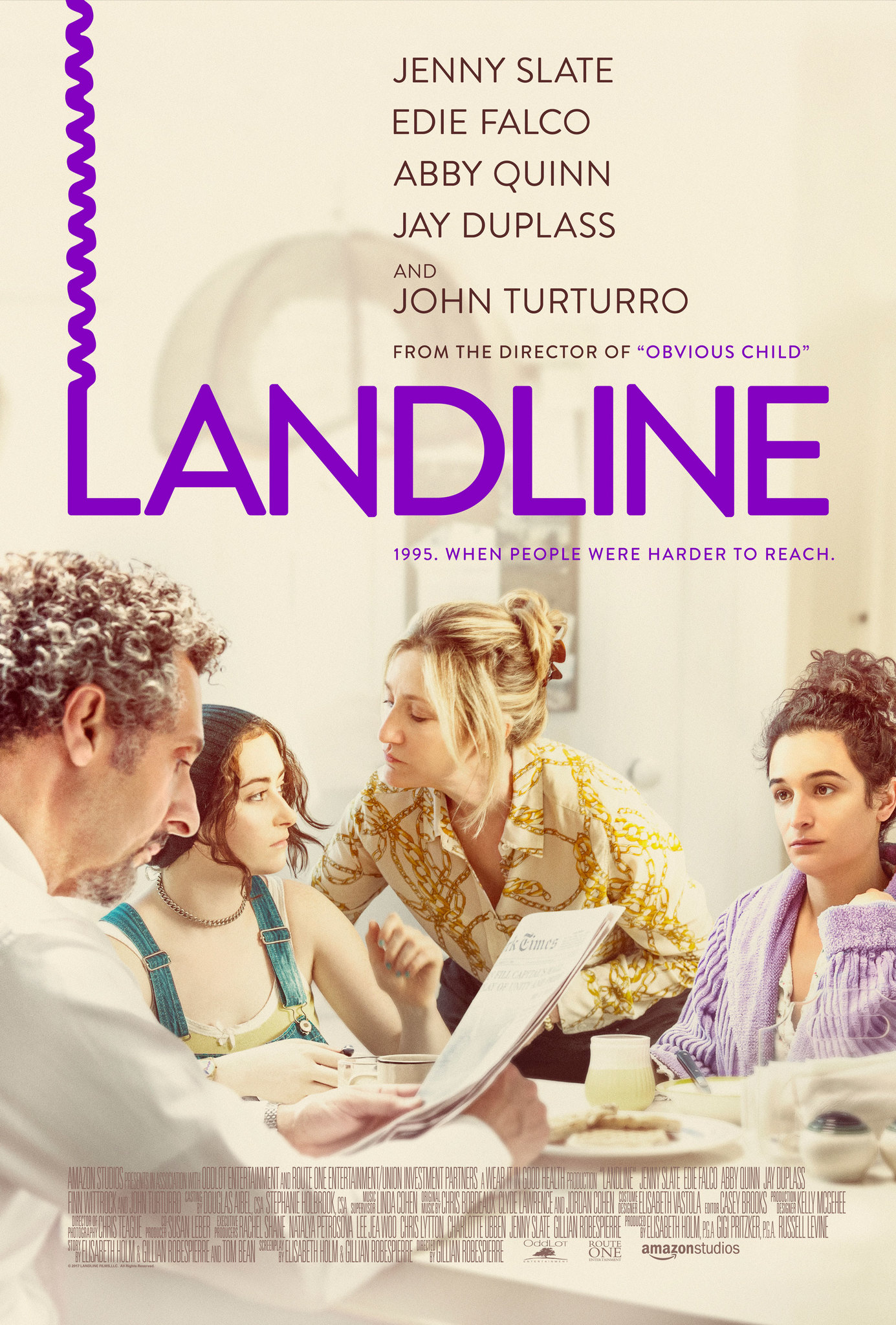
 The Jacobs are an ordinary Upper West Side family in the mid-1990s. They’re headed by Pat (Edie Falco), the stern matriarch, and her more lenient husband Alan (John Turturro), who have to endure the challenges posed by their two daughters – Dana (Jenny Slate) has already moved out of home, but is still regularly involved in family affairs, especially those involving her younger sister, Ali (Abby Quinn), who is in her final year of high school, and would much rather spend time with her friends at the local nightclubs than think about going to college. Over the course of a few weeks, in the period between Labor Day and Halloween, various revelations come to be known by various members of the family. Dana is not truly in love with her fiancé (Jay Duplass), which she realizes concurrently with the resurfacing of Nate (Finn Wittrock), an old flame from her college days, and with whom she strikes up a new friendship, one characterized by a lingering sense of longing for their more carefree days of the past. Ali, meanwhile, finds herself constantly under the influence of her friends, who pressure her into engaging in morally dubious behaviour, culminating in what is clearly the beginning of a drug addiction, which she hides from her overprotective mother, who is herself growing alienated with the feeling that she has raised a family that has simply stopped involving her in their lives. These quandaries are all compounded when Ali discovers that Alan is having an affair, a fact she shares with her sister. The two girls first see this as an adventure, where they attempt to uncover the mysterious identity of their father’s mistress – however, they eventually grow disillusioned with the situation, and realize that this could be the end of their dysfunctional but loving family.
In 2014, Gillian Robespierre and Jenny Slate made Obvious Child, which is now considered one of the most formative independent comedies of its era, mainly because it was the rare film that blended both quirky humour and serious subject matter without one impinging on the other in a way that could be considered either flippant to the grave themes, nor overwrought in distracting from the immense charm. Their second pairing sees them once again venturing into this rare space between comedy and drama in Landline, a poignant film about individuality and the importance of family that traverses treacly subject matter with a precise, endearing execution that is profoundly moving while still being outrageously funny, much in the same way as the early independent comedies from the mid-twentieth century that informed this film, both in terms of form and content. Robespierre proves that her debut was not in any way a fluke by delivering a charming comedy that looks at deeper issues through the lens of sincere, compelling comedy. In addition, there’s a quartet of terrific performances that dominate the film and make Landline into a film that transcends its small scope and manages to be a rousing, beautifully-poetic tale of fearless navigation through an uncertain world, and the bonds we form along the way.
Landline is set in 1995, which could initially be considered something of an unnecessary detail from the outset, as there isn’t anything about this film on the surface that suggests a period setting, even one relatively recent, would’ve influenced the story or made any change whatsoever to what was being conveyed on screen. However, what Robespierre was clearly aiming to achieve with this aspect of the film was to evoke a simpler time, one that she very likely remembers with fondness, and which she attempted to explore through the use of a period setting. Ultimately, the film doesn’t get caught up in trying to replicate the idiosyncrasies of the era but rather uses it as a narrative tool, which gradually supplements the underlying story, which is remarkably timeless in terms of being a steadfast manifesto on the importance of family. The director captures a specific time and the mentality that was restricted to that period, and whether through something like a computer that is the catalyst for the film’s main conflict, or the titular landline telephone (which plays a small but important role in the family), or just the general cultural zeitgeist at the time (such as the reference to the seminal classic Curly Sue, which probably hasn’t been mentioned outside of this film for close to thirty years now), Robespierre effectively puts together a beautifully poetic time-capsule of a bygone era, using it not as the hinge for the storyline, but rather as a supplement to the longing she is feeling towards a much simpler time, even if such a sentiment is entirely the product of hindsight. Nostalgia is a challenging tool that is rarely used well in film – yet, Landline manages to utilize it wonderfully, creating a cheerful but deeply compelling comedy that uses the past to tell a remarkably endearing story.
Moreover, what makes Landline so charming is not only the wonderful script (which Robespierre wrote alongside Elizabeth Holm), but the performances given by those actors who were given the script and tasked with bringing it to life, transforming vague archetypes into fully-formed individuals. Unquestionably driven almost entirely by the characters, Landline evokes some of the best work from these actors. Jenny Slate is as magnetic a screen presence as ever, proving (just like the director) that her extraordinary work in Obvious Child was not just a happy accident, but rather the result of an actress playing a character with the broad sincerity and deep commitment the role deserved. It’s almost impossible to not be beguiled by what Slate is doing with the role – she’s eccentric without being twee, and upbeat and cheerful without neglecting the substance needed to form this character into the well-formed, twentysomething New Yorker looking for some meaning. She’s sharply contrasted with Abby Quinn, who plays her dour, rebellious sister trying to break out of the monotony of her teenage life, hoping to grow up long before it’s her time. Slate and Quinn bring very different interpretations to their characters but still manage to be compatible, with their portrayal of sisterly love being one of the film’s strongest elements, whether it be in their frequent moments of conflict, or the inevitable profession of their undying devotion to the other, proving their bickering nature has long concealed a deep adoration and mutual admiration for the other, both as sisters and as women trying to make their way through a challenging world that is changing faster than they can keep up.
In the supporting capacity, Edie Falco and John Turturro, two wonderfully talented performers that are rarely given the work they deserve, particularly in film, prove themselves to be more than capable when it comes to playing such roles. Both are relatively subdued in the first two acts, having some moments in which they’re scene-stealing supporting presences – but as soon as the film begins to wind down and approach the central ideas that its been flirting with for the previous hour, they’re given moments that stand out more than anything else in the film. Falco’s gradual realization that she’s neglected herself for the sake of her family, and Turturro’s growing regret at how he’s put himself and his desires first for all these years, are contradictory aspects of two characters that are interwoven with a heartbreaking sincerity that gives Landline its emotional heft. This is ultimately a film about heartbreak disguised as an effervescent independent comedy, which only becomes clear in the final few scenes between Falco and Turturro, where they admit the truth, and surrender to the fact that they needed to face the consequences – not only of their actions (or lack thereof) but of their inner challenges, the disregard they have had for themselves or others, which have forced them into putting up a facade, of which neither are interested in maintaining, even if it means they need to accept the inevitable. It’s certainly not as optimistic an approach as one would expect from this film, but the gravitas it gives the film is certainly remarkable enough to qualify it as a very meaningful look into the inner machinations of an ordinary family.
Landline is ultimately a very funny comedy about extremely serious issues. Robespierre, continuing from her previous film, takes quite a subversive approach insofar as looking at moe bleak subject matter, in this cast infidelity and substance abuse, and asserts it onto a delightfully irreverent comic premise, blending the two normally irreconcilable conventions into a mesmerizing comedy that carries an emotional heft not often seen in broader explorations of this kind of humour. The film is a charming affair, one that boasts tremendous performances from a dedicated cast who are able to simultaneously be funny while still conveying the aching pain underlying each one of these characters, and who interpret the terrific script with poignancy and dedication. Landline is nonetheless a film that challenges many preconceived notions of what can be said in a comedy – this is probably the closest we’ll get to a contemporary tragicomedy in terms of the more downbeat independent satires of the 1970s, especially in how it tackles an inherently melancholy topic without the typical resolution that satisfies everyone, even if it means sacrificing authenticity. Landline is a genuine, honest comedy with broad overtures of drama, which it explores with immense sincerity and poignancy towards a sentimental sense of humour that is never saccharine but also avoids being entirely bleak. Beautifully-made and exceptionally conceived by a small group of brilliantly independent artists, it’s a terrific voyage into the human condition, made with humour, intelligence and most importantly of all, undying compassion.
 The Postmodern Pelican