
“A person can run away from anything, but not from his destiny”
It’s a familiar story – a very successful person (normally in the entertainment business) is at the top of their fame, and are absolutely adored by the masses. They encounter a younger, unassuming individual, who they subsequently transform into a sensation of their own, while starting a romance almost concurrently. Soon afterwards, we watch as the roles reverse – the newcomer attains an unprecedented level of fame, while their mentor falters and becomes a shadow of their former self, both as a result of losing their popularity, and the encroaching influence of various substances that help them deal with their fall from grace, which only proves to make them even more erratic and the subject of much public mockery. This has been shown in numerous adaptations of What Price Hollywood? (normally going under the title of A Star Is Born in most versions), and it’s difficult to argue against such a premise – it’s tried and tested, and has been the source of many insightful glimpses into the intersections between fame and the inner quandaries of public figures, which we don’t always see represented so poignantly. One of the works that seems to be inspired by this formula is Kaagaz Ke Phool, the masterful melodrama by Indian maestro Guru Dutt, who does absolutely astonishing work bringing to life a familiar premise in new and exciting ways. He breathes life into a story we have all doubtlessly encountered in various forms, and makes one of the essential works of Asian cinema at the time – a riveting, heartbreaking portrayal of the boundaries of fame, and the extent to which some will go to remain relevant. A fascinating, character-driven odyssey that gives one of the most scathing glimpses into showbusiness of its era, Kaagaz Ke Phool is a truly exceptional piece, and just further proof towards Dutt’s absolute genius as a filmmaker.
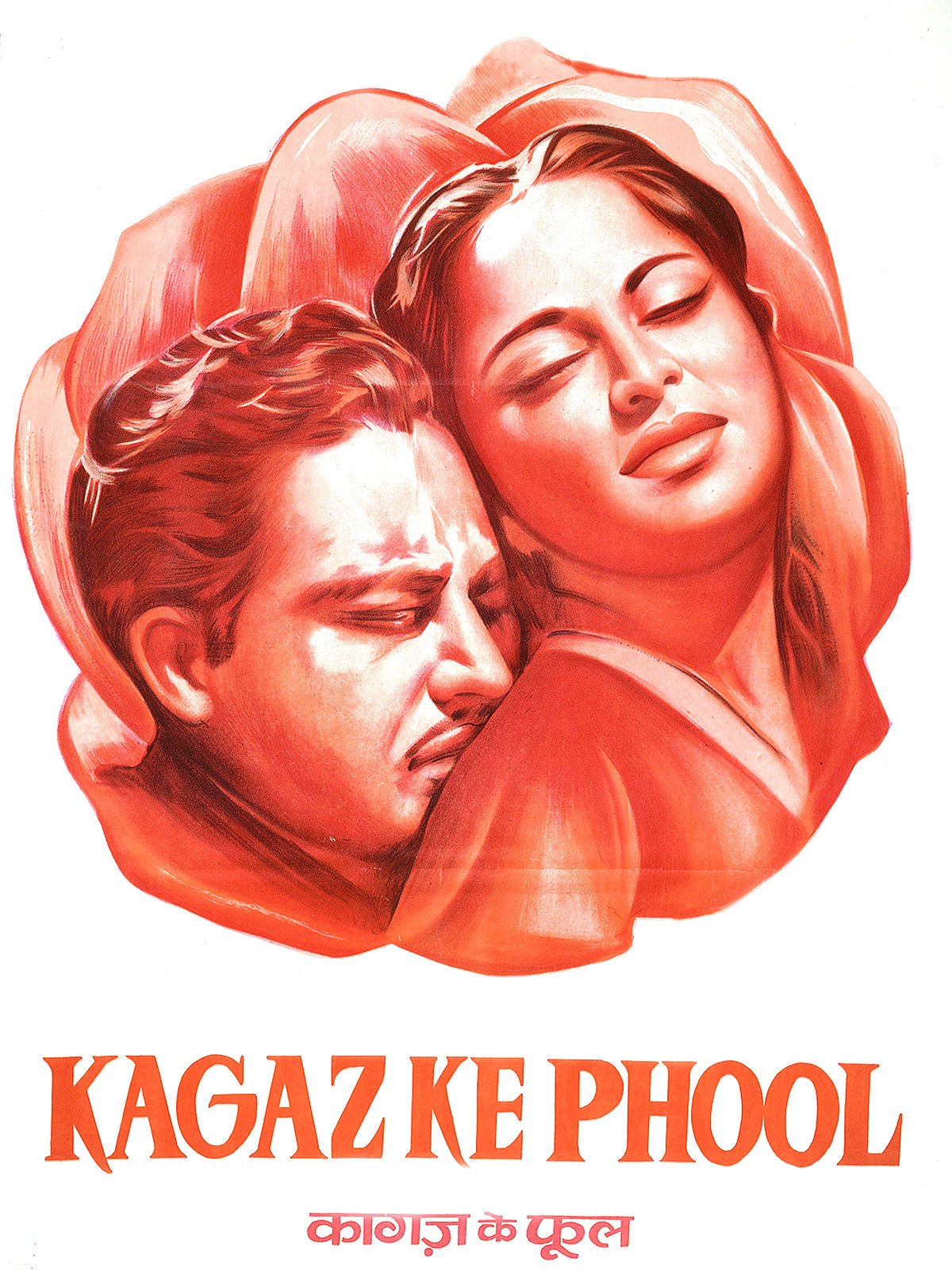
Even by contemporary standards, Kaagaz Ke Phool is incredibly timely. The title roughly translates to mean “paper flowers”, which can very easily be seen as an analogy for the kinds of individuals that Dutt is exploring with this film, with two possible meanings being derived from such an idea – the first is that paper flowers last much longer. Should one take care of them, they can last forever, never losing their beauty with the right treatment, unlike real flowers that wither with time. Conversely, they carry the sentiment of artificiality – they may look gorgeous, but their glory is finite, and they’re bound to lose their impact after a while. This is one of many concepts that the director seamlessly weaves into the fabric of his film – he finds the authenticity in a world built on the foundation of artifice, extracting an earnest truth from a narrative that could have so easily been just another overwrought attempt to revile the lives of movie stars and expose the hypocrisy of an industry so many aspire to be a part of. Elegantly-constructed and truly masterful in how the director controls both premise and tone, Kaagaz Ke Phool is quite an astonishing achievement, especially when we look beyond the wonderful simple premise and ruminate on the many incredible ideas that Dutt employs throughout the film, his fascination with various aspects of the industry he is both celebrating and critiquing coming through in almost every frame, making this both a tender love-letter to the world he adored, and a frank discussion of its more sinister recesses, which makes for a complex tug-of-war of a film, which never quite settles for one discussion over the other, but instead is perfectly content in letting them occur concurrently, extracting value from both building the industry up, and subsequently breaking it down.
Destiny forms a pivotal aspect of Kaagaz Ke Phool, as evident by the quote at the start of this discussion – it may be a trite sentiment, but so many works have focused on complex heroes that realize that there is a narrow boundary between pursuing your dreams, and embracing one’s destiny – and as demonstrated through the story of Suresh Sinha, the once-famous film director who finds himself steadily declining in both popularity and ability, you simply cannot avoid your fate. However, this is less of a case of some divine plan being intended for all of us, and more a statement on the fact that we are all bound to experience the ebbs and flow of life, which only becomes more prominent when one is a public figure – staying in the public eye is easy, but it’s much harder to have perception be positive. Dutt provides the space for a truly compelling conversation on the value of accepting your celestial path. Films about the hypocrisy of the entertainment industry are certainly a dime a dozen, and the director isn’t ever purporting to be creating the definitive comment on such an issue – yet, through the combination of sheer audacity and the insistence on retaining some sense of humility in his approach, Dutt manages to actually make some profound statements that are more potent in the context of this film than nearly anywhere else. A showbusiness epic that feels both towering and intimate, it is constructed from duelling intentions of both showing a side of the industry not often portrayed, while penetrating the psychology of its characters, which would normally be difficult to reconcile, but through finding the right balance, Dutt is able to capture both with a vivacity that transcends nearly every other version of this story, and the concept of the film industry satire in general, which seems more pointed and harrowing through Dutt’s vision than that of any other filmmaker that has attempted to tell similar stories.
The success of Kaagaz Ke Phool lies squarely in the quintessentially human details of the film – Dutt is far too concerned with telling a compelling story than he is litigating whether or not the film industry is treacherous to both newcomers and seasoned veterans. As a result, we have a work that prioritizes the trials and tribulations of the characters as individuals, rather than disguising them as thinly-veiled versions of common showbusiness tropes. In Kaagaz Ke Phool, we do have the beloved filmmaker, the young ingenue, the lovable but resourceful klutz (amongst many others), but they feel as if they are coming from a place of genuine interest, rather than just being placeholders for a bigger discussion. Dutt allows himself to have these conversations precisely because he creates interesting characters – the story resides in each one of these individuals, and through their interactions, the film is able to thrive and provide poignant commentary on a wide range of issues that extend far beyond a lavish film industry satire, which is what stories like this often end up becoming when the intention is more on exposing the seediness of the industry than it is about finding the complexity that often underpins the stories reflected on screen. Dutt’s directing of Kaagaz Ke Phool is truly masterful – he combines heartwrenching drama with some amusing comedy at times (mostly through the presence of the delightful Johnny Walker, who nearly steals the entire film with his hilarious performance as a jack-of-all-trades socialite and film producer), creating a vivid portrait of the industry that feels so incredibly layered and authentic. Dutt himself is towering in one of the two lead roles, and Waheeda Rehman matches him beat-for-beat at the young woman who is thrust into a world she feared, but grew accustomed to after realizing the glory it would bring her. His ability to find the nuance in every situation, and extract meaningful commentary from each moment more than qualifies Dutt’s work on Kaagaz Ke Phool to be entirely brilliant and worth much more attention than it has received thus far.
In multiple areas, Kaagaz Ke Phool is an astounding work of art, but its crowning achievement comes in its simplicity – while it may run quite long for such a straightforward drama, each moment is executed with a profound attention to a small set of themes, which Dutt explores thoroughly, leaving very little unresolved by the time the film has ended. He infuses each moment of the film with a kind of overt sincerity that makes it entirely worthwhile, and an absolute triumph in both theory and execution. The film is quite provocative, but only to the point where it exposes the various obstacles encountered in the industry, rather than becoming hostile to any of these characters – there aren’t any real villains in the film, and it is instead populated by an array of complex characters, each one with their own unique idiosyncrasies and quandaries, which go into forming them as distinct individuals that the audience can fully invest in. As a whole, Kaagaz Ke Phool is a fascinating piece – Dutt dives deep into the narrative, leaving very little space for any criticism, exploring the depths of an industry we are all incredibly aware of, but perhaps not to the extent that we see on screen here. Sophisticated, but carrying a sardonic edge that shows that Dutt isn’t afraid to add some vitriol to his commentary where necessary, it’s an absolutely stunning work that tells an intimidating story, and does so with such nuanced, understated soulfulness, it’s almost impossible to find a work that manages to say so much with such relative ease. It’s a wonderfully layered work, and one of the most essential portrayals of both sides of fame.
 The Postmodern Pelican