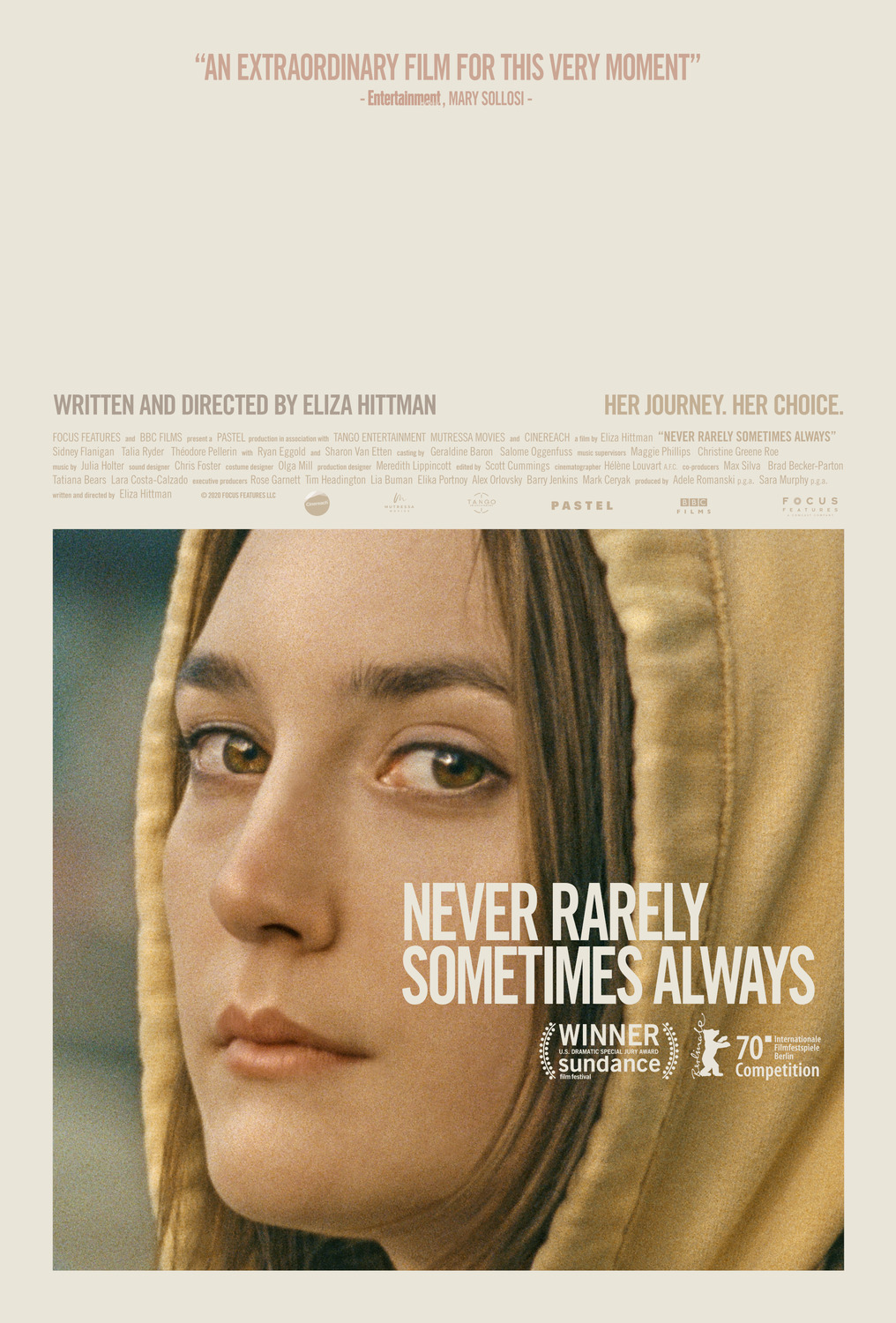
 Autumn (Sidney Flanigan) is a quiet seventeen-year-old that finds herself facing the challenge of an unwanted pregnancy, after an undisclosed encounter that may have possibly been related to molestation. A young woman who is determined to demonstrate her independence by not revealing the truth to her dismissive family, who would likely disown her if they discovered the truth, she ventures to try and terminate the pregnancy. However, her small-town in Pennsylvania doesn’t allow for such procedures without parental consent, and thus she has to venture out of her hometown and into New York City, where she is able to undergo the abortion without any need for permission from her parents. At her side is her cousin, Skylar (Talia Ryder), who is fiercely dedicated to helping Autumn get through this difficult situation by promising discretion and guidance, wherever it is needed. The two young women navigate the perils of the city, finding themselves undergoing unexpected challenges, all of them having to do with the nature of modern life not being particularly easy, especially for those most in need of assistance. Over the course of three days, Autumn and Skylar see a different side of humanity – whether the kindness in the few sympathetic souls they encounter or the sycophantic cravings of others that prey on their vulnerabilities, coercing them into difficult circumstances based on the promise of help in some form.
Films that talk about difficult issues normally tend to fall on a spectrum between being absolutely unbearable, whether through being overwrought in how they handle the subject matter, or they can be absolutely incredible statements on concepts that often go unspoken in mainstream cinema. Eliza Hittman’s Never Rarely Sometimes Always is one of the year’s most powerful films, a fierce exploration of contemporary issues, made by a filmmaker who has shown herself to be capable of looking into the human condition through a combination of her keen understanding of the issues that her stories explore, and her sympathetic (yet no less discerning) vision that brings them to life, through active engagement in subjects that are simply rarely found in cinematic storytelling. The film tackles incredibly difficult subject matter, which it does through astoundingly poignant commentary on various institutionalized systems, and the intersections with the more psychological side of those that are normally the victim of the heartless machinations that seek to categorize us as one homogenous entity, which is primarily what Hittman is indicting in this poignant drama that looks deeper than even the most profound character studies tend to do, with the director revealing a common core to the quandaries many are confronted with, executed with precision, honesty and, most importantly, a soulful understanding of much broader social and cultural contexts, which makes Never Rarely Sometimes Always one of the year’s most extraordinary artistic achievements.
Abortion has been a controversial subject for as long as it is has had some cultural bearing – and even in the more progressive societies that many live in, it remains a challenging concept. Art has always struggled in determining how exactly to approach the subject, which extends to cinema, which has only recently begun to show itself willing to look into the topic. While not many films have been made on the subject of abortion, and the ones that do exist mainly being confined to independent cinema and arthouse-oriented circles, the few that have surfaced tend to be incredibly powerful. Whether the heartwrenching, bleak tragedy of Cristian Mungiu’s 4 Months, 3 Weeks and 2 Days, or the melancholic humour of Gillian Robespierre’s Obvious Child, films that look into this subject normally tend to have one feature in common – deep compassion. Abortion is already a challenging topic on its own, so to bring it into the realm of artistic interpretation is often a difficult endeavour, and only further proves why Hittman achieved something astounding with Never Rarely Sometimes Always, a film in which she presents the audience with a story centred on one of the most contested modern issues, and gives us insight into the psychological basis associated with it, rather than the more cultural or socio-political context that we normally are privy to receiving in the endless debates as to why one side of the issue is superior to the other. Never Rarely Sometimes Always is a gorgeously harrowing tale of despair and independence, but one that also provides some glimmer of hope – and as many of the great social realist dramas of the past show, even the most distressing situations have some form of resolution: it may not be a happy ending, but it’s certainly possible to find some recovery from any kind of torment, whether it be physical, emotional or societal.
Hittman had a challenging task to accomplish in Never Rarely Sometimes Always, as the subject matter of this film is still relatively unchartered territory. The reason why this film works so well is because the director, employing a few techniques that have become indicative of her artistic style and will undoubtedly continue to confirm her as one of contemporary cinema’s most essential voices, keeps everything at the fundamentally human level. Bleak and uncompromisingly honest, Never Rarely Sometimes Always has the authenticity that is often found in works of social realism, where life is represented without any semblance of either exaggeration or manipulation. A film about abortion simply could not work without this kind of genuine honesty, with the director’s approach making this one of the most profoundly heartbreaking, but also deeply ambitious, works of social commentary in quite some time. The story itself is remarkably liberated from any sense of trite over-sentimentality, and Hittman seems to make it a point to only narrowly avoid the situations that we’ve been conditioned to expect to devolve into some kind of emotional manoeuvring, in which the audience is lead to feel certain sensations, which are manufactured in order to bolster the central themes. There is absolutely no need for it here, as Never Rarely Sometimes Always is assured in its own integrity to not resort to the kind of unnecessary manipulation many would expect from such a complex matter. Additionally, this removes the burden of the film having to choose a side – it is very clear where Hittman stands in terms of this debate, but it never becomes a matter of conflicting sides in this film – the viewer is invited to engage with this film based on their own personal values, rather than having Hittman present us with the different sides, which would have undoubtedly contributed very little to the intentions she had when constructing this film.
Never Rarely Sometimes Always is not an easy film to watch, which is directly related to how the director approaches this material. Like many realist works, the story operates less on how the artist feels about the chosen subject, as well avoiding putting the viewer in a position where their experience with this story hinges on their own beliefs. This film simply seeks to portray the plight of one young woman and her journey to solve a problem, where the plot isn’t formed from her impulsiveness, nor her negligence. Hittman effectively keeps much of the circumstances surrounding her pregnancy, as well as her domestic situation, out of the film – there is never anything more than slight implication or allusion to how she came to be in this position. This challenges a well-regarded notion that the audience should be privy to as much information as possible, and even when it is something that we’d logically believe to be relevant, Hittman proves otherwise in Never Rarely Sometimes Always, where only the bare essentials of Autumn’s life are shown to us, restricted to what is immediately necessary for us to know. The film doesn’t provide background to anything that doesn’t play a part in the central conflict, which ultimately works in its favour, and the viewer becomes less ensconced in the details, and more engaged with what we’re seeing presently. The film masterfully keeps everything in order and doesn’t overcomplicate a single moment, which contrasts with the disconcerting view of urban life that forms the core of the film, and situates the viewer in an unsettling vision of a world that is too uncompromisingly honest for us to ever feel truly comfortable or at ease.
Touching on the subject matter that it does, it’s unsurprising that Never Rarely Sometimes Always is a very challenging film to watch. It outright refuses to adhere to conventions by presenting us with a more palatable tale, choosing to rather be truthful in how it approaches its challenging storyline. The result is a film that is as timely as it is powerful – and like many of the great realist films of the past, it can sometimes be a very difficult experience. However, it is undeniable that Never Rarely Sometimes Always is an essential film, as not only does it tell a story that is worth telling through beautiful evocative images and a fierce dedication to the innumerable individuals whose plight it depicts, but it also evokes conversations that many artists have been too apprehensive to explore. Even though it touches on issues that extend far into the past, the film demonstrates why this is a difficult subject to talk about, and while it doesn’t intend to offer any resolution, nor any kind of definitive opinion on the concepts, it evokes a discourse that is long overdue. Never Rarely Sometimes Always is not the first film to look at abortion, nor is it likely to be the last. However, it is quietly revolutionary in its own way, mainly due to the masterful direction of a filmmaker, whose assured vision and earnest belief in the veracity of what she is conveying make this an extraordinary achievement. Beautifully-composed, heartfelt and brimming with authentic emotion, Hittman’s film represents a seismic shift in how these serious matters can be approached in an honest, meaningful way without needing to encompass the entirety of the issue. It’s an incredibly poignant film, and one that is most impressive when it is clear that it is willing to say what most other films refuse to say – it is a small, intimate film that is going to make an enormous difference, which is always an indication of a work that goes above the boundaries of art and becomes a powerful piece of cultural commentary.
 The Postmodern Pelican