 The thriller genre is one that often appears to occur on something of a binary scale, much like horror, its closest generic cousin – it is either derivative and plays upon a set of preordained ideals, or it is thoroughly unique, either having a highly original premise or an audacious execution to some more common traits. Wait Until Dark is certainly aligned with the latter, especially since Terence Young managed to take a stage production that was already quite innovative, and translating it to the screen, where the broader ideas are retained, and the smallest nuances that aren’t possible on stage being subject to wider exploration. Young, a great filmmaker whose current cultural cache is unfortunately being a director-for-hire on three of the more popular James Bond films, put together a remarkably competent adaptation where the theatrical roots of the story are almost entirely concealed through a delightfully straightforward but intensely creative execution that demonstrates a remarkable sense of style on the part of a director, and a cohesive control of story by screenwriters Robert Carrington and Jane-Howard Carrington, who do very well in interpreting the play by Frederick Knott, a masterful playwright who specialized in this brand of complex, foreboding thriller. There’s a great deal that can be praised when it comes to Wait Until Dark, and as we will discuss, its biggest strength is its wonderful lucidity, as well as its dedication to a premise that would normally be the fodder of lowbrow exploitation films, but is here rendered as a poignant, often heartbreaking, melodrama in the guise of an exuberant psychological thriller.
A doll containing copious amounts of drugs is making its way across the border from Canada to New York City. Its intended recipient is Roat (Alan Arkin), a sinister criminal who specializes in extravagant costumes and psychological torture – the signatures of any great thespian who also happens to be an ego-driven psychopath. His mule fails to deliver it to him directly and instead gives it to an unknowing passenger named Sam (Efrem Zimbalist Jr.), who is unaware of the contents of his new possession. Now desperate to retrieve his property, Roat hires two incompetent criminals (Richard Crenna and Jack Weston) to infiltrate the home of Sam, a photographer who Roat sends on an assignment, posing as a potential customer. They unfortunately didn’t anticipate the presence of his wife, Susy (Audrey Hepburn), but once they learn that she’s blind, they’re able to take advantage by winning her trust through deception and well-choreographed trickery. The good-natured Susy finds herself falling victim to these sleazy opportunists, who go to any lengths to deceive her, weaselling their way into her home, and ultimately into her fragile state of mind. Alone in her home, surrounded by strangers she is unable to see and armed with nothing but her own instinctual tenacity to survive. She has to battle against the malicious forces that have taken over her home, but she puts up a fight strong enough to evade them until she’s able to plan her own method of overpowering them, which turns out to be as simple as turning their tricks back on them entirely.
Wait Until Dark was made primarily to be a star vehicle for Audrey Hepburn, who was currently in an era in which she was moving away from more archetypal roles, and instead looking for more interesting work. This film occurred in the same year as her finest performance in Two for the Road and created a duality that proved why she was one of the most magnetic stars of her generation. Her elegance and emotional gravitas concealed a fiercely brilliant sense of intensity that only manifested when it was absolutely necessary, resulting in a career that saw the actress give some truly dynamic performances in the most unexpected of situations. Wait Until Dark is some of her more underrated work, but nonetheless yet another exemplification of why she was able to command the screen with such incredible grace, but also to go deeper into the character in a way other actors would find difficult. Playing a blind character may not be considered entirely challenging for a sighted actor, but Hepburn brings such a vulnerability to the role, albeit one that is not as innocuous as it would appear. She overcomes many of the trite tendencies of able actors in portraying someone with a disability by never reducing the role to just a few quirks, as well as never playing it for laughs, but rather seeking some depth in a complex role. The rest of the cast is quite small, with the compact ensemble serving the intimate nature of the story well – however, none of them is able to rise to the same level as Hepburn, who is simply stupendous. Alan Arkin does come close in playing one of the most absurdly bizarre villains in film history, but he seems to struggle with avoiding playing to the rafters, resulting in an entertaining but otherwise one-note performance from a solid actor who thrives with these kinds of offbeat characters. Jack Weston, an endlessly underrated character actor who does not receive the praise he deserves, once again does really entertaining work, the kind in which there is always an underlying malice that makes his roles as the foolish patsy to much smarter people all that more effective.
Moving beyond Hepburn’s masterful performance, Wait Until Dark is a fascinating addition to the thriller genre, mainly because it takes advantage of the growing tendency for films to deviate from a single set of ideals, and rather samples from a variety of genres, which results in a multilayered film that evokes just as much thought as it does unhinged excitement. Like the play, Young’s film takes on the challenge of contributing to the canon of great thrillers while still attempting to be innovative on its own terms, which is certainly not an easy task, but one that everyone involved seems to have embraced with gusto. It starts with the screenplay, which was written in the typical style of the genre, in which the audience is thrust into the story without much context, and where the intentions of the plot come to the fore, whether gradually through demonstration, or with exposition, which is a method that only works in the thriller genre, although only when done with restraint. We develop an understanding of the plot as the film progresses, and the underlying thematic content, if any, comes to the fore slowly, almost as if we ourselves are embroiled in the events depicted, uncovering clues and coming to terms with the fragments we were initially presented with. The key to understanding Wait Until Dark isn’t to try and make sense of what we’re shown initially, but rather to just submerge ourselves into this bizarre, nightmarish urban landscape that Young exploits so well (the film grapples the fine line between psychological thriller and horror particularly well), and following the intricate cat-and-mouse game that serves as the foundation for the film as a whole.
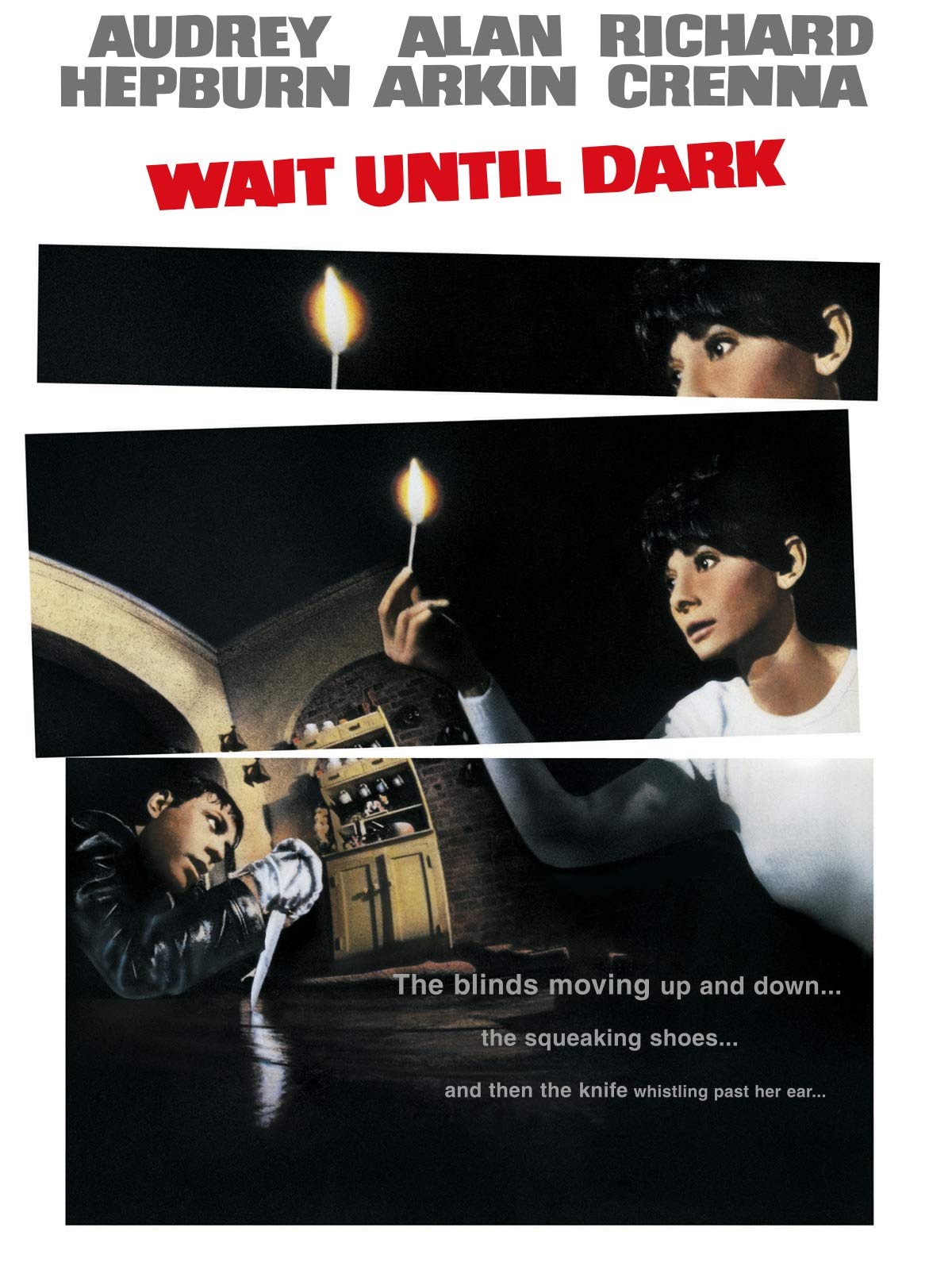
The true strength of Wait Until Dark comes in how Young realizes the occasionally convoluted themes – perhaps not done with the tact some would necessarily hope, the film can tend to be clumsy at times, especially at the start, in which the director has the difficult task of setting up the rest of the story without over-complicating what is already quite a layered premise. Ultimately, the approach that worked best was one that entailed a great deal of simplicity, specifically in how the film plods along at a relaxed pace, leading to an exhilarating climax in which the previously measured approach is turned around completely, replaced instead with the excitement of seeing what had transpired gradually subverted, where the calmer, foreboding sense of dread flourishes into unhinged chaos, in the best way possible. The theme of blindness is certainly not lost on Young, who employs a method of immersing the characters, and the audience by extent, into almost complete darkness, with only the slight flickering of a match serving to guide us in what is one of the most memorable thriller climaxes in memory. The film’s approach to the story as less of an exploitative crime film, and more as a dark satire of urban life and the intersections between different classes of individuals all converge into a deceptively dark tale of debauchery on one side, and survival on the other, with the director inverting this towards the end, showing how the tendency for the victim to become the perpetrator if they’re driven to that point by sheer will to survive, and those that put them in that position could certainly feel the burden of having taken advantage of the wrong person. That’s when we truly know Wait Until Dark has been effective when we realize that we’ve been watching it from a completely different perspective all along, and our gaze is shifted in a different way. Not many films are able to do that.
Wait Until Dark is a terrific film, the kind of slow-burning psychological thriller that has seemingly gone out of fashion, replaced with bolder ideas and more unique approaches to these stories. Terence Young proves that even the most simple of stories can be repurposed in a way that they appear entirely innovative, without needing to resort to any kind of narrative manipulation that would betray the humbler roots of the plot. Young combines a terrific ensemble, lead by the incredible Audrey Hepburn, who gives one of her strongest performances, with a fascinating premise that serves as both a tremendously exciting thriller that keeps the viewer on the edge of their seat, and a compelling character study that gives us the chance to venture below the surface and investigate these characters less as archetypes and more as fully-formed individuals that have nuance and depth, which is ultimately the work of a good script and capable actors tasked with interpreting it. It is tempting to view Wait Until Dark as just a mindless genre film without any real meaning, but when we look beyond the confines of the genre and instead peer into the message the film harbours, and how its evoked in unexpected ways, the true brilliance of this film immediately comes to the fore. It’s an entertaining, but still very intelligent, entry into the psychological thriller genre, and yet another reason why it often takes an unexpected premise to evoke the most interesting commentary.
 The Postmodern Pelican