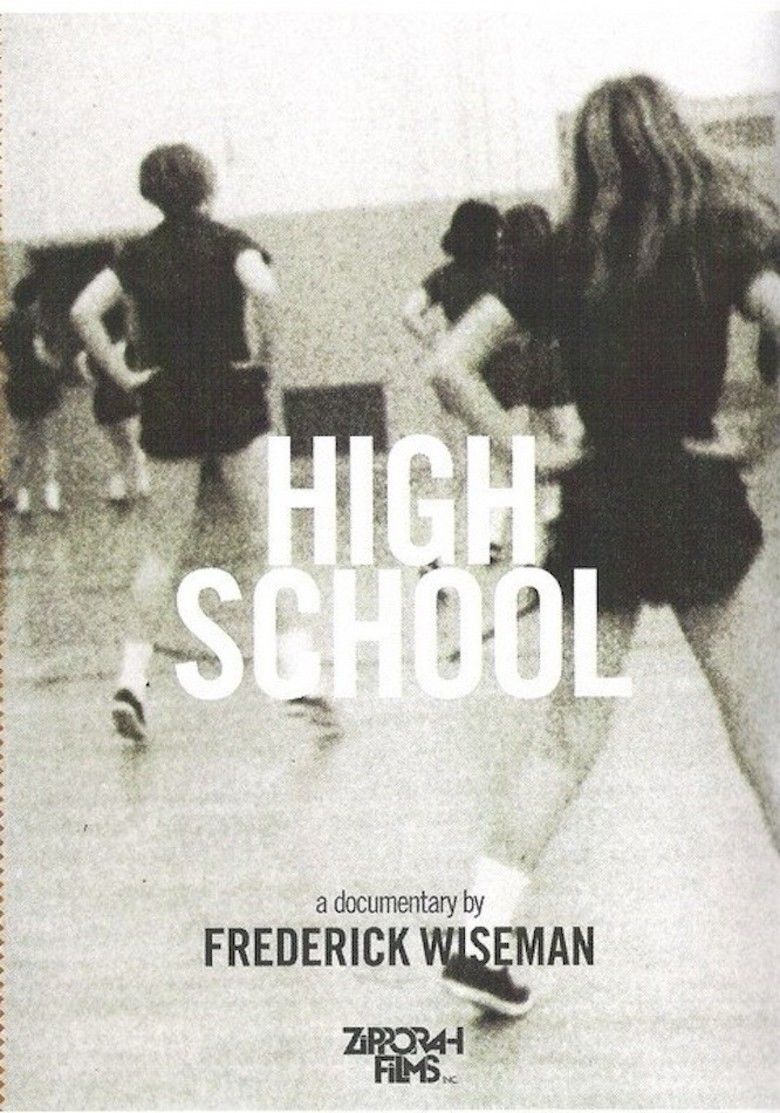
 Frederick Wiseman revolutionized the documentary – in many ways, he essentially invented the modern form of non-fictional filmmaking, alongside the work done by other renegade auteurs such as the Maysles Brothers and Shirley Clarke, who sought to represent reality in a way that was honest, poignant and direct, with the results often being fascinating studies of society that are often missing when it comes to narrative storytelling. In a career that has stretched over half a century, Wiseman’s work has been indicative of a filmmaker whose interest in the human condition seems to not know any boundaries, with each of his magnificent films being powerful explorations of a different side of society. High School is one of his earlier films and serves as a formative moment in the career of a director who has always been unwavering in his support of those who he deems worthy of cinematic representation, especially if they are often thrust aside in other forms of artistic expression. This film features many of the early qualities that would not only serve to be a crucial aspect of Wiseman’s own career, but also the wider approach to documentary filmmaking that would come about as a result of this revolutionary movement in storytelling, where Wiseman looks at ordinary subjects and portrays them in unexpectedly moving ways.
Wiseman’s skills as a filmmaker appear so effortless, but they certainly came about as a result of the director attempting to take an enormous risk in how he portrays his subjects. High School belongs to a generation of non-fiction films that sought to document rather than craft a narrative from an overarching idea. The intention here, as it has always been with the director, was to convey the social truths surrounding his chosen subject without inserting himself into the narrative frame at all. This kind of non-invasive filmmaking is one that truly benefits a piece like High School, with the director venturing into the hallways of the quintessential American high school, armed with only his camera and a very loose idea of where he intends to go with this story, to the extent of just choosing what to portray as a part of the wider picture here, because despite the simplistic execution, there needed to be some kind of logical flow to this film, which Wiseman puts into effect through both the footage he captures and the subsequent editing of it into a beautifully poetic piece of cinema. The style of filmmaking, often referred to as cinéma vérité due to its tendency to occur at the intersections between artistry and reality, has lead to many significantly powerful works, and High School certainly stands as one of the more fascinating experiments, if only for the sake of the earnest approach that Wiseman takes to a relatively simple story that harbours a lot more meaning than we’d normally expect, based on what this film appears to be.
Like many avant-garde films made during the 1960s, when filmmaking was becoming more accessible to those on the outskirts of the mainstream, High School sees an ambitious young filmmaker attempting a remarkably simple endeavour, taking aim at a few specific concepts, and ultimately overthrowing them in favour of a more subversive message. Wiseman set out to provide a stark and uncompromising portrait of a high school – but there is so much more to this film than appears, with the deeper message underlying it being the precise reason why this is such an unexpectedly brilliant film. It’s more than just a riveting portrayal of the well-known, archetypal American high school – it’s a stern indictment on unseen institutionalized issues, conveyed over a series of vignettes that are carefully curated by a filmmaker who is propelled by a combination of fascination with the subject matter, as well as quiet resentment towards a faction of society that is far from flawless, and required a more discerning gaze in order for the more innocuous qualities to be eroded in favour of a more direct, and perhaps far more unsettling, portrayal of these issues. Wiseman’s thesis statement seems to be around the tendency for public high schools to take advantage of the cultural cache associated with this kind of system in order to spread their beliefs to impressionable minds – certainly not as nefarious as it would seem, it is nonetheless an oppressive concept, and through the act of repetition and forced discipline, draconian rules and an imbalance in agency are omnipotent.
It would appear that the main theme of High School is actually quite reprehensive to celebrating the very nature of the system, whereby these institutions are used not necessarily to only educate positively, but also to manipulate its constituents, were feisty teenagers are turned into complacent individuals. Wiseman obviously avoids blaming anyone in particular, as he sees this as an inherent problem in the system. However, this doesn’t mean that he isn’t holding the social system accountable, and anyone viewing this film will either be enthralled by the stark approach to the concepts it explores or entirely unsettled by the deeply disturbing message lurking beneath the surface. Wiseman’s raw, direct approach only benefits the film as a whole, where there is nowhere for the bleak commentary to hide – it is shown to use in a way that doesn’t see the director shepherding us to one particular viewpoint, but also where his judicious qualities as a filmmaker allow him to cultivate some truly harrowing elucidation on the extents to which high schools are both a place where young people go to further their education, but also where they’re presented with a microcosm of the real world, taught by those who had themselves been victim to a restrictive system the coerced them into thinking in one way.
High School, despite the depth of meaning imbued into what initially appears to just be a very simple snapshot of the education system at one point in time, is not a piece of sensationalist propaganda, and there is a complete lack of conspiratorial speculation – Wiseman is not hoping to expose anything or to lead the viewer into changing their mind about a particular subject. Rather, his intentions with this film were clearly just to document, and to derive some objective commentary to the state of the public high school system, which is as beneficial to students as it can be restrictive and impeding to their social and cultural growth, which normally suffers as a response to normativity, which is perhaps the only aspect that Wiseman is clearly critical of, as many of his earlier works tend to feature an inherent quality to challenge institutions and their role in the psychology of the individual. High School is a brief but memorable work that offers a lot in terms of being an enriching tapestry that is as compelling as it is deeply fascinating, and its quite clear that, despite its simplicity, there’s a great deal underpinning this poignant exploration of the human condition.
 The Postmodern Pelican