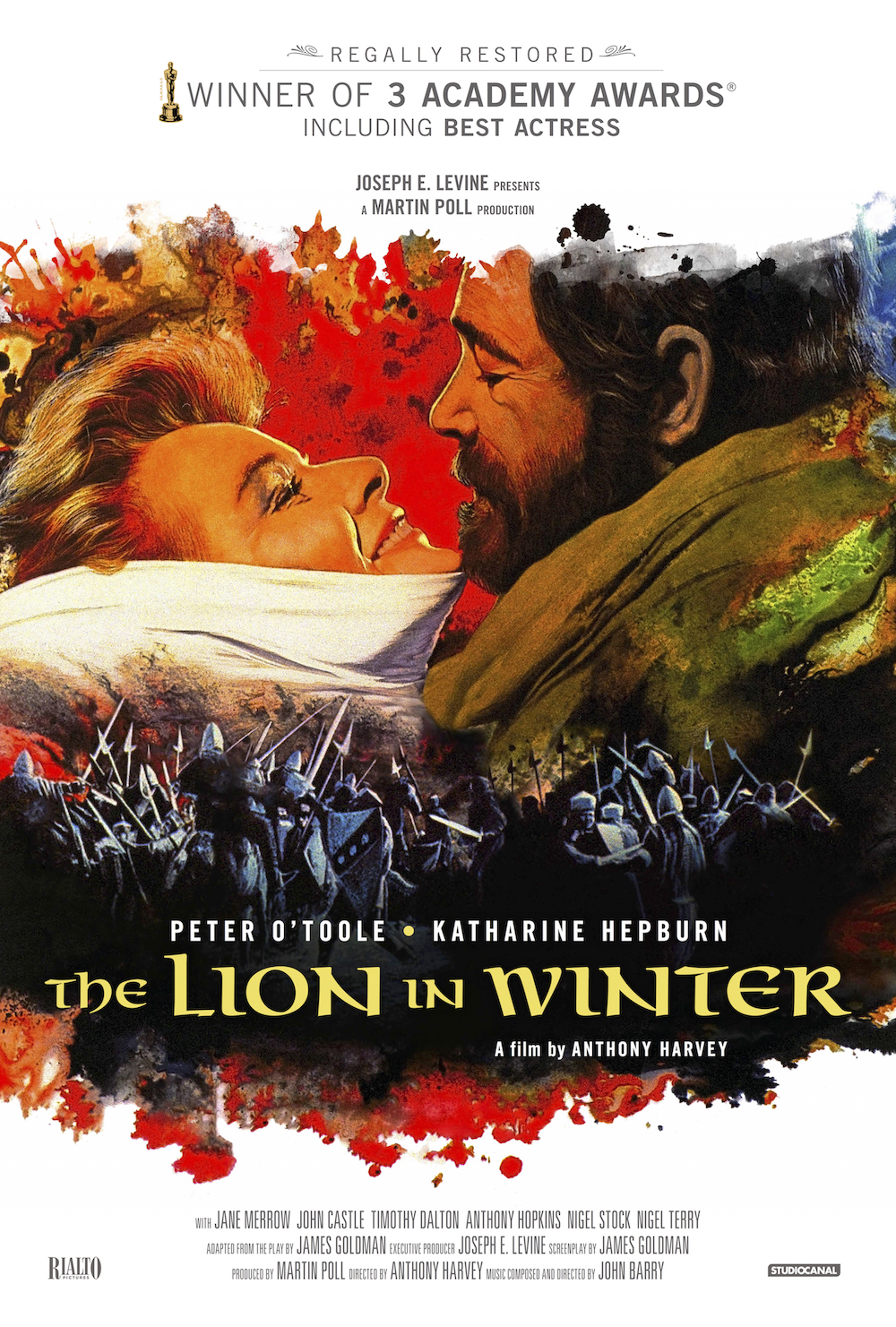
 Henry II (Peter O’Toole) rules over England and the many colonies and territories that form part of his kingdom. However, the broader issues of his empire are not his concern at the moment, but rather a more pressing issue is at hand – the arrival of the young French king (Timothy Dalton) puts Henry in a precarious position, as he is given the ultimatum to either return his mistress Alais (Jane Merrow) to her native France or marry her off to one of his sons, which would essentially confirm one of them as the next King of England. The princes are all radically different candidates – Richard the Lionheart (Anthony Hopkins) is the most king-like, featuring all the qualities that make for an effective ruler, while Geoffrey (John Castle) is an incredibly shrewd politician who manages to concoct intricate schemes that aid him in manipulating the well-composed regal system to his benefit and John (Nigel Terry) is his father’s favourite, a meek but loyal young man who has always believed that the throne would ultimately become his as a result of his father’s clear devotion to him. This dilemma arrives at the same time as Eleanor of Aquitaine (Katharine Hepburn), Henry’s estranged wife, who he has imprisoned for several years as a result of her involvement in a plot to overthrow his reign. The reunion eventually turns into a bitter battle of the wits, as both have their preferred candidate for the throne, and will go to any lengths to prove why their choice is the most adequate. The tensions rise in the family, with the debate sparking games of manipulation to gain dominance over each other, all with the intention of asserting control over a crucial decision that could change the fate of the entire kingdom.
Filmmaking consists of many different components, all of which have particular examples that tend to stand out when focusing on that particular element, with different films often being associated with some technical or creative achievement, exemplifying the artistry that went into it. In terms of acting, one of the finest examples of a film capturing the brilliance that can come from a good cast is The Lion in Winter, a historical drama that has amassed an almost folkloric reputation as one of the finest pieces of acting in the history of cinema. While such bold statements often lead to disappointment, the experience of seeing Anthony Harvey’s interpretation of James Goldman’s masterful stage production is certainly something viewers will not be able to resist, solely for the strength of the story it tells, and the people tasked with bringing it to life. It’s a film that operates on numerous different levels – as a powerful piece of historical filmmaking, where Harvey and Goldman work in tandem to thrust the viewer into the 12th century, as a riveting political thriller about the machinations of the regal system, and as a darkly comical character-study that takes aim at the egos of the nobility and those at the very top of society. It’s a beautifully-made film that manages to avoid the pratfalls of many theatrical adaptations by taking a far more simple approach, while not neglecting the more stylistic qualities that make the genre such an enduring one, particularly at the time in which The Lion in Winter was made, which is often considered the peak of the epic historical drama.
To talk about The Lion in Winter as anything other than an acting achievement seems inappropriate, as everything that went into this film was done only for it to converge to the performances, particularly those of the two remarkable actors that lead the film. There are few actors who managed to have as meteoric a rise to worldwide acclaim than Peter O’Toole, an actor who, despite having the definition of a history-making performance as the titular character in Lawrence of Arabia, never once rested on his laurels, and almost immediately sought out even more audacious roles, such as his sequential portrayals of Henry II at different eras of his reign in Becket and here in The Lion in Winter. The quintessential stage actor, he occupies the role of a character much older than he was at the time, still managing to convey an authenticity and gravitas to this performance that is quite simply not seen nowadays. His interpretation of Henry II is certainly one of his most fascinating performances and one that is not cited as being the towering piece of acting it deserves to be. The way he occupies the role of a king that is neither a benevolent, heroic ruler or a vicious megalomaniac, but rather a blend of both is fascinating. The Lion in Winter shows that even when presented with the chance to play a role that is perfectly suited to his talents (there are few actors in history that are quite as regal as O’Toole), he still puts an enormous amount of effort into his work, and it shows with this incredibly intricate performance of a man driven by his ego, and restrained by his belief in order, which is increasingly difficult to find as a result of the chaos ensuing from a bitter domestic drama he himself perpetuates.
O’Toole is only half of what makes The Lion in Winter so compelling, with Katharine Hepburn being equally complicit in the enormous success of the film. While structured as a sprawling family drama, this film is almost entirely reliant on the characters played by O’Toole and Hepburn, with every aspect of the film being funnelled through these roles. Hepburn is an actress who is too often criticized for giving performances that were derived from the same set of idiosyncracies she became known for – and while it is true that she did play these roles in a way that could be seen as plucking from a variety of quirks, its categorically untrue that this was a shortcoming, as every performance she gave, regardless of the genre of the film or the kind of character she was given to play, Hepburn always brought everything she could to the role. The Lion in Winter is undeniably some of her best work, not only because is a role that speaks directly to her talents (namely in being a powerful, independent woman who refuses to surrender to social expectations, and defies everything that isn’t compatible with her own intentions), but also because it affords her the chance to play both a broadly entertaining character, but one that also has a sincerity that only Hepburn could bring to the role, particularly in the more quiet, introspective moments. The work she does here is so endlessly impressive, especially because of her innate ability to derive every bit of authenticity out of even the tritest moments. We never know where this character resides psychologically, which is entirely due to Hepburn’s layered, nuanced portrait of a complex individual, whose inner quandaries reflect a deeply fascinating character that the audience is both compelled to love and resent, which is always a tricky prospect, but one that works exceptionally well here.
The Lion in Winter rests solely on the characters, and the performances of the cast are exactly what propels it to the incredible success it now enjoys. The chemistry between O’Toole and Hepburn is the very definition of what great film acting looks like – I implore any viewer to look at these two acting legends, who were undeniably amongst the greatest in their profession, and not be utterly enthralled by the work they’re doing. The plot of The Lion in Winter is definitely fascinating (and kudos must go to Harvey and Goldman for never attempting to over-complicate the material to make it seem more ambitious – the simplicity of the premise, combined with the beauty of the dialogue, are indicative of why this is a piece that brings out the best in the actors), but its the chance to see these actors working across from each other that elevates it. Not only are they collaborating, but they’re playing adversaries that spend a good portion of the film actively engaging with each other, with their verbal sparring being as captivating as the most epic battle sequence in other historical epics. O’Toole and Hepburn take Goldman’s incredible script and devour it, imbuing the story with performances that are bold and audacious, without ever being gaudy or excessive, which is indicative of their admirable restraint, and their inherent knowledge of the craft and its many intricacies, honed by several years working in the industry. There’s nothing quite as enchanting as seeing two legends not only working across from one another but sampling liberally from the other, playing off their scene partner with a might that only comes from the most self-assured, dedicated performers, which is an indelible quality of this duo.
Harvey, perhaps not the most enthralling visual stylist, does exceptionally well in translating the play to the screen, managing to move the story outside of the confines of the theatre (thus not limiting it to the rather restrictive space that a stage can offer, and allowing it to flourish on a wider scale), while still retaining many of the elements that made the original production such an enthralling piece of theatre. Certainly the epitome of a competent but straightforward filmmaker, Harvey was an exceptional choice to helm The Lion in Winter, which is ultimately a film that will always benefit less from the direction and more from the strength of the script and the actors chosen to bring their interpretations to these brilliant roles. The simplicity with which this film is executed, with the riveting drama unfolding through the gorgeous but humble locations of France and Ireland, is perfectly adequate, as it prevents any sense of distraction. Where most period films would use the lush production design and elaborate costumes as a way of complementing the story, The Lion in Winter evokes the drama in a far more modest, unassuming way. This isn’t to imply the film isn’t well-composed – it’s beautifully made, and Douglas Slocombe certainly photographs the simple but incredibly beautiful locations in a way that hearkens back to another era. However, as we soon come to realize during the process of becoming immersed in The Lion in Winter, it isn’t the appearance that is so compelling, but rather the intricate, evocative use of more intangible qualities, like the sparkling dialogue and atmospheric tone that rapidly shifts between jovial and unsettling, which makes this film a rousing success, and such a mesmerizing work of historical drama.
The Lion in Winter is a fantastic film, and one of the few towering classics that may actually receive less acclaim than it deserves. It’s easy to view this as a stuffy chamber drama, where verbosity is mistaken as great acting, but to look at it this way betrays the very nature of what makes it such a compelling piece of drama. We simply can’t ignore the incredible premise, which conveys one of the most fascinating sagas in British royal history with elegance and tact, and where the complexities of such a situation are broken down into a straightforward narrative that not only allows the viewer to have unfettered access into the machinations of the most powerful family in Europe but also engrosses us in this fascinating tale of betrayal and deception that is as thrilling as it is entertaining, which is a quality that has been seemingly lost in many historical dramas, where dour authenticity often takes preference of the more compelling, sumptuous qualities that made these such bewitching works. The theatrical roots of The Lion in Winter are not concealed but openly embraced, with Harvey and Goldman translating the production to the screen in a way that allows it to venture beyond the stage and into a more realistic space, without losing any of the dramatic material that made it so endearing in the first place. It’s a wonderfully eccentric work, and features Katharine Hepburn and Peter O’Toole at the peaks of their careers (although one can argue they were always incredible throughout their professional lives), engaging in some of the most delightful combat ever committed to film. The Lion in Winter is a poignant, fascinating piece of drama that never takes anything for granted, whether it be the subject matter, the prestige of the actors involved, or the general qualities of the genre. It’s both majestic and buoyant, which is a rare combination, but truly one of the reasons why this has grown to be one of the most enduring works of the genre and a truly unforgettable foray into the past.
 The Postmodern Pelican