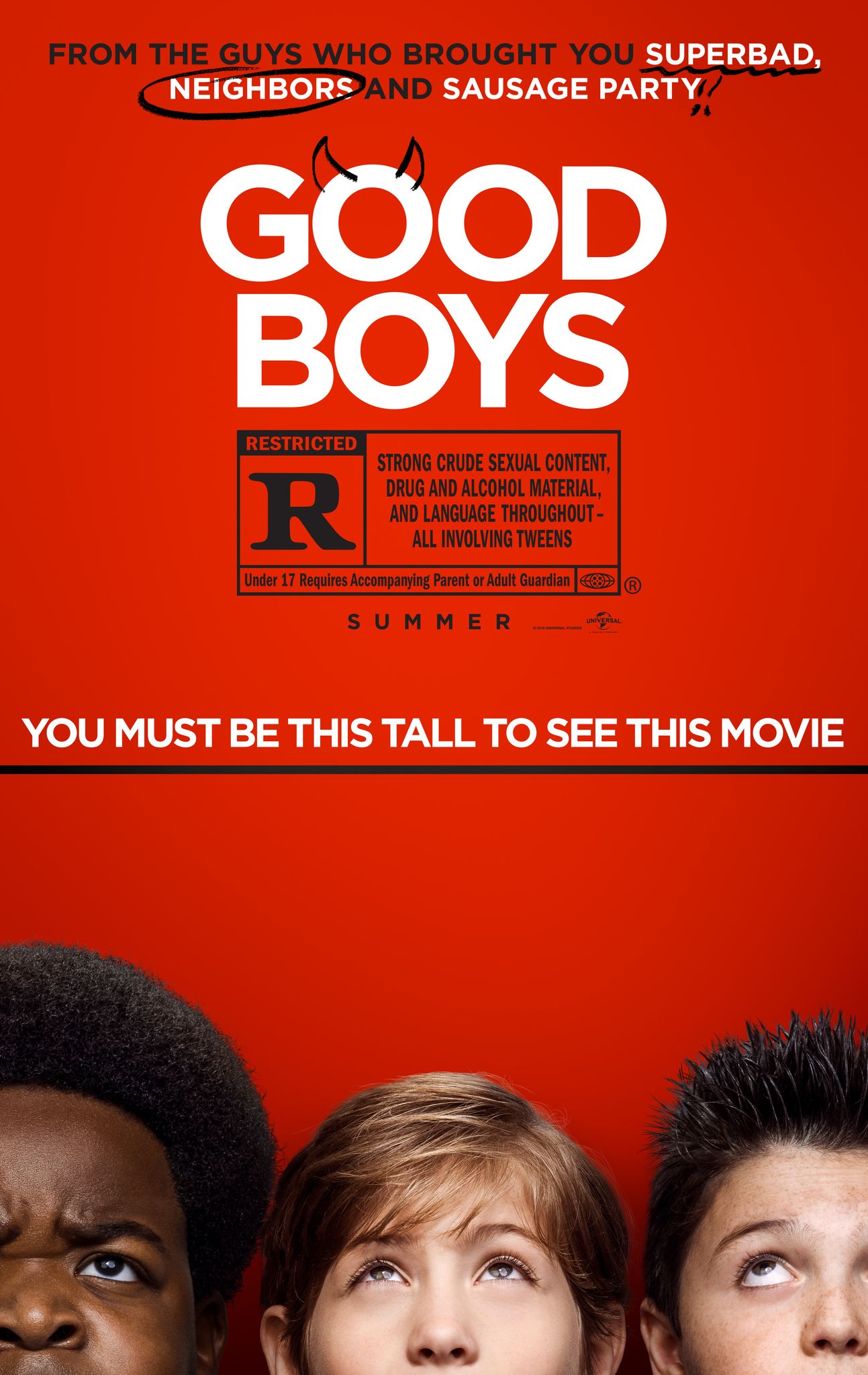
 Sometimes, we need a film like Good Boys to remind us of the incredible power of foolishness. A film made from the perspective of almost complete narrative disregard, but done with the earnestness of someone who was intent only on entertaining more than contributing anything meaningful, it’s a wonderful exercise in escapism, where we can momentarily just leave behind whatever ails us and just venture into a kind of unhinged absurdity that normally serves to be the thesis statement for this kind of lowbrow humour. Good Boy may be predictable, vulgar and far too reliant on a novelty premise, but it overcomes it in the same way many other films like this tend to – combining a lot of heart and a sincerity that is often lost in more serious fare, director Gene Stupnitsky manages to make a very endearing film that takes elements of the coming-of-age story and turns it into a rousing comedy, where the moments of unrestrained, excessive crudity ultimately come together to form a very touching, if not truly moving, portrait of growing up, albeit delivered in a very unexpected way. This is the kind of film that benefits more from an open-minded approach on the part of the viewer, and can really only be appreciated by those willing to suspend their disbelief for as long as this film is willing to challenge every notion of feasible logic. More than anything, Good Boys is nothing more than a brief bundle of unadulterated fun, which is ultimately all it aspires to be, and what it manages to achieve.
Max (Jacob Tremblay), Lucas (Keith L. Williams) and Thor (Brady Noon) have just entered sixth grade – their last year of elementary school, and they’re intent on making it worthwhile. The only problem is that they are far from as popular as they’d like to be. Referring to themselves as “The Beanbag Boys”, they stand strong together, but often find themselves the subject of ridicule. While confident in their own interests, and not entirely insecure enough to want to change themselves, they still want to fit in, as would any child during their formative years. Their chance to prove themselves comes with an invitation to a party one of their classmates is throwing, which piques the interest of Max, who hears that a girl he has grown to have a crush on will be there, and the chance to express his love is too good of an opportunity for him to pass up. However, naturally, there are challenges, and the trio finds themselves in a number of situations that threaten to get them into very deep trouble – but they’re willing to take every risk, solely to prove that they are just as capable as their more popular classmates. One obstacle leads to another, which not only tests their resilience and resourcefulness but forces them to think about deeper issues, particularly the extent of their friendship and the impending danger of drifting apart, an inevitable challenge for people at this age. Yet, they manage to stand united, not without their differences, but fully committed to achieving whatever they set out to do.
Based on this premise, it’s understandable to feel that this story has been told before – there are so many films that look at such situations, it almost feels redundant to describe it as anything other than what has been done before. However, the element that makes Good Boys stand out more than others is how Stupnitsky approaches the subject – while we have seen an endless stream of comedies that place emphasis on unexpected groups as defiant of societal standards, where vulgarity and darkly comical situations make up a large portion of the humour, Good Boys takes it a step further by actually managing to be quite endearing, where the gross-out comedy is supplemented with a more touching story of friendship. Make no mistake, this is just about as predictable as one could expect, and while there are many surprises that are lurking beneath the surface (normally done at the expense of the protagonists’ innocence, which is truly put through the wringer throughout this film), the film operates less as a unique subversion of expectations, but rather just a mindlessly fun foray into the lives of a very precocious group of elementary school children, who are let loose on the world, and forced to fend for themselves, with the exact kind of hilariously irreverent misadventures ensuing, and the expected heartwarming resolution that no film aiming for this kind of audience will ever dare deviate from. It’s a formulaic film, and one that doesn’t extend far beyond the bare minimum, but the work it does in bringing the laughter to what could’ve easily been a trite and excruciatingly twee story is worth praising because it is what ultimately elevates the film.
One of the more interesting parts of Good Boys is how the film takes one of the most common tropes of the coming-of-age story, namely how younger characters are portrayed, and uses them in a significantly different way. There are countless examples of films with similar subject matter casting adorable children to play these twee, innocent young people who are trying to navigate a world they don’t quite understand. Good Boys goes another direction – while the innocence of these characters, or rather the corruption of it, is a significant element of the plot, the film doesn’t rely only on them as being the embodiment of the quintessential young protagonist making sense of the experience of growing up. Ultimately, it gives the three main protagonists a chance to have fun, and each one of these young men are very good. Jacob Tremblay, who is currently the most sought-after child actor, abandons the more straight-laced persona he’s played over the past few years since his breakthrough and manages to actually show some range, which isn’t always very clear in younger performers. Tremblay is contrasted nicely by the performances of Brady Noon and Keith L. Williams, who are equally as endearing, playing off the subversive portrayal of childhood innocence that Good Boys seems so intent on exploiting.
Good Boys doesn’t do much, but it does enough to qualify it as a relatively harmless piece of comedy. This isn’t the kind of film that warrants any form of effort, which is perfectly adequate, because its the kind of undemanding, easygoing viewing that we all need from time to time. It’s innocuous filmmaking, where there is hardly a risk taken throughout, which is overcome with an abundance of earnest compassion, something that sets this film apart from the more deplorable attempts to derive humour from manipulating well-preserved archetypes. Good Boys isn’t revolutionary in any way, but its as diverting an experience as one could hope for, featuring the immense charm and buoyancy needed to make this relatively straightforward exploration of taut concepts successful. Ultimately, the biggest merit of this film is that it gives the viewer exactly what they’re expecting – there isn’t a moment where Good Boys betrays its premise or deviates from the preordained structure needed, and while it may suffer from lack of originality, it tends to be endearing solely on its commitment to being the exact kind of mindless entertainment needed. It’s not brilliant, but it certainly is good enough, which is far more than most films along these lines could hope to be.
 The Postmodern Pelican