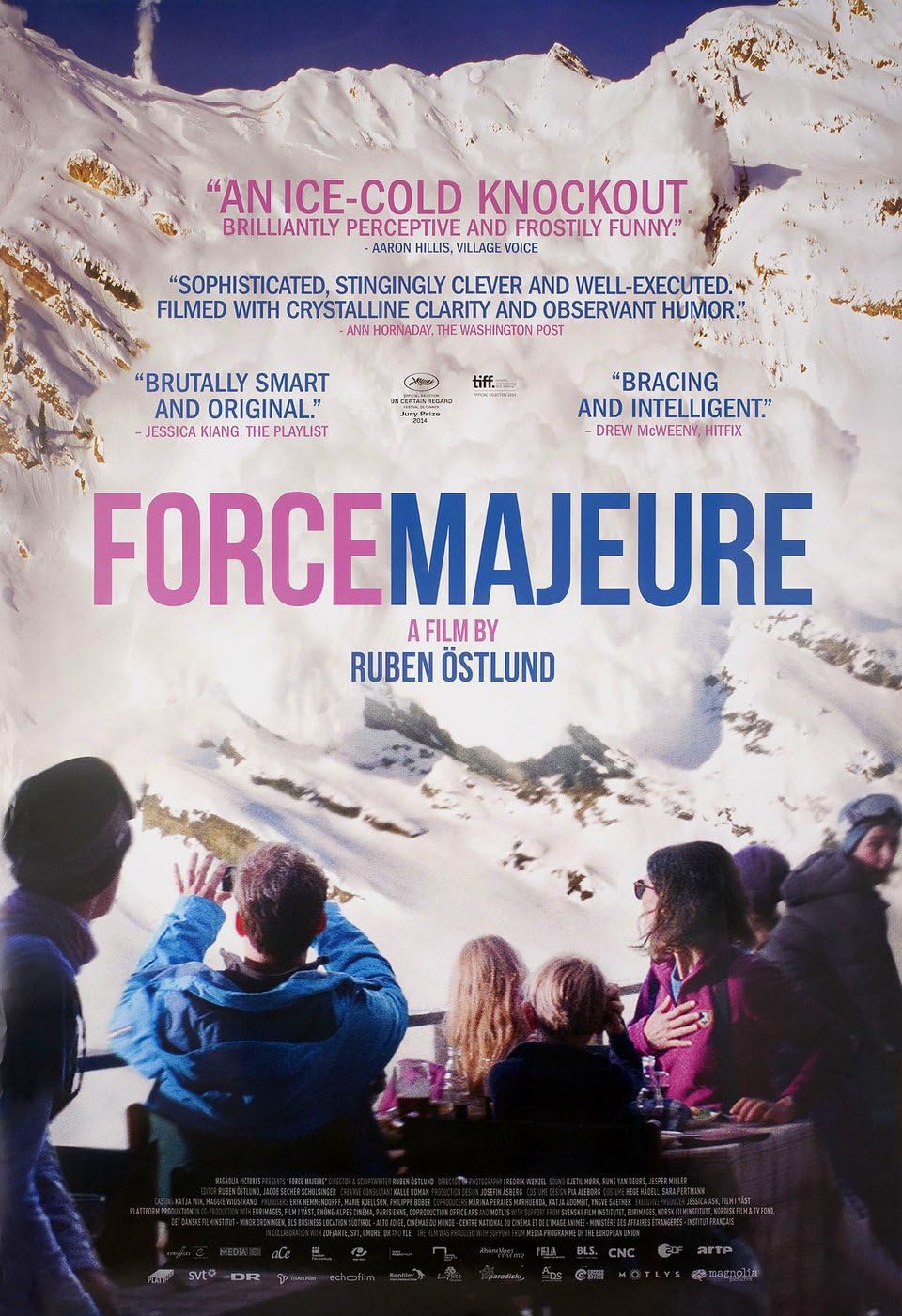
 Tomas (Johannes Bah Kuhnke) and Ebba (Lisa Loven Kongsli) are a married Swedish couple that decide to take a short vacation in the French Alps, where they hope to spend a few days with their children (Clara Wettergren and Vincent Wettergren) skiing through the snow-white landscapes and appreciating the tranquillity of the gorgeous countryside. However, during lunch one afternoon, a controlled avalanche gives off the appearance of a perilous disaster, which causes many of the residents to panic – including Tomas, who is so overcome by fear, he abandons his family momentarily, saving himself without so much as a second thought for his wife and children, who would have been annihilated had it been a more dangerous occurrence. Suddenly, this seemingly perfect family is thrown into a state of unease, with the marriage between Tomas and Ebba being tested – his cowardice in the face of a disaster changes how his wife perceives him, and their children begin to worry that their parents are going to find themselves torn apart by this event, which is certainly a very real threat. This is most evident in the days following the event, where Ebba and Tomas begin to see their dynamic changing, and the trust they had in their marriage starting to erode, with the innumerable problems they have seemingly ignored for years having no choice but to resurface. Their friends and new acquaintances that weave through their vacation begin to find themselves squarely in the middle of what is very clearly a disintegrating relationship that appears to have no resolution in sight, particularly when both parties are insistent on dwelling on their own perceptions.
Ruben Östlund has gradually increased his status to become one of the most exciting European directors working today, with his films all being compelling portraits of the lives of a variety of individuals all along the social and economic spectrum, and the various cultural standards and practices that they either abide by or vehemently opposed, which normally manifest as these darkly satirical social statements that normally focus on one particular storyline, which harbours a lot of commentary to a range of wider issues. It was Force Majeure (Swedish: Turist) that drew attention to Östlund in the first place as a filmmaker to watch carefully, and with good reason. The director crafted one of the most subversive films of the past decade, an irreverent tragicomedy that takes a remarkably simple premise and imbues it with an immense amount of broader meaning, particularly into the concept of marriage, which is used as an allegory for various cultural normalities that are often taken for granted. An immensely provocative, and incredibly funny, glimpse into the trials and tribulations of a group of ordinary individuals finding themselves faced with enormously intimidating metaphysical challenges, all set to the backdrop of the gorgeous landscapes of the French Alps, Force Majeure is understandably a powerful piece of filmmaking, where the meaning embedded in this subversive morality tale work in conjunction with terrific performances and impeccable stylistic filmmaking in telling an incredible complex, riveting story of survival, albeit a drastically different kind.
Much like his most famous cinematic compatriot, Östlund portrays a marriage that is slowly deteriorating in Force Majeure, but instead of a gradual erosion due to incompatibility, infidelity and, quite frankly, utter boredom, the impetus for this marriage being called into question was a brief moment of disaster that permanently shifted perceptions from both sides. The event in question occurs early within the first act, with the rest of the story focusing on the aftermath, which is more of an unconventional choice for a film like this, especially when the actual event is relatively minor in comparison to what would normally be the catalyst for such an intense examination of a marriage. Perhaps not the most realistic portrayal of such a story based on the overarching premise, once we move beyond the surface, we’re presented with a far more compelling story, one that doesn’t necessarily intend to show us only the emotional separation the two main characters find themselves encountering in the wake of this event, but also the underlying hope that remains. In this regard, Force Majeure is truly authentic – Östlund clearly didn’t intend to only show a marriage falling apart through growing resentment on the part of the central couple, but also their innumerable efforts, both internal and interpersonal, to overcome these feelings of uncertainty and betrayal. It’s ultimately a very hopeful film and one that manages to tell its story without resorting to the same cheap tactics normally employed to increase the intensity of a plot centred around such a resonant theme.
Force Majeure is propelled by many elements that go into making it such a successful piece of resonant fiction, most prominently in the approach to the tone with which the story is executed. When presented with the opportunity to make an overwrought, dour drama about marital strife, Östlund opted to go another direction entirely, choosing rather to make something that may be somewhat flippant about some of the themes to an extent, but which also uses dark humour as a mechanism to propel what is essentially a very bleak story about human perception and the limits of a marriage in the aftermath of a particularly perilous event. The film is presented as an amalgamation of a broad comedy, with some elements of physical humour and satire, and a serious drama about very dire social issues. Naturally, blending these two genres could have easily resulted in something that has diminished effectiveness, particularly in terms of the more grave storyline that underpins the comedic situations. However, Östlund masters the tone, perfecting it by finding the right balance between the many elements that go into successful bringing about both the upbeat humour and haunting dramatic moments that are peppered in quite evenly, making this quite an idiosyncratic film, one that focuses on presenting us with a story that will entertain us, but not neglecting the emotional gravitas that a film with this message should convey.
The challenge of making a film that can both enthral and provoke thought is far greater than most would expect when watching this film because Östlund seems to execute it with such precision, no doubt a result of his many years behind the camera, even prior to venturing into making narrative features. Force Majeure is very much indebted to the intelligent script and remarkably poignant direction demonstrated by Östlund, and bolstered by the incredible cast. Johannes Bah Kuhnke and Lisa Loven Kongsli lead the film and are both incredible. At the outset, they’re archetypes – they stand at the helm of an ordinary family, with Kuhnke’s Tomas being a dedicated working man who has to force himself to leave his work momentarily to recalibrate his priorities and give focus to a family that has become starved of his attention, while Kongsli’s Ebba is the typical maternal figure who holds the entire family together, being in firm command of everything, and making sure to assert the authority that no one would dare question.
However, it’s in these archetypal roles that Östlund is able to comment on the more subversive themes that come about through presenting us with what appear to be ordinary individuals. He manipulates cliched characters into portrayals of social roles, and the angst that tends to co-occur alongside them in stories like this. While it is often marketed as an eccentric disaster comedy, Force Majeure truly works best when it follows the conventions of a character-driven drama, where the more comic elements only serve to realign this film with a more effective tone, in which the absurdity of the narrative only increases the bleak nature of the underlying story. The cast is kept small, and thus are afforded countless opportunities to develop their characters – both Kuhnke and Kongsli are given extraordinary monologues, where we’re afforded insights into the minds of these characters stricken with the despair that comes with realizing the fallibility of what we previously thought was sacrosanct. It’s incredible work from the actors, who embrace Östlund’s script with the same intensity and honesty with which he wrote it.
The brewing tension that pervades this film is incredibly palpable, and Force Majeure always seems to be on the verge of eruption – yet, the most compelling part of the film comes not during that brief but memorable sequence that serves as the centrepiece of the story (an astonishing work of building and framing tension and fear), but rather in the more quiet moments. Östlund’s tendency to allow the camera to linger for a few moments longer than expected is a subtle but brilliant choice, as it exposes the vulnerability of the characters, and allows the performances to become even more indelible, with the authenticity facilitated by these longer shots creating an even more uneasy atmosphere, from which the director is able to derive a long of dramatic nuance, which remarkably goes almost entirely unspoken throughout the film. Force Majeure is a terrific exercise in experimenting with genre, with the director oscillating between comedy and drama with an ease that many other filmmakers fail to perfect, and deriving a sense of almost tranquil chaos from a story that feels so close to eruption throughout. It’s a tremendously simple foray into the depths of humanity, and as he has shown prior to this, and subsequently, Östlund has a keen understanding of how we focus, both individually and as a homogenous society. He gets beneath these archetypal characters and exposes their insecurities and quandaries in an endlessly fascinating way, resulting in a tremendously powerful, and immensely hilarious, portrayal of the human condition.
 The Postmodern Pelican