 If you put aside his prowess for the visual form, his depth of knowledge of both acting and directing in practically any medium, and his masterful control of character, whether central or peripheral, Orson Welles was simply a gifted storyteller – all of his films, whether his towering masterpieces or his more obscure works of experimental fiction, were mesmerizing forays into the roots of the human condition, fascinating character-pieces in which the plots revolved around unconventional protagonists in challenging situations, or portrayals of a world slightly detached from reality, and from which Welles was able to assert his own dominance as a filmmaker, where his authorial voice quite literally took over every aspect of the story, resulting in powerful, and occasionally quite affecting, tales of intrigue. The Immortal Story is a bit of an outlier in Welles’ filmography, no less due to the fact that it was his shortest film (running at just under an hour), as well as one that seemed less complete in a traditional sense, but also more intricate in its approach, where the director is able to assert his unconventional vision on a film that presented quite a challenge to anyone daring enough to venture into its labyrinthine structure. However, while it may be one of Welles’ more underseen films, there’s no denying that The Immortal Story is a true gem – brief, but extraordinarily memorable, it may deviate from some of the director’s more detailed sensibilities, but remains just as enthralling and fascinating as any of his more audacious productions.
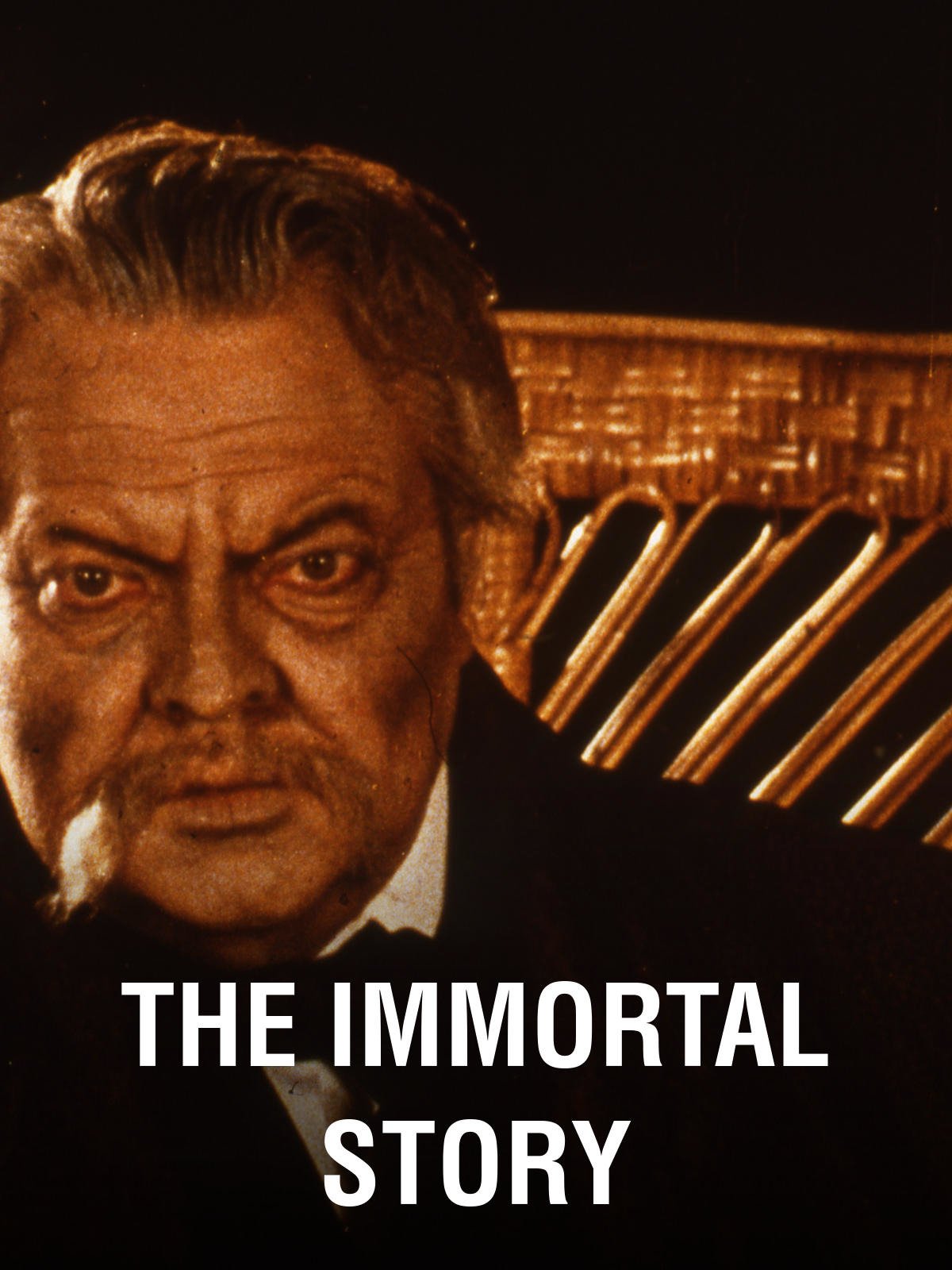
Based on a novel by Karen Blixen (writing under her socially-necessitated pseudonym of Izak Dinesen), The Immortal Story tells the story of Mr Clay (Welles), a wealthy American merchant living on the island of Macau, which was at the time still a Portuguese colony. A man of immense wealth and even greater loneliness, Clay finds his only companion in the form of Levinsky (Roger Coggio), his loyal manservant, valet and financial assistant. They spend Clay’s insomnia-filled evenings discussing matters of finance and trade, in the hopes of filling the empty space that plagues the lonely manor. One evening, their discussion turns to Clay relaying an old story he was told about a sailor who was paid five guineas to impregnate a beautiful woman – Levinsky, a man of the world himself, had heard the same story many times before from innumerable sailors, claiming this to be an old sea-tale that is shared between many seamen. Clay, disappointed by the fallacy of a story he thought was true, decides that he is going to use his wealth to make this fantasy a reality, with Levinsky venturing off into the streets of Macau to find willing participants. The two people employed to satiate Clay’s desire for this old tale to come true are Virgie (Jeanne Moreau), the daughter of a former business partner of Clay’s, and Paul (Norman Eshley), a grimy sailor. Their task is not made clear until Clay explains what he needs them to do, and once they eventually find out, their hesitations begin to intertwine with the financial gain that they’ll get from momentarily surrendering themselves to the perverted games of a man who has become so jaded by the perils of wealth, he is willing to use it for sinister reasons.
The thrust of The Immortal Story is essentially provoking the idea that there is some possibility of questioning reality, with the boundaries between reality and fantasy being far less sacrosanct than we’d imagine it to be. The rare kind of work that focuses on literature, or rather the culture of it, without being overly academic (one of Welles’ finest qualities – even his towering Shakesperean adaptations were liberated from the stigmas of being constrictive or dour), the film is a poignant exploration of storytelling in many forms. The core of the story is that of turning fiction into reality, with the premise being remarkably free of pretensions, an increasingly rare quality for this kind of subversive work. It makes great use of the concept of metanarratives, with the character of Mr Clay being a sour old man who realizes that he can take on an authorial voice, asserting his control to bring an old sailor’s yarn to life, and therefore in the process achieve some kind of immortality that is only afforded to those who construct these kinds of immortal stories. He takes advantage of the fact that the tale that serves as the catalyst for the plot has the benefit of being authorless, with every new version of the story contributing the longevity of what appears to be a beloved part of the culture. Breathing life into it through the use of his immense wealth is only going to bolster his own status, and is also going to compensate for his imminent death. The story is immortal, and Mr Clay hopes to achieve that same kind of ethereal remembrance, because while he has amassed a vast fortune and a reputation that most would be envious of, these memories will fade, but as long as the tale of the sailor and the virgin is told in the candle-lit cabins of the high-seas, Clay will live forever.
The Immortal Story is a remarkable film for a number of reasons, which we can all attribute to Welles, who takes a relatively complex set of themes from a somewhat intimidating literary source and repurposes them as something incredibly simple without sacrificing the brilliance of Blixen’s story. Made for French television, The Immortal Story is not very long, but Welles does not waste a moment of the space he is given, crafting a version of this story where the simplicity of the execution is less of a choice, and more of a necessity. Welles was never someone to turn down a challenge, so for him to make something this complex within such strict confines seems very much aligned with the overall message of the film as a whole. Standing outside the traditional style that the director normally made use of, this film somehow still manages to be a visual spectacle – from the outset, the otherworldly appearance of The Immortal Story stands out as being particularly prominent, with the engrossing use of saturated colour and gorgeous locations making it quite unfortunate that this was one of only two films Welles made in colour. His control of the form was almost as exceptional as his understanding of the story, which manifests in a truly incredible portrayal of a man descending into madness in the days leading up to his death and using whatever time he has left to leave a legacy. The Immortal Story is a film that develops itself along a particularly poignant line of questioning, and the simplicity through which Welles is not only able to explore these questions, but also offer some answers to them, is magnificent all on its own.
Ultimately, The Immortal Story works because it never tries too hard to be profound – despite being a filmmaker obsessed with crafting detail explorations of both art and the human condition, Welles’ work never resorted to the kind of arrogance that most would expect, especially from a story like this, where the nature of reality is not only a theme but the central thrust of what turns out to be an unexpectedly thrilling film. It is executed with a brisk pace, in which we are asked to question the very nature of truth, and what separates a mere story from reality, and how the pursuit of authenticity is not always as straightforward as it would appear. Featuring exceptional performances from the cast (in particular, Welles as his most brooding and deity-like, and Jeanne Moreau giving one of her signature ethereal performances that are still somehow grounded in reality), The Immortal Story is an atmospheric masterpiece, a brief but unforgettable affair that gives us the chance to encounter a wealth of challenging ideas, engaging with them with the kind of compelling humanity and fascinating insights into concepts far bigger than the film would normally suggest that only someone like Orson Welles, in his efforts to investigating broader themes of both artistry and humanity, could possibly afford to give us.
 The Postmodern Pelican