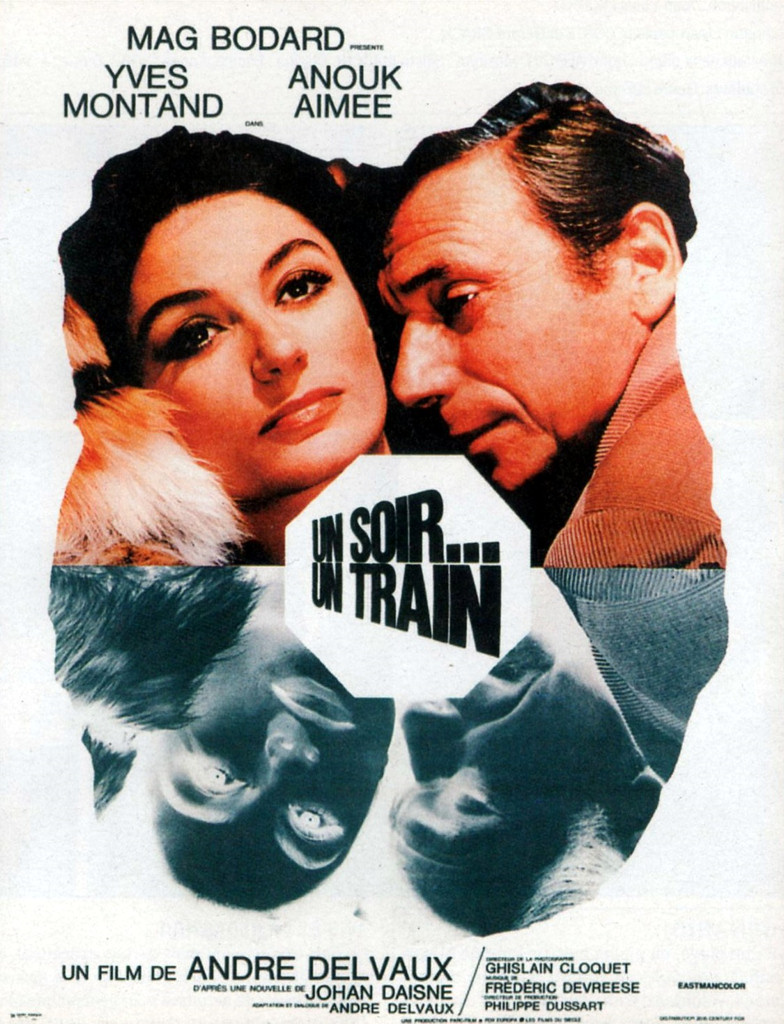
 Mathias (Yves Montand) is a mild-mannered linguist who is passionate about his work at a Belgian university, where he teaches a course that implores his students to look beyond the simple use of language and consider the semiotics of the environment around them, as they live in multimodal linguistic landscapes where meaning can be derived from absolutely anything. However, he seems unable to apply this in his everyday life, whether in his hobby, where he is working on a new experimental stage adaptation of an old story about religious dogma and the relationship with the self or in his domestic life, where his longtime girlfriend Anne (Anouk Aimée) urges him towards marriage, something he is clearly uncomfortable with, hiding his fear behind worries that their cultural differences would cause troubles in a marital situation. Their relationship is tested one fateful afternoon, as they board a train to a conference on the other side of Belgium. Mathias falls asleep, and when he wakes up, he discovers that Anne has mysteriously disappeared. A brief search for her leads him outside of the stagnant train, which has stopped momentarily to diagnose a problem, but sets off immediately, leaving Mathias and two strangers – the elusive elderly academic Hernhutter (Hector Camerlynck) and the youthful Val (François Beukelaers) – in the middle of nowhere. They embark on a search for any sign of civilization, which leads them, to their initial relief, to a small, unnamed village. They soon come to discover that the inhabitants, while demonstrating seemingly-identical cultural practices, are far removed from any kind of understanding, speaking a language none of them can conceive of, and being reluctant to engage with these strangers who enter into their lives unexpectedly. The search for Mathias’ partner continues, with it becoming very clear that this village harbours many more secrets than they would initially have thought and the key to the mysterious disappearance of Anne.
André Delvaux made an extraordinarily complex portrait of a society in flux with Un soir, un train, a profoundly moving, and often darkly comical, story of identity and communication that rests on the incredible power of words, whether the presence or absence of them and how we tend to negotiate meaning depending on how we perceive the world around us. A work of wonderfully abstract surrealism, where the fundamental story is kept simple, but rather the implications and underlying messages that surround it being the folly of more experimental forays into the human condition. Beautifully-composed by a director whose background in visual art pervades every frame of this film, turning it into a gorgeous tapestry of existential issues that is unwaveringly confident in its portrayal of larger issues, which is delivered in a poignant, memorable series of images that are buttressed with commentary that may take some active engagement with the work to truly understand (Un soir, un train is not a film that facilitates passive viewing – the audience becomes a part of the story in quite unexpected ways, going on this unconventional voyage with these strange characters, rather than just peering at them through a voyeuristic lens), but becomes an entirely worthwhile endeavour, especially when the film descends into the most pleasurable kind of narrative chaos, the anarchy of complexity enveloping this film and its characters, and taking us in some of the most unexpected directions, which is gaudy when done without tact, but through his intricate understanding of both the content he seeks to represent, and the form he wants it to take, Delvaux is able to make one of the most fiendishly original works of classic postmodernism, the rare kind that doesn’t propose complete objectivity but rather exploits it in wonderfully twisted ways.
Un Soir, un train is a film that doesn’t give the viewer much in terms of context – it launches us into the middle of a story, with only minor indications of the direction it is going to take, with the task of putting everything together being the responsibility of the viewer, who forms their own interpretation of the basic thematic content that Delvaux is providing to us here. The key to understanding this film comes in the form of a very basic concept – the use of language. What seems to be a quaint story about a linguist struggling to find compatibility with his potential wife due to their cultural differences, and the languages that come along with it (he understands her ancestral language, but she’s completely unversed in his). Communication is key to this film, and a lot of the plot depends on various spoken, and more importantly unspoken, interactions between characters – whether the wordless exchange between Mathias and Anne when they encounter each other on the train, in which more is said without a single utterance, or the verbosity of the stories told by the main characters while they’re in search of some understanding of the situation around them, always trying to contextualize reality, which becomes increasingly difficult the further they venture into the realm of linguistic absurdity, where nothing makes sense to them, which is against their primal instincts as academically-minded individuals. Un Soir, un train is effective because the cultural differences are played for the sake of surrealism, rather than for humourous effect. This is not the upbeat comedy about culture shock and the shenanigans that afflict two different groups of people when they find themselves intersecting – its a dark, brooding tale of misinformation derived from misunderstanding. Inarguably a film that doesn’t intend to make any sense, and certainly succeeds in this regard, Delvaux’s approach to this film, while sometimes slightly convoluted, is impressive in both scope and intention, which makes it a thoroughly compelling, and extraordinarily intelligent, work of postmodern fiction.
However, unlike most postmodern films that would come after this (Un Soir, un train is remarkably ahead of its time in some of these themes), it doesn’t have the same kind of playfulness that would normally be evoked with this kind of story. The themes that Delvaux looks at in this film are certainly not to be underestimated – death is the overarching metanarrative at play here, even though the only time it is explicitly spoken about, or where it is actually directly addressed, is towards the beginning of the film, where Montand’s character is giving direction to the actor playing the embodiment of Death in his play (the rare kind of foreshadowing that is both obvious and incredibly subversive). The film takes us into a dreamlike state, making use of a transcendent perspective on reality that manifests as something quite pensive, particularly in how it approaches some of the challenging themes that form the thrust of the story. Delvaux curates a film where reality is not only questioned, its eviscerated, provoked to the point where it almost unrecognizable, with the form being uncanny, and the feeling of familiarity that these characters would feel being rendered entirely irrelevant as a result of this unreal, waking nightmare they have found themselves in. Its not a coincidence the three travellers in this story are a linguist, a theological anthropologist and a world-weary vagamundo, all of which would naturally relish in the chance of immersing themselves in a different culture, but find it to be an unsettling experience when it becomes clear none of their knowledge, no matter how ratified by years of experience, could prepare them for the disconcerting world they have stumbled across.
Un Soir, un train is not a film that is always as approachable as it appears to be, which may come as something of a surprise, as the filmmaking is enriched with a kind of warmth not normally found in this kind of abstract surrealism, with Delvaux drawing on his own experience in artistic composition to infuse every frame of his film with a certain vivacity that would otherwise have been missing, had it not be produced with such rigorous passion. The film is committed to presenting the audience with an unforgettable experience, making use of an incredibly intelligent screenplay, exceptional performances (particularly from the wonderful Yves Montand and Anouk Aimée, who bring such nuance to otherwise thinly-conceived roles, archetypes that are interesting to perceive, but only become impactful under the careful interpretation of these gifted actors) and a style of filmmaking detached from all semblance of reality. Un Soir, un train is a profoundly magnificent work, where the grandeur of the human condition, and the complexity of the darker recesses of our existential angst, converge into a disquieting, but truly compelling, story of a dreamlike descent into a different kind of social order, one that defies our occasionally restrictive confines, repurposed in a way that suggests reality may be far more malleable than we normally imagine it to be. Delvaux finds the perfect blend of style and substance with Un Soir, un train, and gives us a chance to explore these questions along with his unconventional protagonists, with their journey culminating in a bizarre, but wonderfully layered, vision of a world that doesn’t quite make sense – not that it necessarily needs to, especially not when conveying as potent a message on the delicate balance between life and death, as it is here.
 The Postmodern Pelican
A movie about a linguist? I had a giggle till I actually thought about it.
Outstanding movies about linguistics
1. The Miracle Worker (Penn, 1962)
2. My Fair Lady (Cukor, 1964)
3. The Wild Child (Truffaut, 1969)
4. Ball of Fire (Hawks, 1941)
5. Youth Without Youth (Coppola, 2007)
6. Arrival (Villanueva, 2016)
7. Iceman (Schepisi, 19984)