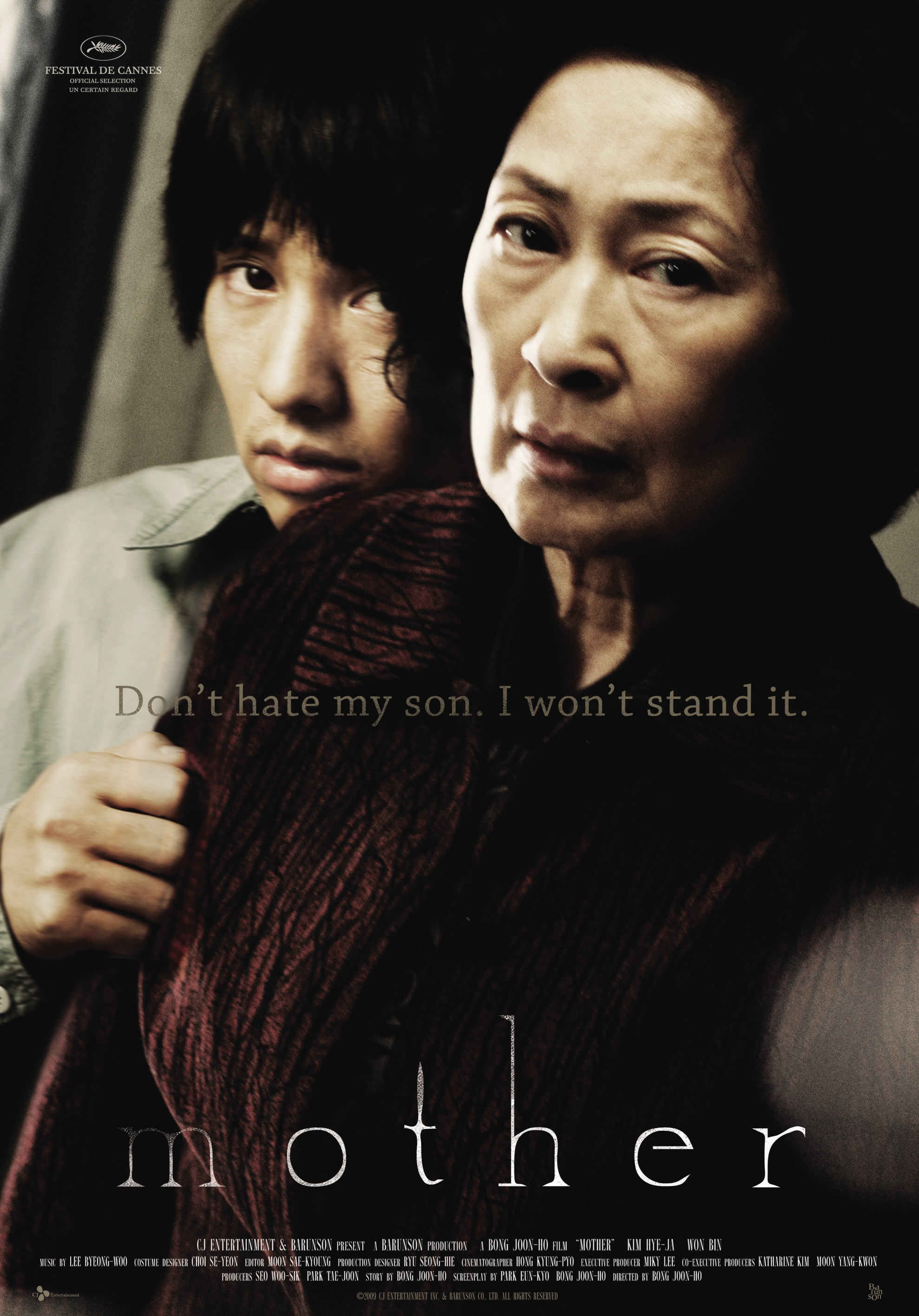
 When it comes to taking matters in your own hands, Bong Joon-ho’s Mother (Korean: 마더) is a film that redefines the concept. A darkly comical psychological thriller, very much analogous to the director’s intentions as a social commentator, this film proves Bong as someone who can take the most conventional concept and turn it into something extraordinary. Telling the story of an unnamed widow that simply goes by “Madeo” who decides to defy expectations and take vengeance on those who wronged her mentally-disabled sons, the film is able to comment on only on broad social ideas, but the very nature of the genre in which it’s operating. Bong is a director whose work always reflects a keen understanding of the human condition, and even when he’s delivering work that may not be as perfectly-calibrated as some of the towering classics that have put him at the forefront of contemporary world cinema, but is still remarkable even on its own terms as a subversive investigation of certain ideas, where the story challenges conventions in a twisted, but ultimately brilliant way. Mother takes on many themes and navigates challenging subject matter in a way that shows the director daring us to suspend our own moral grounding for the sake of this story, and as a result sometimes tends to forget about some of the broader concepts it introduces, but its ultimately just as fascinating, meaningful and compelling as the director’s other work, and a worthy addition to a career that is well on its way to defining modern filmmaking.
One of Bong’s most fascinating qualities as a filmmaker is that his work always reflects a certain curiosity with humanity – even when sampling from the horror and science fiction genres, his work is always kept at a profoundly human level, with the stories exploring the underlying social and cultural themes that persist in even the most outrageous of stories. This lends his films a simplicity many of his contemporaries are not afforded, and in taking on a straightforward story, he is able to build on some substantial themes without ever deviating from his more basic intentions. Complex without being too overwrought, Mother is a film that benefits significantly from his approach and often manages to be compelling even when it is at its most bleak. Produced during an era in which Bong was experimenting with form and content (with this film occurring between his forays into monster horror with The Host and apocalyptic science fiction in Snowpiercer), Mother explores many different genres, most prominently the neo-noir, with the story of one individual growing weary of the authorities and asserting vengeance on those who dismantled her relatively happy life being aligned with some of the darker crime films made in the past few decades. Moreover, like the director’s frequent flirtations with genre work, this film isn’t content to just look at a single set of generic conventions, but rather challenge a deeper variety of ideas, bringing wit it commentary on society as a whole through its acidic sense of black humour, which never quite allows the audience the solicit the comfort we’d expect from a film that initially proposes itself as a heartwarming tale of mother’s love. There’s a lot lurking beneath the surface of Mother – but for anyone who has seen even a moment of the director’s work will undoubtedly tell you, this isn’t only common, it is thoroughly expected.
I’ll say this: any film that starts with its elderly protagonist dancing in a wheatfield already has my heart from the outset. Kim Hye-ja proves one of the most unheralded merits of Bong’s filmmaking – his ability to derive incredible performances from actors while allowing them to still be subtle and nuanced. While there are certainly some extraordinarily broad performances in some of his films, Mother is one that approaches its characters from a more reserved space, and Kim leads the cast with a sincerity that will undoubtedly prove to be one of the best performances the director was ever able to capture. The unnamed protagonist of Mother is a fascinating figure – at the outset, she’s just a humble urban woman who runs her business and is happy to get by with the bare minimum. She only breaks out of this cycle when it comes to her son, who she watches over with an overprotectiveness that is intentionally quite stifling, already constructing a character who is compelling while still having clear flaws. The smallest nuances in the early stages of the film set up the rest of the story, where Kim develops a character alongside Bong that defies all expectations, yet without venturing too far out of the carefully-curated confines of who the character is. “Madeo” is a woman who doesn’t suddenly change after a traumatic incident – she remains the same, with only her attitude towards the situations she finds herself in positioning her as different. Even in the boldest moments of the performance, Kim’s work resounds the most when she is the most reserved, with her introspective portrayal of a woman venturing into a form of modern turpitude for the sake of protecting her son, without actually abandoning her primal principles, being the most enduring quality of the film. Despite the ensemble who occurs around her, Kim commands the screen and we struggle to ever divert our attention away from her, which is truly symbolic of an astonishing performance by an actress who creates an endlessly intriguing character that defiantly resists tropes in a fascinating way.
Resisting cliche seems to be the primary manifesto for most of Bong’s work, and Mother is certainly not any exception. The film tackles deep thematic territory, being simulatenously able to comment on more personal issues (such as mental disability and familial relationships) in contrast with much bigger social ideas, which converge into this unconventional dark comedy about the limitless bounds a parent will normally go to in order to protect their child. This is not a theme that has gone amiss in literature before, and where this film differs is that it uses this resonant subject as a launching pad for something more profoundly offbeat. By blending family drama with psychological thriller, Bong creates an audacious combination of ideas that may lose momentum, especially towards the end, but remains endlessly fascinating, even when it becomes too concerned with a relatively one-dimensional approach to the characterization of the peripheral roles, which is only superseded by the astounding work done by the lead actress. Mother unfortunately devolves into something a bit too convoluted, especially between the initial impetus of the main plot, and the shocking resolution, with the journey towards the answers provoked throughout being slightly too labyrinthine to work to the capacity they possibly could. Certainly not an indictment on the film as a whole, but rather a comment on how Bong seems to have focused more attention on the smaller details than how he puts them together, the film is still excellent, it only tends to deviate from brilliance in some instances, especially when a more simple approach to some of these moments (such as the portrayal of past events through flashback) could’ve been subjected to a slightly more simple approach. It’s always an inherent danger with these kinds of genre-bending films that it loses some of the potency as the different conventions intertwine – but Bong is aware enough of the challenges to overcome them in a way where the visceral brilliance of the film is ultimately not lost, but only slightly muted in the moments leading to the heart-wrenchingly brilliant conclusion.
Mother is yet another triumph for the director, and while it predates the enormous gloval success he has amassed in recent years, it shows that he has always been keenly aware of the powerful a medium like film has for conveying certain meanings, especially in the form of a film like this, where the story is kept relatively simple, but the directions it is taken becomes almost intimidating in its approach, and where the darkest recesses of human nature can be exposed with a certain ferocity that has defined so much of what the filmmaker has expressed throughout his career. Anchored by a reveletory performance by Kim Hye-ja, who brings out both the outrageous humour and aching melancholy in the story, as well as conveying the darker recesses in which this film takes the viewer, Mother is the perfect exemplification of why Bong is an artist at the peak of his craft. Like we’ve come to learn throughout his career when it comes to Bong’s work, the best expectation is to anticipate the unexpected, because nothing can prepare us for the maelstrom of subversive excellence that he brings to Mother, a film that rises above middling flaws and convoluted subject matter to be an explosive, darkly comical investigation of human nature, made by a director whose work has never once come close to being conventional, making it very clear that no one can surprise us in the way Bong Joon-ho can.
 The Postmodern Pelican