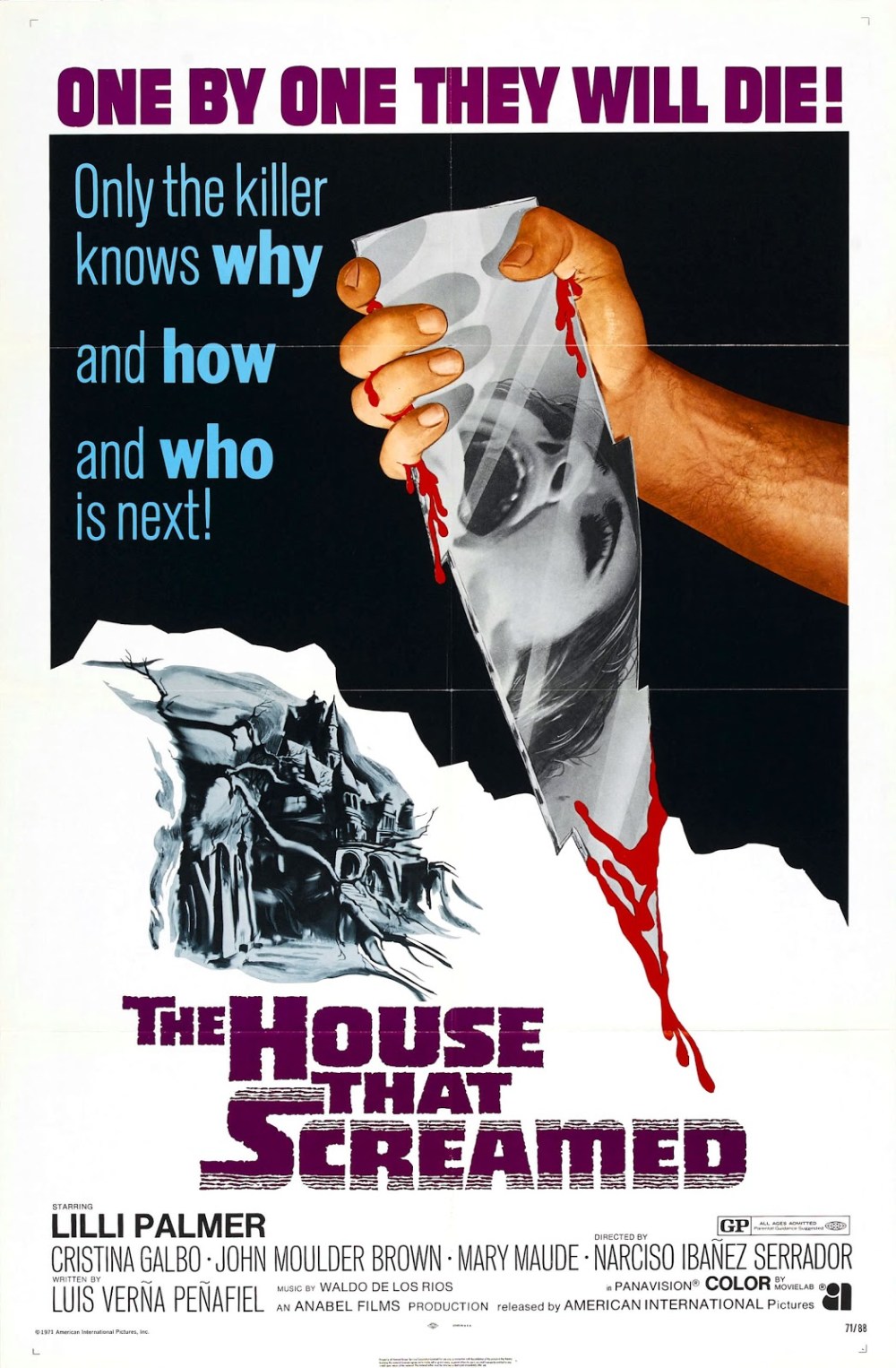
 Horror is a genre that has produced just as many iconic figures as it has thrust audacious filmmakers into obscurity, regardless of the quality of their work. A figure that grapples the line between these two is Narciso Ibáñez Serrador, a director who may have only made two theatrical films, but did so in such a way that they would not only be exceptional entries into the genre but also subversive experiments with form and content. The first of the two was The House That Screamed (Spanish: La residencia), a film that may appear to be a standard gothic Victorian-era horror, but soon devolves into something far more sinister, and memorable in a way that just cannot be overlooked. This isn’t a film I particularly loved – there were many qualities, both in terms of the story and the various social and cultural concepts it looked at, that kept me at a distance, but to deny the brief but prominent moments of sheer genius isn’t only misguided, its a great disservice to a film that dares to be different, and even though it is confined to follow a familiar thematic formula (as well as being restricted geographically in a way that does tend to become too self-indulgent at times), it overcomes these obstacles through being a deeply compelling, and sometimes deliriously surreal, piece of horror filmmaking that succeeds the most when it is trying the least, which is something that is increasingly rare with this kind of European horror, a film that The House That Screamed sometimes relies far too heavily on.
Señora Fourneau (Lilli Palmer) is the stern headmistress of a mysterious boarding school for girls somewhere in the French countryside, far from the rest of society. There is something amiss with this academy, which the newest addition, a wayward young woman named Teresa (Cristina Galbó) soon realizes. Her classmates are initially very friendly – they are enthusiastic about someone new joining them, and do their best to welcome her in as warmly as possible. However, Teresa soon learns there is something sinister about this school – the constant surveillance, draconian rules – such as sleeping in a locked dormitory, the only keys being in the possession of Irene (Mary Maude), a vitriolic sycophant who relishes in being the favourite student over the rest of her peers – and the general sense of unease starts to erode on Teresa’s sanity, and she begins to plot her escape. However, this kind of rebelliousness has not worked for any of the other girls in the past who have escaped, as they all meet a gruesome demise at the hands of a malicious entity that lurks throughout the school, looking to find a victim for their perverted entertainment. Fourneau refuses to believe these disappearances are anything less than successful escapes, and appears to think nothing of it until her own paranoia starts to alert her to the very clear dangers that are afflicting the school she runs with such pride – however, does she know more than others think she does or is she headed towards becoming a victim as well?
My reaction to this film is certainly not an easy one, and I do have mixed feelings towards it. The best place to start would be with the more negative side of this film. Serrador would go on to make Who Can Kill a Child?, one of the most unsettling horror films ever made, where the director subverts all expectations by setting the story across the sunny seaside vistas of luxurious Spain and making the villains a group of adorable children, who terrify us more than most traditional horror figures. While we can assert certain criticisms on the director, its difficult to deny that he made two very distinct horror films that feel on opposing ends of the spectrum – it just so happens that The House That Screamed is at the end that is far less original, taking most of its cues from a set of derivative conventions that governed European horror with an almost intimidating sense of urgency. A time period distant enough to evoke a sense of unease, but recent enough to not be alienating, a large building that harbours many secrets, and a large ensemble of characters ranging from woefully innocent to viciously sinister. Add to this the unfortunate tendency to be highly predictable (at least for the most part), and you have The House That Screamed, a film that follows the trite structure almost too closely for it to be considered anything less than intentional. European horror, while successful, does often refuse to stray, and this film is not much of an exception, often meeting every expected beat with disconcerting precision – this is ultimately remedied with the climax (which we’ll discuss momentarily), but the film doesn’t do too well in establishing the story as being anything we haven’t seen before – it does have its complexities and quirks, which do prevent it from becoming as vapid as other films with similar subject matter.
The question is whether or not the film falling victim to expectations is harmful or quite an ingenious move on behalf of the director. Serrador appears to be quietly challenging preconceived notions of this kind of horror film, which he does through a meticulous recreation of many of the genre’s more pedestrian qualities, to the point where one couldn’t be blamed for genuinely thinking it was just another forgettable European horror that purports to be terrifying, but actually turns out to be a bit more complex than this. Naturally, this requires us to assume that Serrador was actively challenging conventions through embracing them, albeit momentarily. There is no clear evidence of it, outside of three scenes that could be considered as being indicative of something much deeper here. The first is one of many murders that occurs towards the beginning of the film, where an innocent young girl ventures out past the curfew to engage in sordid activities with a young man, only to be brutally murdered – the camera captures this harrowing act through overlaying her dying face with the lethal weapon, as well as enormous significance coming on behalf of the accompanying score, a piano piece that goes from cheerful to sombre, and slowly goes out of tune as the life is steadily drained from her. The second scene is one that is much less conventional and almost feels out of place in a film like this, when one of the older girls taunts their new arrival, demanding she sing and “smile more” – perhaps the most unsettling moment in the entire film, and far more terrifying than any of the murders that take place.
The third scene is one that is most confusing, mainly because the concept is impeccable, but the execution poor, with neither managing to dominate the other, creating a sense of unease, perhaps intentionally so. Without giving the specifics of the scene away, we can note how Serrador deconstructs the common ideas of a traditional horror by leaping into truly grim territory – where most films in the genre would end with some form of salvation, or good prevailing over evil, The House That Screamed is much less interested in this. This all speaks to the impressive character work done by the ensemble – throughout the film, we are led to believe certain characters are the antagonists, only to have the director shift the moralistic goalposts by killing the heroine (who turned out to be merely a plot device), and launching the characters of Irene and Sra. Fourneau into the centre of this demented story, where they are no longer afflicting suffering and despair, but feeling it for themselves. Serrador, for all the flaws present in the film, certainly knows how to challenge convention, and he infuses many shocking surprises into the film – arguably not frequently enough, as the film does still tend towards being far too traditional for a story like this to flourish. It allows for The House That Screamed to feature some impressive performances, particularly those by Lili Palmer and Mary Maude, who are very strong, especially when it comes to shifting from unhinged villainy to complete vulnerability. If we are to praise The House That Screamed for anything in particular, it would be in how, despite the dominance of cliches, Serrador’s approach to constructing his characters as more than just stereotypes.
The House That Screamed may be formulaic, but at least its interestingly so – there are so many films produced during this era that rely too heavily on the saturated sense of dread, and the inherent fear of the unknown, it is refreshing to see a film that may not venture too far out of these themes, but at least manages to successfully use the resources it has to make something that appears to at least be more original. The film ultimately thrives on the effective use of location to supplement the story, and a general sense of dread pulsating throughout the film, which sets an eerie atmosphere and allows the film to continuously flourish, even when the material it projects isn’t all that impressive or unique. The House That Screamed is a film that knows its limitations, and it openly embraces them, and even if the ending, which is far more insidious than one would expect, falters due to time constraints preventing the tension needed to make it as terrifying as it could’ve been. It’s still a gripping, fascinating excursion into the depths of terror, and while it does take a while to surface with something worthwhile, the final result is good enough for us to proclaim this a success, and proof that Narciso Ibáñez Serrador truly had it in him to become one of horror’s great auteurs, having crafted two of the most unique entries into the genre, leaving an indelible impression on the future of horror storytelling, even if we didn’t realize it from the outset.
 The Postmodern Pelican