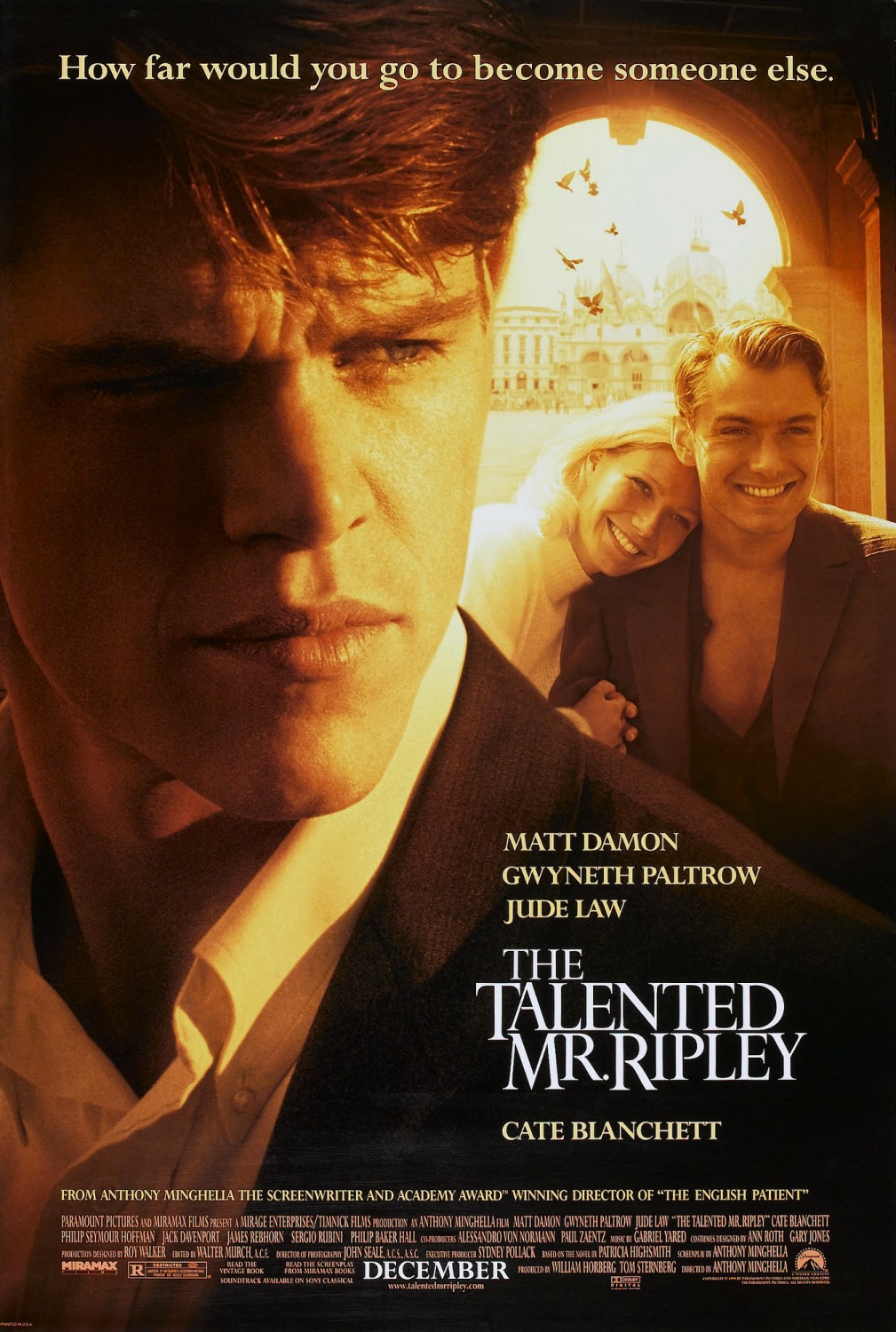
 One of my great blindspots in cinema has always been The Talented Mr. Ripley, a film that has always lurked omnipotent as something I knew I’d get around to eventually, but never felt much urgency to watch, as so much has been said about this film, despite the praise compounding with every passing review or piece that explores its various intricacies, and proclaims it as one of the finest films of its era. In fact, it wasn’t this film itself that motivated me to finally watch it, but rather Wim Wenders’ exceptional film, The American Friend, from which I finally understood what precisely was so compelling about Patricia Highsmith’s incredible creation, Tom Ripley, and why this enigmatic con artist has been a source of fascination for many artists for over half a century. However, none of my expectations could have anticipated The Talented Mr. Ripley, a film that could be as close to perfect as possible, specifically because of how devilishly it tends to embrace its slight imperfections, a fact that it not only accepts but thrives upon, using them to its advantage in this rugged, monumental achievement. Films like this tend to develop a certain reputation, either through the accolades they receive, or their entry into the canon of great films that push the boundaries of art in ways that sometimes unexpected, or simply their immense popularity with audiences or critics, forcing them to have no other choice but to be named a cinematic classic. The danger with such labels is that there’s always the risk of newcomers to the work feeling underwhelmed, considering the scope of the acclaim. The delight I felt in realizing that not only did The Talented Mr. Ripley meet my expectations, but exceeded them in a way almost unheard of for a film of this stature, is unprecedented. This is an instantly captivating work of fiction that feels so authentic – no doubt the result of a director who understood the smallest intricacies of humanity, even when the scope of the project is intimidating – and it’s commitment to taking Highsmith’s novel (which had been adapted previously on a few occasions) and turning it into one of the finest films of its period, is all the more reason to confirm that The Talented Mr. Ripley truly is a masterpiece in every sense of the word.
Anthony Minghella made a film that found a specific cinematic quality that was lost somewhere between the rise of New Hollywood and the growing independent arthouse movement that was already an established institution, despite still being relatively in its infancy. The precise quality isn’t ever made clear, but it becomes evident in the most subtle moments, whether in how the director captures the atmosphere (could this be the most authentically European film ever made by an American studio?), or how he derives every bit of elegant shock out of Highsmith’s astounding novel, or simply the fact that The Talented Mr. Ripley is an incredibly intelligent film, filled with many surprises and a twisted sense of sardonic humour that is never played for laughs, but with the dignity of the most profound character-driven drama. One element of The Talented Mr. Ripley that so many who adore this film seem unable to put into words is the exact nature of why it succeeds so much – Minghella was walking a fine-line with this film, but never allows it to default into pretention, which was something that would have been far too easy to accomplish, especially with a story built out of the arrogance of youth, which is only bolstered by the presence of money, which worsens the moral conditions of these characters. Not necessarily an indictment on the upper-class, and more a critique of those who allow their offspring to live excessive lives, whether as a reward or (as this film suggests) a way of ensuring certain secrets are kept hidden, the film takes the viewer on a twisted psychological journey, where we may think we have some idea of where everything is hidden, but just as we believe resolution is on the horizon, we’re thrown in another direction – this is why, despite the length, The Talented Mr. Ripley flows with such an incredible pace, being expeditious in how it traverses the demented actions of Tom Ripley, but also willing to be a meditative exploration of these characters, their mindsets and their actions, which goes towards building this film as a truly enthralling piece of modern storytelling, where the director finds the perfect balance between zest and rumination and delivers it with such unprecedented precision.
The Talented Mr. Ripley takes on Highsmith’s novel with such a stateliness, it’s sometimes difficult to remember that we are essentially watching a pulpy crime thriller, disguised as an elegant, almost noble, period drama – and the fact that it doesn’t only appear to be this on the surface, but actually becomes it by the end of it, shows how Minghella made sure that there was a certain narrative grandeur sewn into the fabric of this film, which allowed it to avoid some of the more tiresome conventions that are too common with this kind of story. It’s a tremendously fascinating literary adaptation that leaps off the page in a way that very few tend to do (Minghella’s script contains the delicate touch that was particularly prominent in the groundbreaking work done by Ruth Prawer Jhabvala in her partnership with Merchant Ivory) and flourishes into an opulent psychological thriller set to the lavish background of some of Italy’s most gorgeous locations, filled with a genuine sense of tension that never allows the viewer to let their guard down for even a moment, keeping us on edge in a way not even the most well-made thrillers are always able to do. It’s exciting without being overwhelming, lavish without being excessive, and finds the nuances in a daunting story that could’ve so rapidly descended into nothing, but rather thrives as a masterful example of taking a brilliant story and translating it to the screen in a truly unique, but still fiercely loyal, manner. This is a perfect example of restraint when it comes to telling a story that threatens to be overwhelming, guided by a director whose vision was intent not only on building this world, but also getting to the very human root of the story, which is where The Talented Mr. Ripley flourishes the most – Minghella’s deft ability to make something of such a grand scope, but not neglect the intricacies of the story, the kind of details normally lost in the spectacle of similar films, confirms this as something truly special, and earns every bit of acclaim as the kind of unhinged psychological thriller the story deserved.
However, while certainly an aspect that tends to be amongst its most significant strengths, The Talented Mr. Ripley isn’t only propelled by a great story, but also by a set of extraordinary performances, with the cast being composed of actors who may have achieved massive acclaim already, but were still the embodiment of the younger generation of Hollywood was on the precipice of dominating it, given the task of interpreting these characters and bringing them to life, populating Minghella’s gorgeous Italian landscapes that he captures with such tender but magnificent elegance. These performances brought out something very rare in the film, as it was portrayed by an ensemble that may have already achieved so much by this point, but were still young enough to be seen as relative newcomers, especially in an industry that grasps onto its veterans with a fierce intensity, and where films centred so much on the follies of youth were far from being given this kind of attention. The titular role of Tom Ripley is played to perfection by Matt Damon, who gives perhaps his finest performance to date in the role. Damon is certainly a charismatic actor, but he’s not someone who commands the screen in the same way as his contemporaries, normally being a reliable but sometimes dull presence that represents heroism, but rarely ever the kind of nuance other actors of his generation were known for. This is obviously very different for The Talented Mr. Ripley, where Damon embodies the malicious Tom Ripley with such ferocity, it’s baffling that he never managed to get roles of this calibre again. Gloriously evil, but portrayed with an affection that never makes him all that unlikable, Damon’s version of Ripley is incredibly complex, and such a delight to despise. It’s not often that villains are executed with such a distinct charisma, and there’s something about how Damon plays the role that seems effective but offbeat – it’s almost as if we are being manipulated by Ripley ourselves, falling victim to his deranged mystique in the same way as the other characters. Tom Ripley is such an interesting character, precisely because each time one of Highsmith’s novels are adapted, the role changes depending on the actor playing him – and Damon’s blend of innocent studiousness and an underlying sense of insidious malice work extremely well in conveying Ripley’s inner state, which is most clear in the shots that bookend in the film, which may be identical in form, but could not be more different in how the audience perceives them.
Damon is simply incredible in The Talented Mr. Ripley, but so much of this film also depends on the cast around him. Ripley would not be as compelling a character had he not been afforded the opportunity to deceive a wide group of individuals who fall for his schoolboy charms, being unaware of the evil lurking beneath it. Ripley’s immorality is contrasted with the excess of Dickie Greenleaf, played to utter perfection by Jude Law, who comes very close to stealing this film from Damon entirely. Law’s greatest merit as an actor is his magnetic charm – his mischevious smile, his subtle intensity and extraordinary ability to bring out the nuance in even the most archetypal characters, makes Dickie less of a plot device, and more of an indelible element of the film as a whole. Law and Damon have magnificent chemistry, mainly because they embrace the radically different charms of their two characters in a very symbiotic way – Dickie can get anyone to do his bidding based solely on his effortlessly enticing nature, while Ripley is far more manipulative, which makes for a fascinating dynamic. The Talented Mr. Ripley, while undeniably Damon’s film, does benefit from the supporting cast, even those outside of Law, including Gwyneth Paltrow also doing some of her strongest work (no doubt the result of the realization that restraint is best suited for the role), and early indications that Cate Blanchett and Philip Seymour Hoffman, while already established as great actors, would go on to be defining performers of their generation. Blanchett is at her most regal, Hoffman at his most endearingly smarmy, and while their roles are relatively small, they still make a considerable impact in this impressive ensemble. The cast in this film is extraordinary, and not only do they complement Damon, but they also have their own moments of unhinged brilliance, which is always something wonderful to behold, especially from a film like this, where the characters normally tend to be disposed of in favour of the story. It’s not often that we get such detailed character development in a film already profusely brimming with labyrinthine turns, but The Talented Mr. Ripley just proves to be something truly extraordinary in every regard.
Minghella was a director who, even at his most conventional, demonstrated a kind of genius present in some of the great monuments of directing like Lean and DeMille, where his authority, coupled with his vision and penchant for telling these dauntingly complex stories, and which has seemingly faded from memory as a result of more auteur-based simplicity. The only difference is, Minghella was not a victim of spectacle and was able to make a film that has all the qualities of a great epic, but the intricacies that came about in the shift towards more character-driven storytelling. This works very well with The Talented Mr. Ripley, which feels like a bold thriller that sees our anti-hero trotting across beautiful European cities, engaged in his sinister plot, but featuring a kind of intimacy that allows the director to really get beneath the surface and explore the roots of these characters, exposing their twisted mentalities and peering at their desires, in a way that feels elegant in its voyeuristic intentions. Minghella composes this film with such a precise touch, not only recreating the beautiful locations Highsmith wrote of with such enthusiasm, but capturing the author’s tone, creating an atmosphere that is simultaneously sophisticated and thrilling. The Talented Mr. Ripley is Alfred Hitchcock by way of Luchino Visconti, with the fast-paced titillation and unexpected twists that keep us guessing throughout of the former contrasting with the cautiously stylish elegance of the latter. The period setting also doesn’t serve as a distraction for the story (as tends to be all too common with these kinds of films), but rather where they work in tandem – the film transports us to the past, but doesn’t rely on the historical context to tell the story, but rather functions as a background for the events depicted. Evoked in equal part by Minghella’s exceptional screenplay and tremendous attention to detail as a director, and the gorgeous cinematography by John Seale, The Talented Mr. Ripley is a beautifully-devised thriller that somehow manages to be effective without sacrificing its intelligence, elegance or authenticity, using them all in the endeavour to be as riveting as possible, and where the complexities found in the novel are flawlessly translated from the page to the screen in a way that feels completely authentic.
As gorgeous as this film is, we can’t neglect to comment on what lies beneath the beautiful exterior, and the essential story we’re being told – The Talented Mr. Ripley is ultimately exactly what a great psychological thriller should be, mainly because it manages to be make sense of a very complex narrative without ever being overwhelming, but also not feeling the compulsion to simplify it in a way that would mean it loses its edge, never resorting to eroding the imperfections underlying Highsmith’s story, but rather using them as a means of conveying the rugged despair that underpins the trials and tribulations of our troubled anti-hero. The Talented Mr. Ripley is an enthralling experience solely because it understands that simply presenting this story to us isn’t an effective strategy, with Minghella taking the approach to make us active participants – we are never told too much, but are given just enough information to keep us guessing what Ripley’s next move is going to be. It makes for a memorable game of cat-and-mouse, where we peer into the life of Ripley and his many associates (or rather, those who believe themselves to be associated with Tom Ripley), and are witness to the deranged psychological machinations of one of fiction’s great villains. This isn’t necessarily an unknown concept – there are many films that thrive on getting the audience involved in our own minor way, and where we feel as if we are voyeurs into this story, rather than just passively viewing it from a distance. Where The Talented Mr. Ripley differs is that it plays on our psychology as well – the film never quite tells us who the titular character really is, and even from our first introduction to him, he’s already playing a character. Any work of fiction that manages to incite such a visceral reaction in the audience is worthwhile, and with this film, we undergo the same process of trying to make sense of Tom Ripley, and even after all the time we spend with him, we leave the film none the wiser as to who he really is. The Talented Mr. Ripley is not afraid to deliver an unlikeable protagonist, which sets it apart from other films that tend to humanize these morally-ambigious figures without offering anything more substantial.
The Talented Mr. Ripley is an extraordinary achievement, and everything about it is executed with such precision. Even the most cynical perspective is able to be shattered by this film, which delivers on every promise it makes from the outset – filled with some nasty surprises that repulse and delight in equal measure, and dedicated solely to the cause of being as intelligent and well-composed as Highsmith’s novel required (as much as I adored Wenders’ adaptation of another Ripley novel, that film was plagued with inconsistencies that often detracted from the more interesting aspects), it’s difficult to conceive of anything being done to improve this film, other than perhaps investigating some of the minor characters in more detail, only to give us more insight into who they are, as even the most insignificant role is portrayed with such earnest dedication. The folkloric reputation surrounding The Talented Mr. Ripley was, to my pleasant surprise, entirely earned, because not only is this a wonderfully complex psychological thriller that makes sure to never neglect the many twists and turns that Highsmith’s novels featured, but also a deeply compelling character-driven drama, where Minghella’s attention to not only executing the delightfully clever labyrinth, but keeping everything at the fundamentally human level, is incredibly admirable, and one of several reasons why this film is a resounding success, and one that has aged in a way only truly brilliant works tend to. A film that gives the audience a great deal to think about, while inciting a certain excitement in the viewer that can only come as the result of a director commanding their craft with complete lucidity and entirely control, conveying the broad strokes of social drama, and the small nuances of everyday interactions, turning it into a mesmerizing, and thoroughly unforgettable, affair. Anthony Minghella truly did compose an extraordinary psychological thriller that stands the test of time, and remains one of the most incredible journeys into the mind of a psychopath ever committed to film, and a truly disquieting example of social drama that never quite manages to leave the mind of the viewer, much like Ripley himself tends to pervade the lives of the people foolish enough to fall for his charms.
 The Postmodern Pelican