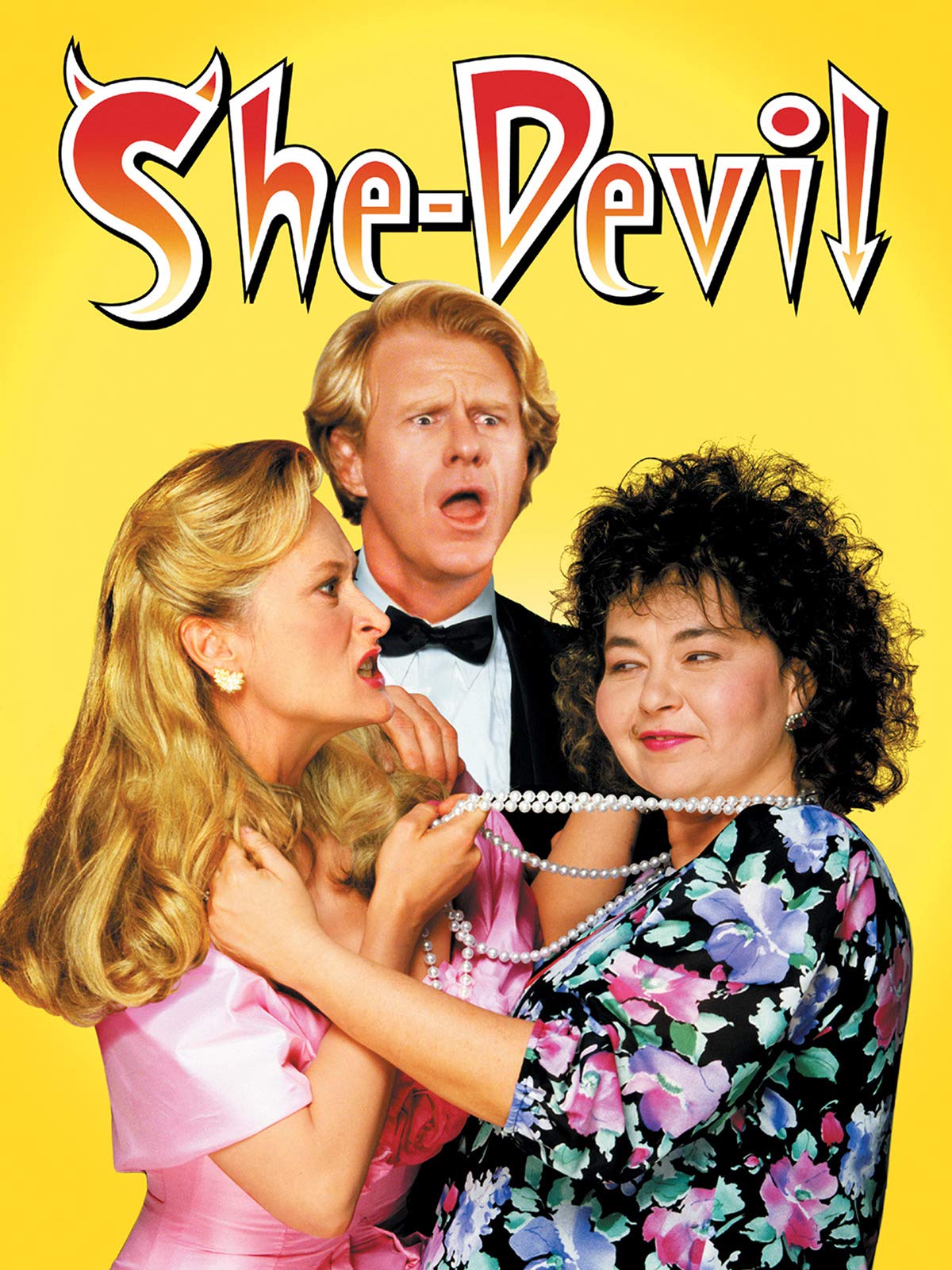
 Ruth Patchett (Roseanne Barr) is an ordinary American housewife – she’s married, has two wonderful children and leads a relatively happy suburban life. However, below the surface, there’s something bothering her – she feels like her marriage lacks spark, with Ruth trying her best to be a good wife to her husband, the effortlessly charming Bob (Ed Begley Jr.), a successful chartered accountant, who also does his part to keep their relationship afloat. Chaos comes in the form of Mary Fisher (Meryl Streep), a popular romance novelist who presents herself to be quite a fierce adversary for Ruth, being the antithesis of everything she stands for – she’s beautiful, rich and can provide the emotional support that Bob seeks. An encounter between them at a party leads Bob to undergo a very secret (but transparent to Ruth) affair with Mary, eventually leaving Ruth, who becomes vindictive over the manner in which he departs – according to Bob, she’s nothing but “a she-devil”, but instead of taking this to heart, Ruth decides to live up to her newly-minted reputation, ensuring that if she can’t be happy, Bob certainly can’t either. She hatches an elaborately cunning plan to bring him down to size, destroying his most prized assets one by one, making sure that he never forgets the sensation of getting on the wrong side of a woman so scorned, she’ll go to any lengths to get the satisfaction she deeply craves.
She-Devil is an oddity – it isn’t necessarily obscure (it’s a well-loved cult classic by those who have been witness to its gloriously deranged vision), but it isn’t regarded as the comic masterpiece it deserves to be – a film that may have some flaws, but an equal amount of extraordinary merits, it’s a bold journey into the roots of feminity, crafted by Susan Seidelman, a filmmaker who was at the forefront of female-led comedies in the 1980s, making films that were entertaining, but also had deeper meanings. She-Devil doesn’t sit in the cultural zeitgeist in the same way that something like Smithereens or Desperately Seeking Susan does, but it wouldn’t be wrong to call this her best film, mainly because it is so demented, it becomes nothing short of brilliant, which is an achievement all on its own, especially when dealing with a story that could’ve so easily gone off the rails and been dull or overwrought with the commentary. Through combining a great cast (and a pair of eclectic leads that feed off each other so brilliantly), and a superb story that combines outrageous commentary with broad feminist issues in a way that is authentic without being dour, She-Devil is a remarkable success, the exact kind of dark comedy that becomes terrifyingly potent, and remains just as unique and resonant today as it did then. Definitely not the most serious fare (it is mainly just an opportunity for the audience to have some fun), the film still carries some weight, which is terrific, if not somewhat groundbreaking for the time in which it was made.
Despite the incredibly acclaimed co-star of the film, She-Devil belongs almost entirely to Roseanne Barr, which is not quite as outrageous as it would sound. In 1989, Barr had already established herself as a great comedian, and her self-titled television show was still relatively new, but no less beloved by audiences, who appreciated the show’s incredibly grounded approach to blue-collar life. However, this film was Barr’s film debut, and to have someone like her, who may have been an acclaimed comic performer but whose acting talents were still relatively unchartered territory, was an enormous risk – and Barr is exceptional in the film. Perhaps a controversial figure due to her erratic behaviour and abstract beliefs, we can’t avoid the fact that she was tremendous in She-Devil, a film so tailor-made for her sensibilities as a performer, it allowed her to play a character that wasn’t too much of a stretch for her, but still allowed her to give a more complex performance than she had demonstrated before. Ruth Patchett is not a particularly easy character to play – she has to go from pathetic frump to vindicative, but glamorous, villain without undergoing any extreme makeover or change in personality, only gradually developing as a character through the smallest details in the performance – and Barr manages to easily play both sides of the character with equal gusto, never failing to sell the idiosyncrasies of the character in any way that wasn’t thoroughly invigorating and believable. Regardless of how you feel about her political or cultural views, she was exceptional in She-Devil, and gives a comic performance for the ages in a film that isn’t always very easy to execute.
Naturally, She-Devil is rarely ever remembered for Barr’s performance – but this isn’t necessarily an indictment on her skills, but rather the iconic work Streep does here. I’ve long held the belief that while she is an exceptional dramatic actress, Streep is at her best when she’s having fun, and some of the fondest memories I have of watching her involve comedy in some form. No one can deliver camp quite like her, and She-Devil offers her the chance to play to the rafters in a way that is broad and entertaining, but never gauche. A forerunner to the brilliant work she’d go on to do in more notable films like Postcards from the Edge and Death Becomes Her, her performance as romance novelist Mary Fisher is an utter delight, where she takes a large supporting role, but still manages to liven it up to the point where she becomes a co-lead. The dynamic of the film is borne from the polarity of Barr and Streep, and while naturally playing rivals, they complement each other so wonderfully, bringing out the very best, and while they may only directly interact at the beginning and end of the film, they remain omnipotent in the separate storylines, to the point where it feels like they’re almost entirely in tandem. Ed Begley Jr, an actor who has rarely ever deviated from his niche of genial, if not slightly socially-awkward, characters takes on one of the vilest villains of the 1980s, forming Robert Patchett into someone who is both pathetic and despicable, which is a difficult feat to accomplish. There are a pair of scene-stealing performances from the criminally-undervalued Sylvia Miles (as Mary’s vindictive mother) and Linda Hunt (as a by-the-numbers nurse who breaks free of the confines of her position after encountering Ruth), contributing significantly to the hilarious ensemble of the film, perhaps the biggest reason for She-Devil‘s success.
She-Devil operates mainly as a comedy, but one with some grounding in something relatively serious, looking at important issues, but in a way that is increasingly hilarious, which only bolsters the sometimes heavy-handed material. Seidelman, whether intentionally or not, crafts one of the most exuberant feminist manifestos of its era, and makes something entirely memorable, if not sometimes oddly touching. This isn’t a film concerned with heroes or villains – despite the subject matter, and the initial expectations we have for this film, neither Ruth nor Mary are all that evil – they’re just very different women doing what they need to do to survive. The film never blurs the lines between morality and debauchery, keeping them very clearly defined, but rather treating the female leads not as necessarily bad people, but rather desperate ones. She-Devil often feels like a film that wouldn’t exist without the work of John Waters, and just as we saw with Divine and his portrayals of many different female archetypes, it isn’t how one acts, but rather the situations around it and the aftermath, that should be judged. This is perhaps a bit too much of an in-depth reading a film that arguably just exists to be a bit of mindless fun about two women duking it out for dominance over one man, but we can’t deny that there is something deeper to this film, an underlying theme that touches on something far more serious, without detracting from the hilariously irreverent core of the film. This is, after all, a deliciously odd dark comedy, and whether we look at it as such, or consider some of its more audacious qualities a bit more deeply, we can see what a true gem this film is, and how it should be taken very seriously, especially because of how mindlessly silly it tends to be at times – this film is almost too off-the-wall to be anything less than a distinctive, potent social satire, which is often where it flourishes the most.
She-Devil is a terrific film – at first glance, it may not be particularly appealing, seeming to be made for a very specific subset of individuals that like this kinds of trashy revenge comedies that normally see two polar opposites fighting over a banal issue (I’d even argue this film is the last truly great “biddy horror”, but purely in subject matter and the themes it touches on rather than in the leads being older women). However, when we break it down into its essential components, and consider it as a unique and daring exercise in borderline surrealism, with some poignant satire thrown in for good measure, we begin to understand precisely why this film is such a resounding success. Add to that a pair of performances from two very different actresses, working in tandem to bring this story to life, and you have a tremendously entertaining film that is more than just an offbeat romp, but something a little more serious, which is perhaps the most unexpected aspect of the film as a whole. She-Devil has remained relatively loved by a small but dedicated portion of the population, and while not without some narrative flaws (and some filmmaking choices that locate it to one particular cinematic period), it’s very difficult to dislike a film as daring and entertaining as this, and it overcomes some of its more hackneyed ideas to deliver a truly endearing piece of brilliantly unhinged comedy.
 The Postmodern Pelican