
The murder mystery is a sub-genre of storytelling that has been popular for nearly as long as stories have been told. Stretching from the earliest days of Greek tragedies, straight through to the Shakespearean era, right into the works of Arthur Conan Doyle and Agatha Christie and their various narrative offspring such as the hardboiled detectives of the great noirs, the whodunnit is something that has been almost omnipotent, including in the world of filmmaking. While it perhaps hasn’t entirely faded away, it isn’t as vogue now as it was before, which has led to some filmmakers trying to reinvent the genre in clever new ways, while others just surpass the inherent glamour of these stories, opting for something far more natural. This recent deficiency of great films in this genre was the impetus for Rian Johnson’s extraordinary Knives Out, a film that deftly gives classic whodunnit tropes a distinctly modern twist, with Johnson delivering one of the year’s most surprisingly original and entertaining films that takes a killer approach to a very grisly set of conventions, resulting in a daring and revolutionary foray into a sub-section of the crime genre that has seemingly gone out of style, but is here repurposed as truly enthralling through the meticulous detail and extraordinary lucidity of a director intent on reinventing the genre with the dormant brilliance it demonstrated in the past, succeeding in making one of the year’s most exceptional films.
Knives Out is a film that works well on so many levels, with all the smaller elements converging into a broader piece that is nothing short of a resounding success. Johnson may have recently been a more divisive figure due to his work on the previous instalment of the new Star Wars trilogy, with some considering it to be one of the strongest entries into the series, others feeling far more lukewarm to his approach to the Skywalker saga. Regardless of how one feels about his previous work, he’s certainly a director who has made an eclectic series of films, and while Knives Out may be a considerable step-down in scope, it’s no less audacious, and fits in very well with the director’s previous films, through its originality and playful approach to genre conventions. He has made only five feature films, but each one of them is highly original, which is due to Johnson’s uncanny ability to take the genre that inspired the film and breaking it down into a series of basic concepts, from which he constructs his own unique vision. Sometimes this results in a broad subversion of tropes, other times a loving homage to the conventions that made these such successful films in the first place. This certainly extends to Knives Out, which is a film so clearly paying tribute to the long culture of whodunnit stories, both printed and visual, with Johnson’s inspirations being very clear, but used in such a way that they’re very often extraordinarily original on their own terms. It’s this kind of intrepid filmmaking that positions Johnson as a filmmaker to really take seriously, because despite having directed a major franchise film, which normally begets further franchise films, Johnson decided to reduce the scope and deliver something more intimate, but no less bold, which resulting in him making his finest film to date.
In this film, Johnson is taking on murder mysteries, which are unquestionably one of the most entertaining kinds of films (as well as thriving in novel and television format as well, going back to Wilkie Collins’ seminal masterwork, The Moonstone, which is considered the first real detective novel, and seemed to be one of the innumerable inspirations behind this film), mainly because their structure naturally makes them thrilling without requiring all that much effort in constructing a highly original story, with the entertainment coming from the details and the many twists and turns these stories tend to take. Knives Out takes place mainly in a single location, and employs an ensemble cast, each one with distinct personalities, creating a motley crew of memorable characters. These two elements then work together with an intricate plot to create something simple, yet so compelling, where the emphasis is placed on the story rather than the spectacle (even if this film succeeds in both regards). Whodunnit films normally find themselves being highly entertaining due to the attention being placed on detail – they’re propelled by the strength of the story and how each element needs to be pieced together in such a way that the audience not only enjoys the film, but also feels like an active participant in the story. The sign of a great mystery film like this is the ability to draw upon our inherent curiosity, which Johnson manages to pull off with deft precision in Knives Out. He takes the conventions of the genre and brings it to the current era – this isn’t a film that rests on the laurels of previous entries into the whodunnit genre, nor one that depends on residual affection from those who remember stories like Clue or Murder on the Orient Express. Rather, Knives Out takes a dedicated approach to delivering thrills that are authentic without being predictable – and in the process of doing so, manages to subvert many expectations of the genre.
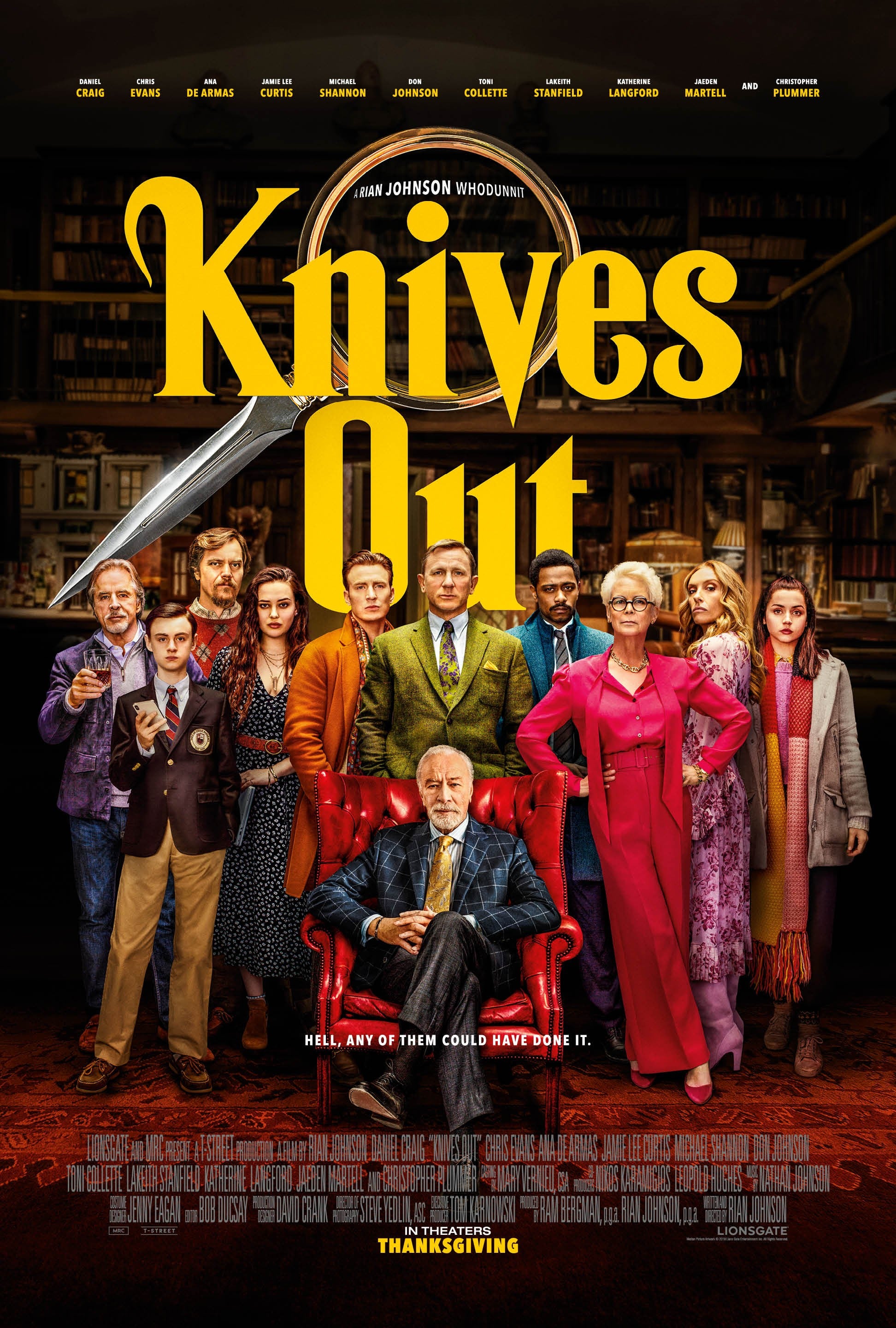
Knives Out, like many great films in this genre, has a great cast, brimming with a wide array of talented actors, all of which surrender their talents to Johnson, aiding him in bringing his twisted story to the screen. It’s difficult to choose a standout, mainly because everyone is so excellent, and play a pivotal part in the ensemble as a whole. Jamie Lee Curtis gives one of her best performances in years, occupying the kinds of role she is naturally very good at, but hardly gets to play. Christopher Plummer, Toni Collette, Don Johnson and Michael Shannon are all very good as the slain writer and his family, bringing their idiosyncratic talents to a film that makes great use of them, even if it does have the difficult task of giving each of these talented performers meaningful moments while not sacrificing the rapidity of the story around them. However, the three performances that form the heart of the film come on behalf of Ana de Armas, Daniel Craig and Chris Evans, all of which demonstrate a certain brilliance that had never been glimpsed from any of them before, mainly because how it was a role that went against the kinds of characters they are known to play. Craig takes on the role of Benoit Blanc, the eccentric private detective brought in to be an independent consultant on the murder of Harlan Thrombey. Craig’s character work here was exceptional and distances himself from the more suave role of James Bond that he’s played for over a decade, and proves that there is far more to his abilities than most would expect.
Craig’s comedic timing is also brilliant, but he goes about playing this offbeat individual with a certain candour that makes it even funnier – he plays Blanc completely straight, with the same sincerity that made Leslie Nielsen in Airplane! so compelling – Craig knows that this is a very funny film, but he derives the humour in the character from playing him with complete seriousness, which only bolsters the hilarity. Similar to Craig, Chris Evans has made his career playing heroes – so the opportunity to see him play a reprehensible, despicable character was unmissable. Evans has such a deep understanding of the nastiness of the character of Ransom, and exploits every bit of malice from a character that starts as nothing but a myopic brat, but ends as the embodiment of pure evil. This is counteracted by de Armas, who gives the most surprising performance in the film – as the central character, she demonstrates an innocence and conviction none of the other characters do. The film’s promotion very cleverly doesn’t give away the fact that de Armas is the main character, probably as a way of distracting from Johnson’s intentions to subvert traditional themes of the murder mystery, and also to conceal the truth behind de Armas’ character’s role in the story. The actress has such a delightful sweetness, a gentle charm that makes her so compelling, and such a wonderful lead. She never distracts from the many eccentric characters that occur around her, but also doesn’t recede into the background. She stakes her claim with sincerity and elegance and serves as the most surprising element of the film. Knives Out affords de Armas an extraordinary opportunity, and she derives every bit of potential from a character that would otherwise be a footnote in traditional films of this genre.
Naturally, Knives Out is not going to be a conventional murder mystery, with Johnson taking some risks in telling this story that not many who worked within this genre would have necessarily taken, because it disrupts the fabric of what makes these stories so compelling in the first place. The most notable sign of this newer approach to the genre is the fact that the murder at the centre of the mystery is given a solution relatively early on, right at the end of the first act. We learn who the killer is, and the circumstances surrounding the death of the patriarch that sets off the film – for those expecting a classic mystery, which ends with the shocking revelation, may be disappointed, especially because it doesn’t have the same dastardly effect that it normally would. However, Knives Out is less a film about revealing the murder, and more of a detective story told from multiple perspectives – Johnson constructs a film where only two people are privy to the truth from the outset: the person who committed the crime, and the viewer, with the rest of the film taking the form of an intimate portrayal of paranoia, as the killer covers up their tracks and tries to hide their involvement in the crime, using the very tools the patriarch, a famous mystery writer himself, put in place. Knives Out is less about murder as it is about covering it up, and the way Johnson playfully employs nearly every cliche of the genre in a highly creative way forms a hilarious and almost insurgent homage to a genre that has always been incredibly successful, but rarely this spellbinding.
Johnson really does well in deconstructing the murder mystery genre with Knives Out, taking so many of the elements that normally make them work, and using them in such a way to give his vision of the genre some contemporary flair. This is by no means a difficult film to make on the technical scale – as long as the performers are good and can effectively interpret the story, the film was always going to be entertaining. Johnson, however, takes it further than this and creates one of the wittiest, most fascinating crime films of the past few years. Not only is it beautifully made (the production design in the film is quite literally to die for), the script is hilarious and brimming with lines that are bound to enter into the public lexicon, and the execution of the story is astounding – the cinematography, while not initially noticeable, manages to effectively capture the insanity of the film, and serves the editing, which is one of the major successes of the film. The film’s pace is one of the reasons why it tends to be so incredibly entertaining – Johnson executes it with such precision, never allowing it to linger too long on one point, but also not sacrificing some of its more eccentric qualities and meticulous details that make this such a brilliant film. More than anything else, Johnson’s quiet rebellion against cliche serves the film well, insofar as he doesn’t avoid them, but does the contrary – he embraces them, to the point where the obvious is still so surprising.
Essentially, what makes this film so extraordinary is how it remains so daring without ever trying to be revolutionary or change the core of the genre. How many cheap murder mystery stories end with the revelation that the butler or maid or some other domestic worker was the culprit? Somehow, Knives Out takes this very idea and makes it tangible, but in such a way where it never feels predictable – and despite learning the cause of Thrombey’s death relatively early on, the film still remains extremely thrilling, with the director packaging a great many surprises into this astoundingly strange film. Knives Out is a chilling, hilarious and twisted film that is both an entertaining romp, finding the perfect balance between the grisly subject matter and the absurdity of the premise that normally launches these kinds of stories, and the intelligent, witty subversion that Johnson is peddling here, to great success. This film would not have worked had it not been for the perfect symbiosis of the many elements that made it a success – the cast, the script, the visuals and the guiding hand of a director who proves himself to be far more talented than those who dismiss him for his franchise work will account for. Perhaps one of the most unexpectedly great films of the year, Knives Out is simply not to be missed.
 The Postmodern Pelican
Rian Johnson brilliantly employs an underlying tone of racial inequality and social justice in his whodunit Knives Out.
The genre of a houseful of suspects who are gathered under pretense by the murder victim to set up a convenient investigation for our amusement has long ago been dismissed as artificial and forced. Here the family of a wealthy murder mystery author gathers to learn that each has been written out of the will which is shortly followed by a violent death. Johnson throws us a curveball by letting us know early in the story that the death was inadvertently caused by the Latina nurse who is devoted to her patient and who is the new recipient of the entire estate.
What makes the film such intellectual joy is that the audience embraces this young girl. Ana de Armas gives such a heart on sleeve portrayal that we immediately forgive her for her part in the error. Hitchcock would be proud of how quickly Johnson gets us to root for the not quite innocent.
Johnson doesn’t rely on red herrings. He casts that film with beloved movie stars as rather insignificant family members and bystanders. This permits a feeling of familiarity with the Thrombeys. As each nonchalantly and insincerely apologizes for previous acts while casting aspersions on the other family members for racist attitudes of exclusion, we gain further affection and affinity to seeing this young woman redeemed. When the plot gets rolling and the family begins to threaten revelations to ICE against the undocumented immigrant mother of our heroine, we become more invested. It is the safety of this hardworking immigrant family that is more essential than the identity of the murderer.
Knives Out is a terrific entertainment that plays to our basic feelings of supporting the right side, the earnest lower class against the indifferent upper crust and the indolent wealthy against the deserving working poor. Such injustice makes us want to vomit – a literal sentiment that Johnson takes to an amusing end.
This is a masterful screenplay that invokes contemporary mores in a wildly successful effort to revive a tired genre.