 I had a strange experience with The Good Liar, which exemplifies the perils of listening to the public discourse and allowing it to construct your opinions prior to seeing something. The Good Liar is a film that was met with such ambivalence upon release, it seemed almost contradictory to what I’d have hoped it would be. If there was ever a film made exactly for my sensibilities, one about Ian McKellen and Helen Mirren engaging in a vicious game of cat-and-mouse was certainly one of them. The realization that this wasn’t just a bland thriller, but rather an intricate and often hilarious caper that is somehow simultaneously elegant and lurid, made it even more of an entertaining experience, and something the defied the apparent reputation this film received. By no means a masterpiece, and quite often extraordinarily absurd in its approach, Bill Condon’s film is something quite odd, but also unconventionally brilliant in its own way, if we’re only going by the film on its own. The flaws that others have pointed out are certainly present and not without relevance, but it doesn’t matter so much if a film has imperfections as it does how it uses them, assimilating them into the overall structure in a way that can only be called dreadfully enthralling, and entirely effective. This is a film that takes a relatively standard approach to a storyline that is not particularly new (and it doesn’t help that the film was adapted from the kind of novel that uses the word “bestselling” very loosely, demonstrating clear quantity over quality), but how it forges such a unique place for itself in the cinematic landscape, certainly aided considerably by the presence of the two stars of the film, makes it something certainly worth a look.
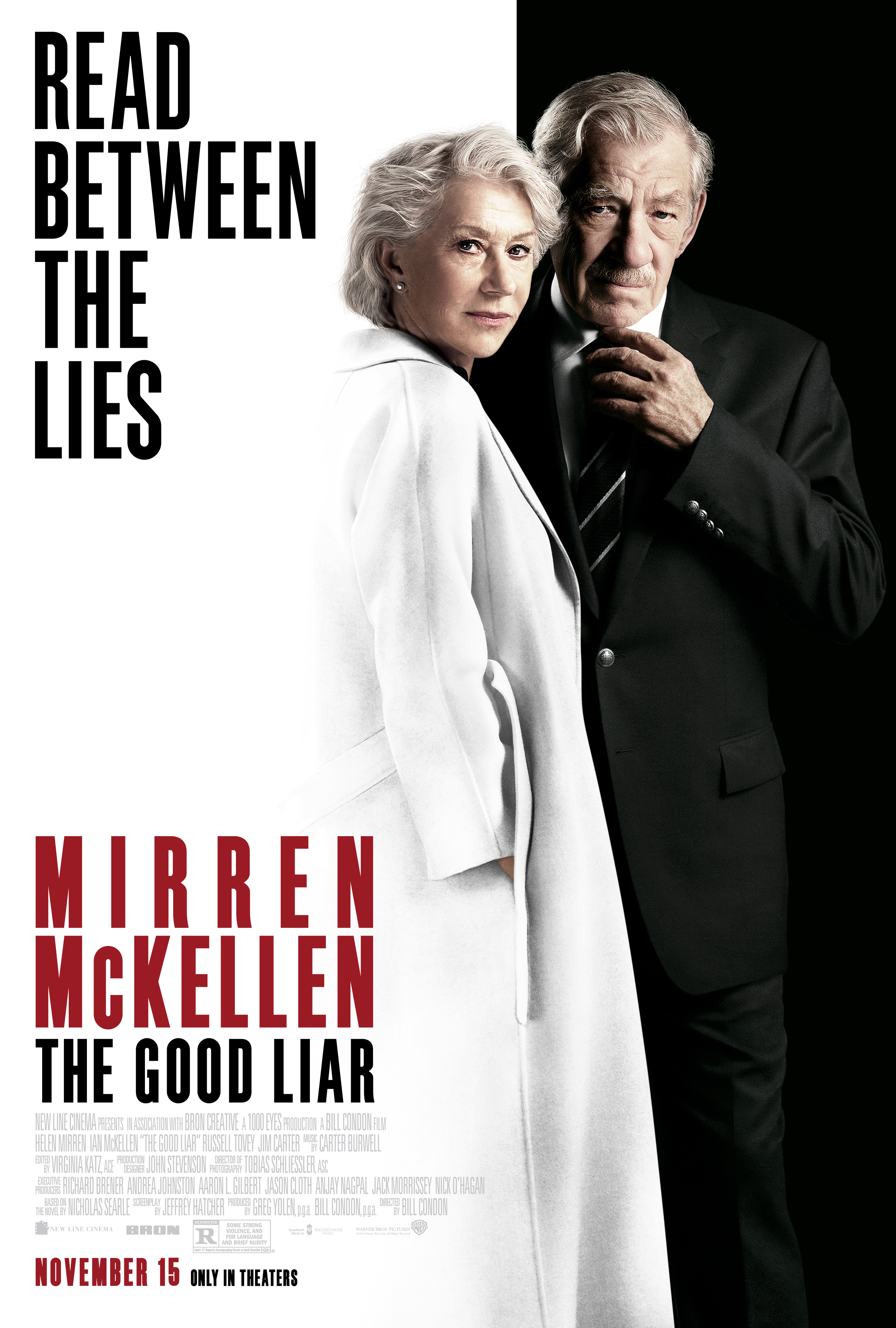
The film focuses on two people. Roy Courtenay (Ian McKellen) and Betty McLeish (Helen Mirren) are lonely individuals, having recently been widowed and left without the connection their respective spouses gave them. They encounter each other on an online dating portal, where they are both looking for companionship, seeking a friend to spend the lonely days as they recede into their final years, just to make them a little less lonely. Roy is a frail man, and Betty naturally shows enormous generosity to the man, even allowing him to move into her home while she takes care of him. However, what she doesn’t realize is that Roy is far from the weak old man he presents himself to be – in fact, he’s a notorious con-man, running schemes with his friend Vincent (Jim Carter) to fleece any gullible individual of large amounts of money. Roy’s friendship with Betty is not what it seems – he’s not seeking her companionship, but rather the enormous amount of money she has been hiding away, mainly due to her savings and the trust fund her late husband set up for her. Roy slowly infiltrates Betty’s life, fighting against her grandson (Russell Tovey), who is vehemently opposed to his grandmother’s generosity, as well as his clear scepticism of the man who has become such an infallible part of Betty’s life. However, there are many secrets underlying this relationship, and over the course of their growing friendship (and perhaps even a burgeoning romantic relationship), the truth about Roy’s past comes forward, gradually revealing himself to be someone far more complex than he initially seemed, with a dark, storied history that positions him as someone both fascinating and utterly terrifying. The question is, can he keep up with the lies? Moreover, what happens if it’s revealed that Betty herself is hiding something sinister as well? Who is going to catch the other first?
Bill Condon may not have the finest reputation in Hollywood, mainly because of his tendency to direct films that are middling at best, atrocious at worst, excepting the few moments of brilliance he has demonstrated throughout the years. Yet, some of his best work has been with one man in particular, Ian McKellen. Together, the duo made Gods and Monsters, which was McKellen’s breakthrough role and the performance that made him a household name, and Mr Holmes, which was a return to form for Condon, and one of McKellen’s finest performances to date. They reunited for The Good Liar, and they once again brought out the best in each other. There are many reasons to appreciate this film, but one of them is that it is a mainstream genre film that cast two actors far older than those that are normally given the main roles in films like this. McKellen, in particular, demonstrates his flawless talents when it comes to playing a leading role, and he commands the screen with the intensity and vivacity we’ve all come to adore him for. In The Good Liar, McKellen takes on the role of Roy, which requires him to play two different sides of the character – the frail, helpless old man who is also in some form of bodily pain, and the sprightly, energetic fox who relishes in using his advanced age in his cunning plans. This role may be very far from being the definitive statement on what McKellen can do – it is ultimately a pretty standard character that any actor of his stature could effectively do. What makes this such a compelling performance is that McKellen uses his charm to elevate it beyond simply an archetype, transforming Roy into an endearing and fascinating con-man who is far more effective than we’d often like to admit.
McKellen shares the screen with Helen Mirren, who is as wonderful a scene partner as she is a formidable adversary. Mirren has never shown herself to be a weak actress, both in the strength of her performance and might of the characters she plays, and The Good Liar presents her with another in the series of layered older woman she has played over the past decade. There isn’t much separating Betty from her performances in films like Hitchcock, The Woman in Gold and The Leisure Seeker, but it doesn’t mean it’s a bad performance by any means. Like McKellen, she elevates the film and makes it something worth watching. Without these two performances, The Good Liar would have most likely been a jarring mess. Yet, with their extraordinary chemistry, and the brilliance they bring to sometimes underwritten characters, they manage to create something special. Mirren in particular shows a remarkable tenderness that we have often seen from her, but which is used to an almost ludicrous degree here, which was done by design, simply to make the third-act revelation all that more shocking (even if we could see it coming from miles away). Like with many of her great roles, Mirren’s sweetness shrouds an acidic sensibility that allows her, like McKellen, to play both sides of the character, victim and mastermind, with such ease. We never question the absurdity of the film, solely because the two leads are so brilliant at making sense of the material and infusing it with elegance, there’s no room to question why this film sometimes takes some excessive liberties. The fact that this is a deeply implausible film is inconsequential, mainly because it’s just so much fun to see these elite actors embracing it.
The Good Liar is, by virtue of the title alone, a film that is intent on exploring truth, using the idea of honesty (or rather dishonesty) as a way of commenting on some broader social issues, even if it doesn’t go too in-depth into any of them. The film does tend towards preaching, especially towards the end when Roy gets his comeuppance when he realizes that despite a career of manipulating others, he has fallen victim to the biggest con of them all, and from the most unexpected source. Perhaps not focused on proving how bad dishonesty is, The Good Liar works when we realize how deeply compelling it is as just an elaborate game of cat-and-mouse and not some moral manifesto on the consequences of dishonesty. It almost feels as if this approach is one that works better – who wants to see McKellen and Mirren giving these kinds of performances in a film that doesn’t let them have some fun with the roles? Yet, The Good Liar doesn’t just reside on this brilliantly lurid level of storytelling – in fact, this film becomes far sinister than anyone could actually realize. The twists aren’t so much surprising as they are entirely unsettling – the story ventures to some truly dark places, which lends the film even more credibility, because not only is it an effective thriller, it’s also one that is unafraid to take risks, even if that means the film becomes extraordinarily cluttered at times, and where it is so excessively plotted, it sometimes loses sight of the themes that a more coherent, rational film would have never dared to do. I won’t comment on the many nasty surprises that this film has in store for the audience, but believe me when I say they’re almost worth the price of admission alone, if only because of the sheer audacity this film demonstrates, which is worth something – maybe not much, but just enough to make it an unmissable experience.
There are many flaws in The Good Liar, and to ignore them is misguided because even those who tend to like this film can’t deny that some aspects of it were far from perfect. Yet, Condon manages to compensate for them with a truly endearing piece of fiction that feels trashy, but in all the right ways. This is a very predictable film, but effectively so – we can tell where everything is heading, but it’s so well-constructed, we can excuse some of the narrative shortcomings based solely on the film’s exuberant attitude towards a genre that doesn’t normally lend itself to this kind of unconventional sophistication. The Good Liar is not a film that should be taken seriously at all – how else can you account for the fact that this is just an endless series of revelations and surprises, with each character trying to gain dominance over the other through manipulative tricks and shocking revelations that converge into an almost exhaustively-plotted crime film that may be trite in some moments, but remains thrilling and entertaining, only because of how it surrenders itself to the genre in which it occurs, never trying to defy the underlying cliches, but openly embracing them, because through the dynamic performances of the leads and the general apathy towards logic, The Good Liar manages to actually thrive in sometimes surprising ways. It is disappointing how the film wasn’t much better, but taken for what it is, can we truly be against a film that gives two of the greatest performers of their generation the chance to manipulate each other in sometimes hilarious, but always truly compelling, ways? Condon may not have made a great film with The Good Liar, but he certainly made an entertaining one.
 The Postmodern Pelican
This movie is for beer addled TV viewers who only occasionally glance at the screen after a tiring day. The screenplay makes no sense.
Ian McKellen uses his extraordinary talent to make us emotionally invested in a particularly vile murderer who annihilates a victim on the platform of the Tube, a rapist who grabs the most vulnerable child in her own home, and a con artist who bilks lonely retirees of their life savings.
Roy Courtenay has succeeded his entire life with his amoral behavior. Yet, we are asked to believe than when preparing for a particularly large con job, he willingly and needlessly puts his entire financial accumulations on the table. Why? Does he want to impress this latest widow with his wealth? Does he feel particularly prideful of his bankroll? Or is it simply necessary for the good liar to behave out of character to permit the machinations of the climax of the film?
I quickly lose interest in movies that give interesting characters temporary stupidity or worse presume that the audience will fail to notice such a manipulation.
Skip The Good Liar. Time is better spent with the stronger McKellen /Condon collaborations Mr. Holmes or, especially, Gods and Monsters