
“Poems are my solace for the eternity which surrounds us all.”
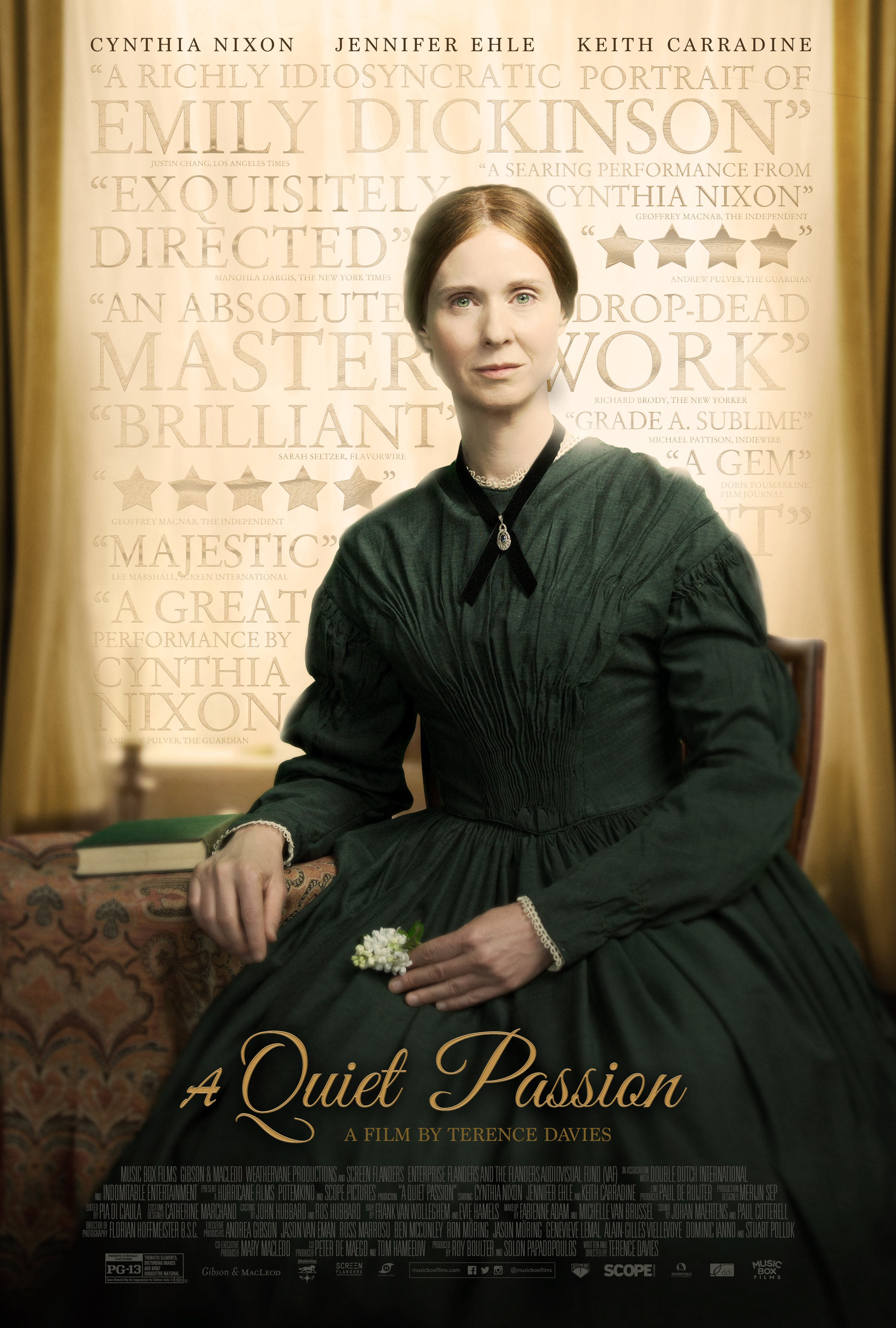
Terence Davies’ A Quiet Passion is a masterful achievement in a number of ways. The story of Emily Dickinson is one that is both profoundly fascinating, but also deeply complex, and any filmmaker who endeavoured to venture into her life was bound to encounter some challenges in representing her life, capturing the spirit of one of the greatest American poets to ever live. Her existence was one that was always going to make for riveting viewing, even if it did tend towards being bleaker and peppered with moments of tragedy. Her colourful life lent itself considerably to Davies’ style, whose previous films all featured the same combination of period narratives and deeply human drama, which converge into sumptuous, but no less meaningful, excursions into the human spirit. What the director captures with A Quiet Passion is truly impressive – a simple, elegant film that extends far beyond the confines of the costume dramas that are normally associated with this kind of story, taking the audience on a intricate journey into the mind of an artist whose work reflected a very unique life, with her inner quandaries manifesting in her beautiful poetry that still persists today as some of the greatest in the English language. Emily Dickinson was a true literary icon, and Davies crafts the most suitable representation of her unique life, with meticulous attention to detail and a gorgeous empathy that makes this one of the most compelling films of its kind.
Dickinson, as we can tell from the quote at the start of this review, was a woman who valued her art over everything else. A Quiet Passion tracks her entire creative life, from her teenage years as a young rebel vehemently against the societal expectations asserted on young women, to her position as a poet who achieves acclaim, but at the expense of being victim to the brutal machinations of a heteronormative society, which refused to recognize her talents, purely on the basis that she was a woman. A notable recluse, her life was spent in her family home in Amherst, where she wrote all of her poetry in between attempts from her family to engage with her, trying to convince her to venture out into the world. Her rebellion extended throughout her life, with her entire existence seemingly being constructed on her desire to never adhere to expectations. Her fierce independence was the only quality Emily valued above her artistry, and throughout the course of her tragically short life, she was the portrait of defiance, never allowing anyone to take control of her in the same way women at the time were manipulated as objects. She communicated to the outside world through her poetry, revealing not only truths about herself but also the inherent understanding she had of the world, each word conveying a woman whose glorious insistence on protecting her own independence made her a woman that was dangerously ahead of her time. She died without receiving the rapturous acclaim she warranted, and like many great artists, it’s only after entering the grave that she finally managed to earn the respect she knew she deserved.
A Quiet Passion is a complex film – on the surface, it appears to be just another elegant costume drama, which is not entirely untrue. Davies has, especially in the latter stages of his career, thrived on these period pieces that take us into previous centuries and present us with stories from another time. The difference between his films and the innumerable other films set during this time is that he isn’t only preoccupied with the spectacle – this is undeniably a gorgeous film, and the attention to detail makes it one of the most enthralling films of its kind. Davies is far more concerned with the profoundly human stories that underly the extravagance, and are often lost in historical representations of the period, where the emphasis on the broad events, rather than the intricate elements of everyday life, which is what A Quiet Passion intends to rectify. The story of Dickinson is one that may not have been inherently cinematic, as it lacks the excitement of the lives of some of her contemporaries, but it is no less a story worth telling, and Davies was perhaps the person best-suited to bring her extraordinary story to life. The authenticity in which the director executes this film, focusing on both the major events and the inconsequential minutiae, makes this an endearing subversion of biographical films, which normally leap between major occurrences. Davies focuses on the moments in between, normally the quietest situations that defined Emily, both as a writer and as a person, showing her navigating a world that she was incapable of fully understanding, at least not socially. Her poetry was a remedy for the insatiable eternity that she felt suffocated by, and through engaging with her work rather than the inconsequential details of her life, Davies managed to create a complex portrait of an artist whose perspective on life was original and revolutionary, especially for a time when such artistic rebellion wasn’t only discouraged, it was often punished.
Cynthia Nixon is an actress who has unfortunately not been given the due her talents suggest she’s capable of receiving – her television work in the past was celebrated, and she has appeared in a few excellent independent films over the years, not to mention commanding the stage on many occasions in a variety of productions that show her as one of the most gifted actresses working today. However, she’s rarely received the kind of acclaim she deserves. A Quiet Passion was clearly an attempt on her part to venture into more unchartered territory and play a character far from her iconic Miranda Hobbes, which took the form of Emily Dickinson, just about as far as one can get from that role. Nixon is terrific as the conflicted poet, playing her with a combination of fierce independence and quiet insecurity, always retaining her strict moral grounding, even if it meant coming into conflict with those around her. Contrasting Nixon is Jennifer Ehle, playing her loving sister who is always by her side, despite never being able to understand Emily’s very different view of the world. Ehle’s performance is so natural, and she makes excellent use of her inherent charms that allow her to play a character that is not particularly noteworthy, but rather a reliable presence in an otherwise arid film, bringing the warmth to a piece that often is at risk of becoming dour. Ehle and Nixon make a tremendous pairing, and the best moments of the film come in the scenes that see them acting across from each other, with the emotional core of A Quiet Passion resting on their flawless collaboration, and dedication to these complex characters. The film has a number of other distinctive performances, such as Catherine Bailey (as the wonderfully-named Vryling Wilder Buffum, a fiercely independent woman who spurs Emily’s defiance), Annette Badland and the ever-reliable Keith Carradine, all of which turn in terrific performances that work wonderfully in the context of the film.
A Quiet Passion is a film that doesn’t limit itself to the confines of the traditional period drama genre in which it finds itself. This is not a film that serves to necessarily be a snapshot of the time in which it takes place – there are various historical events that do form the backdrop for the story, such as the Civil War and the Gettysburg Address, which are mentioned in passing, but the film is almost entirely set in the large Amherst manor, rarely venturing out of its corridors, making this a film that restricts its story to the main character, who uses her words to describe the world as she sees it. As a result, this is a character-driven piece that’s less concerned with history as it is about how Dickinson herself represented it. It is mainly intent on exploring her life, and in the process becomes a compelling tale of female resilience and resistance in a time when women didn’t have voices. The subtext of gender inequality and feminist issues are indelible to this film, but also not overwrought – the director doesn’t intend to create a film that focuses on the societal wrongs Dickinson had to endure, as that’s far less interesting than the actual way she used these situations to create her art, which represented a woman vehemently against any social system that sought to diminish her abilities. So much of what makes A Quiet Passion so compelling is how Davies leaves so much unsaid – the queer subtext, with Dickinson’s sexuality being a notable area which modern scholars have been intent on exploring, is not absent from the film, but also not represented in a way that suggests that the film was trying to portray it as anything other than a pivotal part of Emily’s personality, rather than being a defining quality that drove her work. This is a remarkably simple film, which often contrasts with the gorgeous aesthetic that makes it such a rich and enduring experience.
Emily Dickinson is undeniably one of the greatest poets of her generation, and her work persists to this day as some of the most profoundly moving words ever written in the English language, with her perspective of the world being present in each nuance of her writing. A Quiet Passion takes on the intimidating task of penetrating the poetry and going in search of the woman beneath it, showing us an enigmatic figure whose life may not be so clearly understood, but was still just as compelling, mainly through her audacity as an artist who stood in profound defiance against the social systems that dared to imply that she was not worth as much as her male counterparts. The film looks at a variety of different themes – the role of women in the 19th century, sexuality and religion, with Terence Davies quite admirably crafting an elegant character-driven drama that isn’t just an opportunity to have great performers wear elaborate costumes, but rather a deeply moving odyssey of the human spirit, a complex portrait of resilience and defiance, and an opportunity to give audiences the rare glimpse into the life of one of America’s most brilliant minds. A Quiet Passion is an astounding film, one that is meticulously paced and often very subtle but is also undoubtedly a captivating period drama that is as sophisticated as it is awe-inspiring.
 The Postmodern Pelican