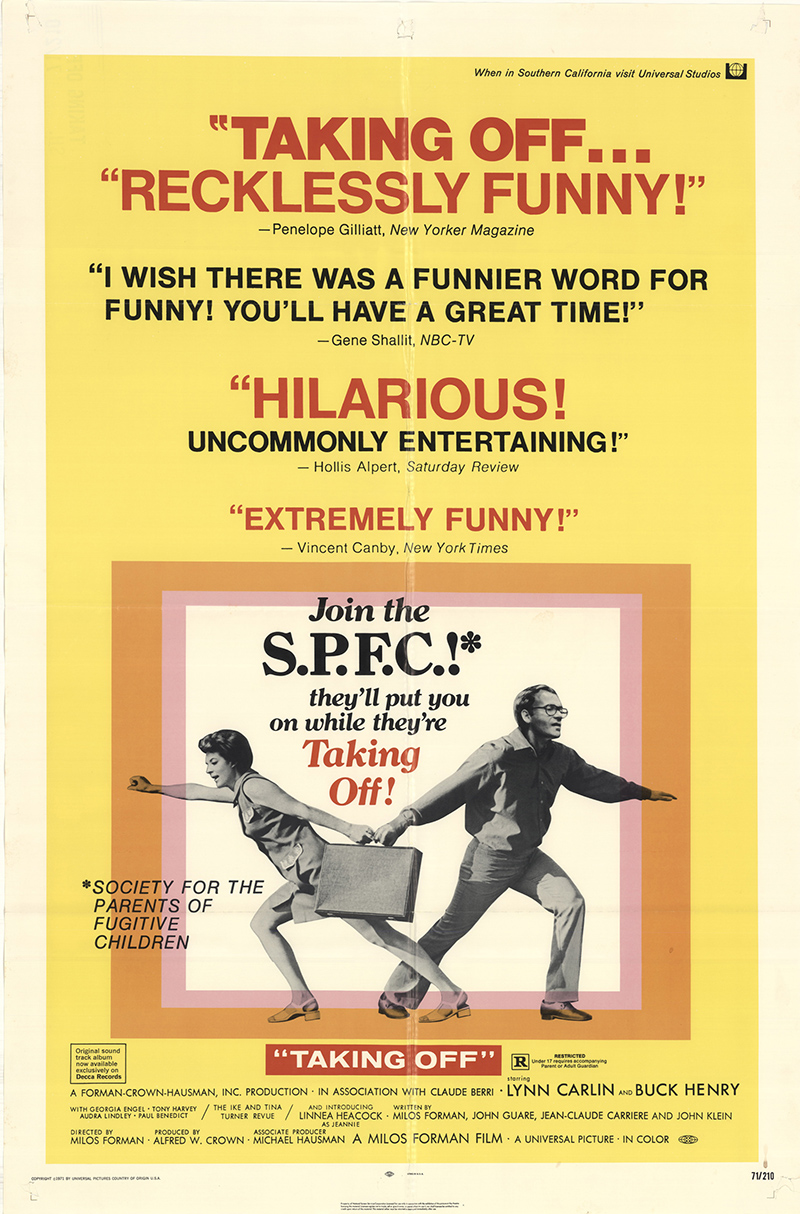
 Jeannie Tyne (Linnea Heacock) is a young woman slowly growing tired of her overprotective parents, Lynn (Lynn Carlin) and Larry (Buck Henry), who do everything they can to control the life of their daughter. Jeannie, wanting to explore the world and learn about life, runs away from home and sets off on her own adventure. However, we’re not focused on her exploits – as far as this film is concerned, she’s just engaged in the foolish follies of youth. Rather, the film follows her parents as they come to terms with the fact that their daughter has left home, and while they initially do everything they can to find her, an encounter with another set of parents in a similar situation enlightens them to the fact that this is a relatively common occurrence – it happens so often, the parents have even started a society composed of parents of fugitive children, who meet regularly to discuss the potential whereabouts of their offspring, as well as learn about youth culture in a changing world. These adults soon realize society is not the same, and the next generation is slowly taking over, and opting to progress rather than fall victim to the ignorant assertions of their ignorant children, the parents engage in the same kind of debauchery they fear their children are partaking in – and often to quite hilarious results.
There’s a brilliant film somewhere in Taking Off – I’m just not sure where to find it. Perhaps not as bad as some have made it out to be, the film certainly still has many problems, made even worse by the fact that this was a transitional piece for Miloš Forman, who had made a significant imprint in European arthouse cinema through the work he produced in his native country, but with all that goodwill seemingly going to waste with his first American film, which was certainly not indicative of the astonishing work he would go on to do. Taking Off is the kind of film that works better in concept than it does in execution, and while there are some tremendously entertaining moments, the film mostly squanders the potential it had by presenting us with a disjointed story that never seems to be going in any coherent direction, rather choosing to be a muddled set of misguided attempts at satire that doesn’t work nearly as well as they should. The film is not dreadful – its very often quite insightful and very funny at moments – but the shortcomings are too inextricable to overcome, and the result is something just disappointing more than anything else.
While it may not always be all that good, Taking Off is at least a memorable film, especially through the concepts it looks at. The film is built out of the idea of confusion – everyone in the film, whether young or old, are confused in their own way, and are searching for some understanding of the world around them. Forman thrusts the audience into this tale of disparity between the generations, and develops the story around the realization that none of these characters seems to actually know what they’re doing, with the intergenerational gap being a source of both potent social satire and exuberant broad comedy that never fails to be clever, even when so much more could’ve been done with this premise. The film focuses on the intersections between social groups, looking at the interactions between the bourgeoisie and their beatnik offspring, and showing how, despite their best efforts, there’s no way to reconcile the way they function socially, which is a profoundly fascinating concept, albeit one that film doesn’t always develop with any notable sense of cohesion. Taking Off does manage to capture the ennui of the period well – the 1960s had just come to an end, and the idea of free-love and anarchic liberation from societal structures were still relevant, but growing stale, with something as volatile as youth even becoming an institutionalized entity. The film feels as if it was made as a response to films like The Graduate and Easy Rider, which looked at the rebellion of the new generation, but inverting it in a way that focuses on the other half of society, the ones that fall victim to the self-serving voyages of self-discovery their children go on.
Moreover, the presence of Buck Henry, a comedic voice very much in-tune with youthful expression at the time (even being a co-writer on The Graduate) was surely intentional – and he’s definitely excellent in the film, playing the milquetoast father forced out of his relatively comfortable existence, first as a response to his daughter’s growing rebelliousness, and later in his realization that he is also constrained by cultural expectations, and should be allowed to abandon his heteronormative ideals and engage with the world without the constraints of what is expected from someone like him. Lynn Carlin plays his wife, with her authenticity and warmhearted geniality being a highlight of the film. Both Henry and Carlin are terrific, playing the roles of worried parents who decide to surrender themselves to the unknown as a last-ditch attempt to connect with their daughter through trying to understand how young people operate. They’re supported by many wonderful performances, many of which only appear in one or two scenes, such as Georgia Engel (whose shocking tale of her husband’s lasciviousness is only made more brilliant by her sweet, endearing delivery) and Vincent Schiavelli, who gives a seminar on how to smoke marijuana that is almost patrician in how formal it is. A distinctive flaw of Taking Off was that it never really gave the talented cast enough to work with, and it would’ve been better suited as a more character-driven film (which it is, at the core) rather than a bold satire that relied too heavily on the concept as opposed to the people who brought it to life.
Another area in which the film falters, and perhaps most tragically so, is in how it makes use of a very promising concept. The film is a relatively unique satire, but one that places emphasis on how smart its concept is, rather than how effectively utilizes its humour. The story does age quite well – young people are just as rebellious as they were in 1971, albeit for different reasons and with their intentions being channelled in various ways, which means that Taking Off does have its own resonance. The problem is that the film just never lives up to its potential by playing it far too safe – Forman constructs the film in much the same way as he did some of his previous films in his native Czechoslovakia, such as his acidic satire The Fireman’s Ball, which took aim at Communism through the director’s own unhinged vision. Produced as a surreal film that made use of large concepts with almost aimless direction, it found the visceral anger beneath a veneer of absurdity. Such an approach may have been effective before, but it doesn’t succeed here, failing to manifest into something nearly as meaningful as it thinks it is. Seemingly unable to decide whether its a social satire or a broad cultural farce, which are not necessarily mutually exclusive but do require some effort in order to make them work together, Taking Off can’t deliver either, becoming a relatively ineffectual and misguided attempt at satire that is often very funny, but lacks a great deal of meaning.
The idea of Miloš Forman taking on the remnants of the counterculture movement and how youthful rebellion was redefined in the early 1970s was certainly an alluring concept because the director had proven himself to be remarkably adept at social satire that didn’t need to overstate its purpose. Unfortunately, the film didn’t manage to live up to its potential, struggling to finds its way and developing into a worthwhile snapshot of the cultural battle between the generations. The film has a unique energy that does make it something worthwhile for anyone interested in this kind of satire that came about during this very tumultuous political period, where cultural and social ideals were eviscerated by filmmakers hoping to expose the hypocrisy beneath the human condition at the time – but it ultimately can’t grasp any of these ideas long enough for it to become fruitful. Less of a failure and more of a disappointment, mainly because it does at least try and be original, Taking Off is a frustrating experience more than anything else, and something that is remarkably dull considering all the potential it had from the outset. The film has a lot to say, yet it still manages to go on for far too long without ever actually saying all that much.
 The Postmodern Pelican