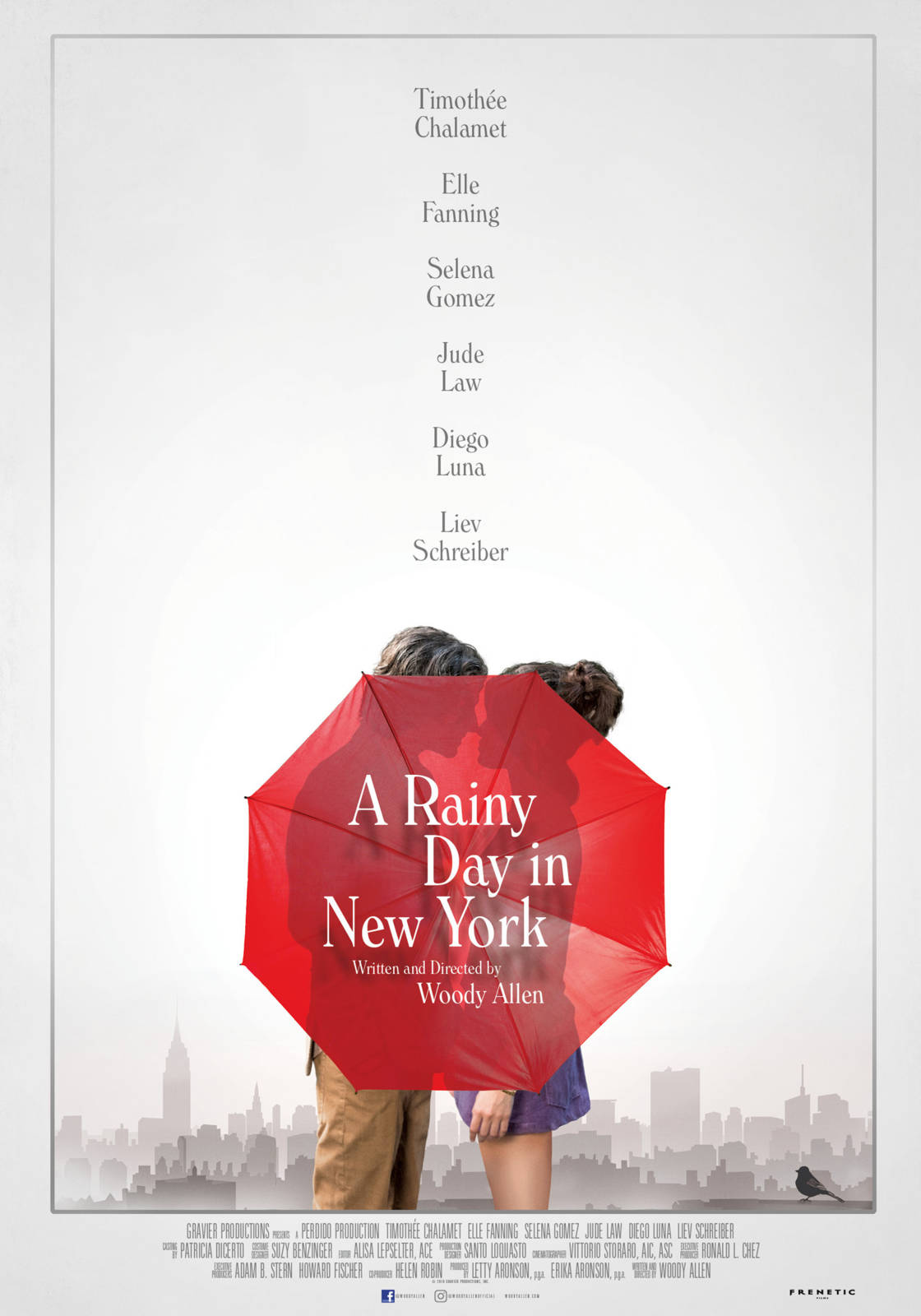
 Gatsby Welles (Timothée Chalamet) is a young man studying at a small but prestigious university in Upstate New York – he doesn’t have much passion for academic life, thriving on his unexpected talents when it comes to gambling. His girlfriend is the film-obsessed journalist Ashleigh (Elle Fanning), who manages to wrangle an interview with someone both she and Gatsby have long admired, film director Roland Pollard (Liev Schreiber), an arthouse filmmaker known for his unique perspective on love, but is soon revealed to have significant problems with the artistic process, as Ashleigh was about to learn in her meeting with him. The young couple takes a trip to Manhattan, with Gatsby hoping to get some time to spend with Ashleigh in the city he loves, showing her the sights and sounds of one of the most idiosyncratic places on earth. However, a series of misadventures tears them apart, and for the duration of one particularly rainy day, the lovers are apart, and find themselves on their own voyages of self-discovery, encountering a plethora of unique and unconventional characters that don’t only teach them about themselves, but life as a whole, opening up the protagonists’ eyes to a wider world around them, allowing them to realize that beyond their sheltered lives are a myriad of stories waiting to be told, many of them coming into focus throughout that magical, rain-soaked day that gives them far more insight into their own existence than any of them were hoping for.
A Rainy Day in New York is a film that stands as a bit of an anomaly from the outset. It sometimes feel as if it is a return to form for Woody Allen, whose work has considerably faltered in the past decade, with only a few instances of the same visionary brilliance he exhibited earlier in his career being found in otherwise forgettable films, with the best being only just above passable, and the worst representing a decline in the director’s career. Yet, despite being considerably better than most would expect, we just can’t detach it from his more recent work, which has been too reliant on a set of ideas that don’t always manifest in quite the profound way he seems to think they do. It’s a film that is by no means a failure – it does exactly what it sets out to do, but while it does have its moments of brilliance, there isn’t much insightful commentary embedded in this film, at least not on the same level as what we know the director to be capable of. However, if we don’t only focus on this film in contrast to Allen’s more towering works, and instead look at it from the perspective of just being another one of his soulfully poetic odes to the follies of youth and the blissful ignorance of being so deeply in love that one loses sight of the world around them, we realize how A Rainy Day in New York is a relative success – a sweet and endearing tale of young love, one that takes a very simple but ultimately quite effective approach to a theme that has become saturated in the work of the prolific filmmaker. While some aspects don’t always work, its a charming film that says what it says with the ease that only comes from decades of working on your craft, which is perhaps the most universally-resonant aspect of Allen’s career, even if he’s lost the spark that made his works from previous decades so enchanting.
Occupying the two central roles are Elle Fanning and Timothée Chalamet, who were cast at the height of their rise to fame, and likely only scouted to capitalize on their position as relatively new but already highly-respected additions to the world of arthouse cinema. Both of them work relatively well with Allen, even if it’s doubtful that anyone would call this career-best work from either of them. Of the two leads, Fanning is certainly the standout, mainly because she is able to work well with the rhythm of Allen’s screenplay, using it as a way of showcasing the unique talents that make her appear far more interesting than the character she’s playing. There are moments in A Rainy Day in New York where Fanning elevates the material and distracts from some of the more significant problems, only through her effective portrayal of a young woman who clearly wasn’t written with much complexity in the first place. Chalamet is on the other side of this spectrum – his character of Gatsby Welles is constructed as being the portrait of nuance – yet the actor, as excellent as he has shown himself to be (even when the material is lacking) seems to struggle with some aspects of the film, particularly in the dialogue, which doesn’t do Chalamet’s unique style of more subdued and reserved any favours – it’s notable how the performance works the best when it makes use of voice-over narration from the actor, who manages to find more emotion in these moments of introspection than he ever does when it comes to the dialogue, which often comes across as stilted and insincere. The character and the actor didn’t quite intersect in any plausible way, which leaves us with an unsatisfying protagonist who we can’t ever really connect with outside a few moments of revelatory insight into his mind, which are far too scattered, especially in a film that tries to amount to far more than was necessary.
Unsurprisingly, A Rainy Day in New York is peppered with supporting performances that often bolster the leads, complementing them and occasionally even taking attention away from them for a brief moment. Where the film falters is that it assembles a terrific ensemble, but seems to struggle to use them adequately, which is certainly unfortunate, as this is amongst the most interesting work some these actors have done. Liev Schreiber has moments of brilliance as the artist on the verge of a mental breakdown, who is re-evaluating not only his latest project but his entire career as a whole. Jude Law plays his friend and collaborator who tries to prove them insecurity is part of the process, and that it’s not indicative of failure, but rather of artistic growth. These two characters are severely underwritten, with the story ignoring the fact that they could have easily made for a more compelling film on their own – both actors are terrific with the paltry material they’re given, and while they may not be on screen for very long, they certainly do leave an impression. Selena Gomez probably gives the best performance in the film, with her outward geniality which harbours a more acidic core being the only instance of the film being able to tap into the performer’s natural charms and utilize them enough to create a compelling figure that isn’t just a bundle of archetypal quirks. Whether its the character being aloof enough to pique our curiosity, but developed enough to satiate it, or the fact that Gomez was able to engage with the requirements for the character in a way some of the other actors weren’t remain to be seen, with the actress showing herself to be incredibly persuasive as a performer, and someone whose charisma make her a truly magnetic screen presence.
I’d love to call A Rainy Day in New York a return to form for Allen, but there’s something slightly disconcerting about the film that keeps it at a slight distance from ever truly reaching brilliance. All the elements that suggest that it would be a great film are there – it does see Allen return to familiar territory, both geographically (his first film solely based in New York City since Blue Jasmine, widely considered to be one of his better works of recent years), and thematically, in how he takes on some concepts that formed the basis for many of his most successful films. It has a great cast and a compelling story that the director has previously managed to wrangle into masterpieces when he tends to put in the effort, and where he prioritizes the story rather than the overt eccentricities. This is probably the reason why it’s so difficult to engage with this film – Allen seems to have receded into a phase in his career where the bold innovation has been replaced by lacklustre regularity – these films all tend to follow the same patterns, drawing from a similar set of ideas that don’t always manifest into something worthwhile. His work here is undeniably very good, and this film does see him once again trying to address some broader themes without the predominance of the same quirky narrative ideals that often govern his recent output. Yet, it also just becomes another of his rather innocuous attempts at gentle humour with some more sardonic or socially-resonant underpinnings that weren’t always very clear. It makes for suitably pleasant, but otherwise hollow storytelling that only becomes more frustrating when we realize there was true potential for greatness in this film, had the necessary work been done to explore some of the more interesting themes underlying it, and not just a sometimes flimsy approach to subjects in which the director has previously shown adeptness.
Everything considered, what Allen does with A Rainy Day in New York is probably his best work in a while, which isn’t really saying much. It may not ever reach the heights of some of his more notable works, but it is enjoyable enough for us to not dwell on some of its weaknesses. This film benefits from a more lenient perspective on the behalf of the viewer, and it works better in isolation than it does in contrast to other films, which allows us to see Allen once again working with common themes that he has somehow managed to master – the artistic process (its unquestionable that the characters played by Schreiber and Law were constructed as a way for the director to work through some of his own artistic quandaries), and the concept of falling in love, and how it is less of an instant moment and more of a process which takes time and work, and requires far more introspection than most would give it credit for. Allen seems to be making a concerted effort towards more conscious storytelling, and this film is far more human than what we normally see from him, both in how it approaches its characters and the situations they find themselves in. Ultimately, A Rainy Day in New York isn’t particularly great, but looking at what Allen has been producing lately, it’s good enough to be considered a high point in the career of a director who has unfortunately receded from the realm of brilliance to that of mere adequacy at the very best.
 The Postmodern Pelican