 The Walt Disney Company found itself in quite a predicament around the time Bedknobs and Broomsticks went into production – they had seen the overwhelming success of Mary Poppins, and how this brand of heartfelt storytelling that blended the real world with live-action was captivating to all viewers, young and old alike. In many ways, Bedknobs and Broomsticks feels like an attempt to capitalize on the success of the previous film, taking a somewhat similar approach to an equally beloved children’s book, and once again venturing into the realm of the hilariously absurd. This isn’t to suggest this is a bad film at all, or even one that doesn’t have its own unique merits – in fact, there are many areas in which Bedknobs and Broomsticks succeeds wonderfully. It is important to admit that it doesn’t come close to some of the studio’s other offerings, whether live-action or animated, but it’s still capable of standing all on its own as a wonderfully charming piece of diverting entertainment that creates a heartwarming story that doesn’t only pander to the younger generation, but is rather appealing to anyone, granted they have a sense of humour and a penchant for the whimsy this film offers in such an abundance.
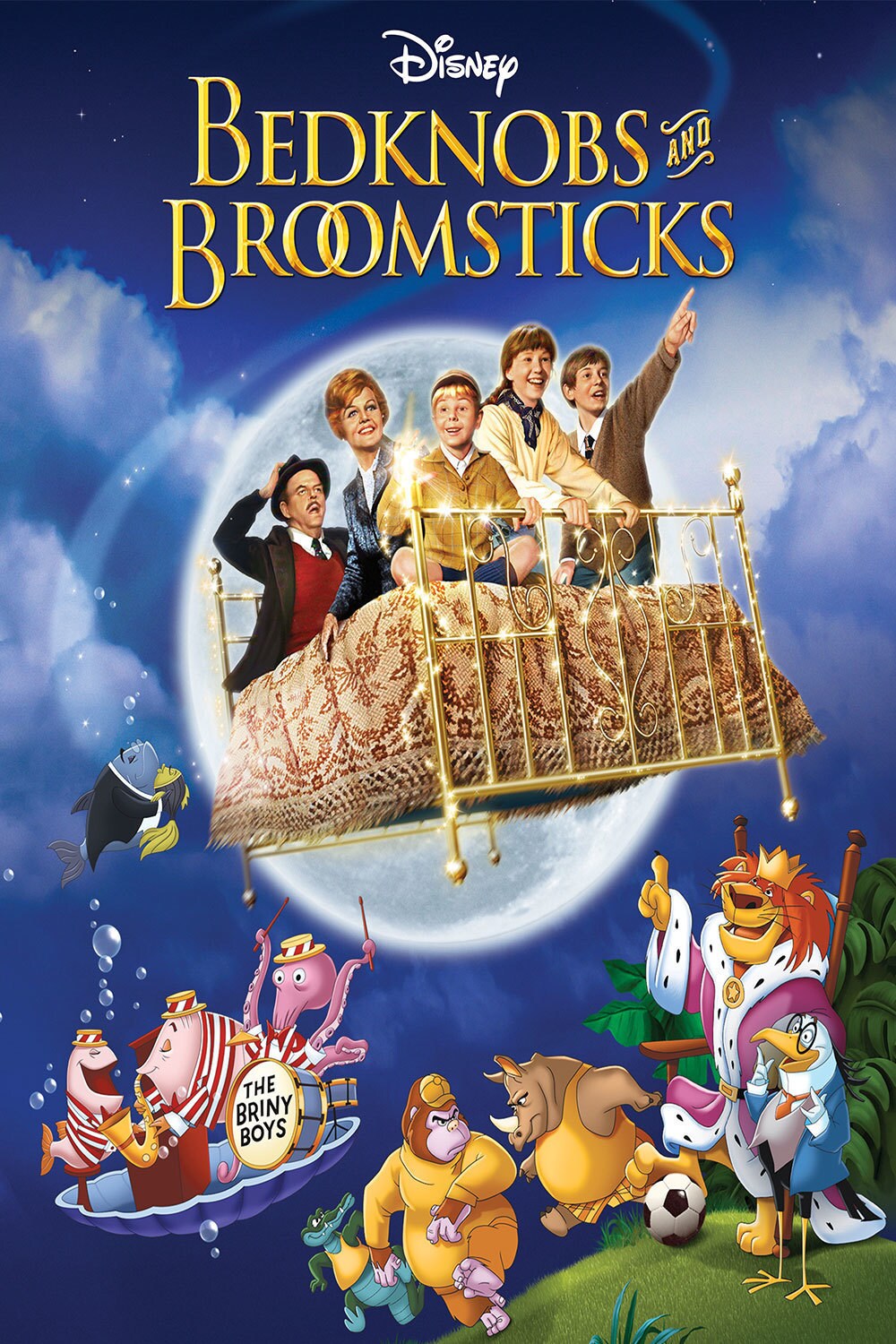
Miss Price (Angela Lansbury) is an idiosyncratic woman living in a small hamlet in the English countryside during the height of the Second World War. A woman of peculiar charms, she is forced into a difficult position when he is tasked with looking after three orphans (Ian Weighill, Cindy O’Callaghan and Roy Snart) who have been evacuated from war-torn London. The children are far from ideal figures of innocence, being quite rowdy and overly curious to the point where it starts to challenge the nerves of Miss Price. However, the visitors soon learn that their temporary foster mother is not exactly what she seems – they find out that she is an apprentice witch who has been taking lessons through correspondence with one Professor Brown (David Tomlinson), who runs a college focused on magic. A few misadventures bring them into contact with Brown, who turns out to be nothing more than a sycophantic street magician with some good ideas. He joins their mischevious coterie, as they go in search of the elusive words that form the most important spell Miss Price has yet to learn, one that will greatly assist her in playing her part in the war effort. Along the way, they encounter a variety of different adversaries in a number of different worlds, all of which stand in their way, whether intentionally or not, and the protagonists have to avoid the challenges posed by them if they’re ever to achieve their mission.
Bedknobs and Broomsticks is a film that will always stand in the shadow of Mary Poppins – and it’s understandable why we’d tend to have to draw correlations between them. The film follows a familiar formula – a quirky woman with a set of unique charms and the ability to defy the natural order takes charge of a group of children who greatly benefit from her influence, and along with a new friend and adult companion, they go on a series of colourful misadventures through the world, taking them out of the dismal nature of relatively, even if only momentarily. There’s no denying that Bedknobs and Broomsticks does borrow quite heavily and doesn’t deviate too far from the formula normally used in the creation of these kinds of films. However, we can’t ignore that when it comes to just being effortlessly cheerful and brimming with vivacity and joy, very few films are more adept than this. Charming to the point where it verges on saccharine (but mercifully defies it well enough to prevent the film from becoming unbearable), it’s an adorable film that may be aimed at children, but should delight anyone who is in search of something so gloriously quaint but still epic in scope, which makes the film not necessarily an imitation from previous works, but rather one that has taken inspiration – whether or not it works well enough is up to the viewer to decide, and while it may not be particularly perfect, it has sufficient moments to suggest that this is still as enthralling as anything else the studio had made.
To this day, there aren’t many Disney films with the immense heart that Bedknobs and Broomsticks so boldly portrays – and so much of this is the responsibility to Angela Lansbury, who has always been a virtuous supporter of these kinds of film, as well as one of the warmest cinematic presences to ever work in the medium. Taking on the central role, Lansbury demonstrates the sprightly vivacity she still continues to exhibit to this day. It’s difficult to fathom anyone being quite as good in the role as Lansbury, who is so delightfully charming here, she borders on excessive, but never quite goes too far to appear insincere or anything other than fully authentic. The film is built around her character, and while the children certainly do have their own moments of revelatory brilliance, Bedknobs and Broomsticks is fully under the firm command of Lansbury and her astounding brilliance as a performer, and a facilitator of nothing less than true joy. Her empathy, her pluck and her joie de vivre are used to the great benefit of the film, taking it from something that could’ve been perceived as lacking focus or being too intent on a certain set of ideas that don’t always work, had the actress not lent her talents that serve to be cohesive to the film as a whole, elevating it beyond simply being a mindless film for children.
Ultimately, Bedknobs and Broomsticks may not be particularly serious (even if it does flirt with some darker themes – just consider how the film is set during the Second World War, and the climax is a battle between witches and Nazis), but its a lot of fun. It has some of the most gorgeous filmmaking in Disney history, both in terms of the animation and live-action sequences, which are still quite revolutionary, even from a contemporary standpoint. Perhaps running a bit too long (at well over two hours, this film could’ve been considerably shorter, especially when you realize that while some of the moments in the film are memorable, they don’t serve much purpose other than being colourful excursions of frantic fantasy), the film is still an utter delight, a truly captivating piece of family entertainment that manages to be the rare film of this kind that appeals to absolutely everyone. It is a film with flaws, but it often seems as if these only add to the charm – and whether through the dedicated performances, the gloriously unrestrained musical numbers or the general sense of exuberant joy pulsating through it, Bedknobs and Broomsticks is an enchanting diversion and a true pleasure to experience.
 The Postmodern Pelican