 Every now and then, someone manages to capture the zeitgeist just long enough in a cinematic form to create something unique and entirely original, yet still very reflective of not only the society we live in but also the ideals that define it. Riley Stearns, in his sophomore feature film, takes on a very strange subject, one that normally doesn’t lend itself to the visual or narrative form that it seems to be aiming for. Through innovative filmmaking techniques, some terrific performances and a wonderfully idiosyncratic storyline that proves to disregard any expectations the viewer may have going into it, replacing it with a sense of discomfort and unease that intentionally never fades away, he delivers The Art of Self-Defense, a hilarious and harrowing dark comedy that sees the director venturing into unconventional areas of the human condition in his effort to represent some ideas that have always been somewhat omnipotent, but through the lens of bleak social satire that may not appear to be anything particularly noteworthy at first, but eventually flourishes into one of the year’s most brilliant comedies, a daring and audacious portrayal of violence, masculinity and social positions that never gives the audience exactly what we want, but rather what we didn’t know we needed when it comes to being meditative on our shared collective flaws. A brutally hilarious combination of social satire and psychological thriller,
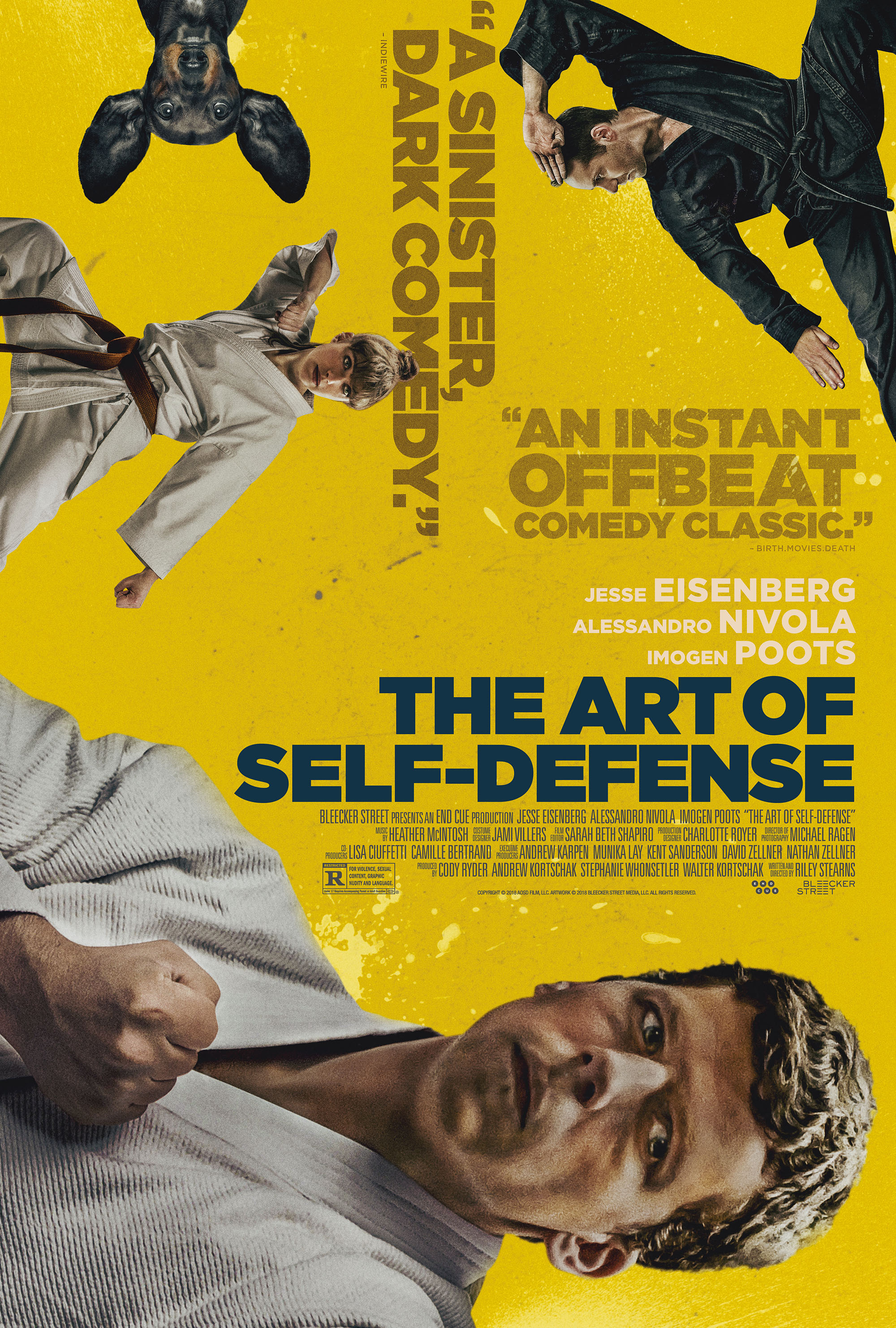
Casey Davies (Jesse Eisenberg) lives a relatively ordinary life – he works as an accountant, where he’s adored by his boss, but despised by his co-workers, who find his pedantic need to always be right rather grating. He lives alone, with the exception of his small dog to keep him company, and seems to be quite happy, if not somewhat lonely. An unfortunate encounter with a group of violent motorcyclists leaves Casey seriously injured, and as a result, he grows paranoid that something similar will happen again – having spent his entire life dodging bullies and a variety of people who clearly intend to do him harm for no reason, he takes it upon himself to finally learn self-defence. He considers weaponry as a way of fending off troublesome people, until karate enters his life, solely by a chance encounter with an enigmatic but seemingly empathetic sensei (Alessandro Nivola), who welcomes Casey into his dojo, where he and the other students slowly help the young man develop his skills and learn to stand up for himself. Yet, the more Casey immerses himself into the group, the more he starts to realize there are some truly sinister secrets underlying it – whether the mysterious night classes which only select pupils are allowed to attend, or the behaviour of the sensei, whose nature is too detached from reality for his warmhearted nature to not be a facade for something deeper. Casey’s curiosity overpowers his natural hesitation to venture into dangerous situations, and he eventually finds himself in quite a precarious position with his new teacher and friends, one that can only result in peril.
The Art of Self-Defense is a strange film for a number of reasons. Firstly, it is almost impossible to market this film as exactly what it is – both because it would distract from the very shocking surprises that tend to appear throughout the film, but also because there are not really many films quite like it. You’d be forgiven for genuinely believing this film to be a more exuberant comedy about a lovable social outcast trying to stand up for himself – this is certainly how the film was initially promoted, with the presence of Jesse Eisenberg and Imogen Poots (two actors that often find themselves in these quirky comedies about culturally-awkward young people trying to make sense of the world around them). However, The Art of Self-Defense is just about as far as you can get from these kinds of films – in fact, it often seems to be directly parodying these overly saccharine independent comedies that present us with a lovable loser, and shows us their growth over time as they learn to be more confident. Stearns seems to be vehemently against this tradition of turning ordinary people into unconventional heroes, and it does work, even if it results in a film that, while excellent in many ways, is still quite unlikeable and difficult to embrace, which seems to be entirely by design. It’s a film that keeps the audience always at arms-reach – close enough to have a grasp on us, as well as to lead us down the complex narrative avenues it seems to relish, but too far for us to actually penetrate the film’s psyche and understand everything that’s happening underneath.
For some, that’s a shortcoming. Personally, this is a major triumph, and proof that filmmaking is more than just creating resonant characters or formulaic stories. The Art of Self-Defense is a very uncomfortable film, but intentionally so – we’re given a protagonist who has very few redeeming qualities. He’s pretentious, socially-awkward and often very abrasive. This is mercifully never chalked up to some form of social anxiety or condition, but the fact that Casey is, in no uncertain terms, just an exhaustingly weak coward who has never taken the time to assimilate into society. It doesn’t make him a bad character, but rather one that’s entirely authentic – some people just don’t fit in, and while some do try and change this in an attempt to actually become more sociable, it takes a near-death experience for Casey to eventually stand up for himself. Once again, the first act of The Art of Self-Defense would lead us to believe that we’re going to see the traditional story of someone previously downtrodden by society finally achieving the ability to exist with confidence. This film masterfully quashes this premise, and we eventually realize there’s something else underlying this film, a sense of despair that pulsates throughout it and merges with the comical tone to create a brilliant dark comedy that may use the idea of defending yourself from bullies at the starting-point but becomes something almost indescribably strange by the end.
While the widespread reluctance to embrace him is understandable, I am a lot fonder of Jesse Eisenberg than most people. He has had one of the most fascinating careers out of many modern actors, solely because for the past decade, he’s had a relatively prolific career that has seen him appear in a wide range of films, playing an array of different characters, which have all been built out of his abrasive, almost unapproachable personality that is often the antithesis of what makes a successful leading actor. While I’d be hesitant to say that Eisenberg lacks range, far too many of his performances have been built out of his tendency to draw from the same acting skill-set, which he has done for years now. The Art of Self-Defense is one of the few films that not only realizes Eisenberg’s slight limitations but uses them effectively to show that while he may have a monopoly on the role of the hyper-intelligent milquetoast who makes up for his social-inaptitude with sincere conviction to anything he puts his mind to. It works well in this film, where we see Eisenberg slightly abandon some of his more notable qualities and take a few more risks than usual, but effectively so. He is contrasted by Alessandro Nivola, who is terrific as the mysterious sensei who allows the protagonist into his dojo and takes him under his wing as his new protege, in an effort to grow his strength. Nivola is an actor who hasn’t received his due, despite being exceptionally hard-working and an omnipotent presence in all facets of the industry. Films like The Art of Self-Defense remind us what an immense talent Nivola is. Oscillating between endearing mentor and malicious villain, the actor plays the role with such intensity (as well as showing his superb comedic timing), he steals nearly every scene he appears in. It’s a very subtle performance, but one that plays to the actor’s natural charms, while still allowing him to play one of the most unexpectedly memorable antagonists of the year.
The Art of Self-Defense is quite an impressive achievement – it never boasts of its own intelligence, or the fact that it’s far more effective when it comes to representing the plight of someone society has thrown away and his subsequent descent into violence as a form of retribution than other films. Yet, it is still so assured and never falls into a pattern of self-deprecating to make it more endearing. Stearns crafted a terrific dark comedy that is often extremely absurd, and makes brilliant use of dry humour in a way that not only works to the deadpan sensibilities of the cast, but complements the often cold and detached story which is never supposed to be entirely resonant, even if we want to view The Art of Self-Defense as a film that attempts to have some deeper meaning about society and how its important to stand up for yourself. The film never loses sight of its very real roots, always trying to retain some form of authenticity, if only to prevent it from being seen as something that trivializes violence (there’s some very unsettling commentary throughout the film, especially when it comes to the matter of gun violence, that is far too potent to just be merely the result of someone trying to deride society). A wry, well-constructed comedy that navigates perilous subject matter with its blend of the sophisticated and the anarchic, The Art of Self-Defense is a meticulous and effective film that is far more profound than it appears to be. It’s a piece that needs a great deal of rumination and contemplation before you can form a definitive opinion in it, but there’s very little doubt that this is a brilliant example of social satire that can still be universally resonant without pandering to expectations. This certainly has all the elements that go into the making of a future cult classic, and we can only hope that more people get the chance to experience Riley Stearns’ gloriously anarchic view of society and its despicable little charms.
 The Postmodern Pelican