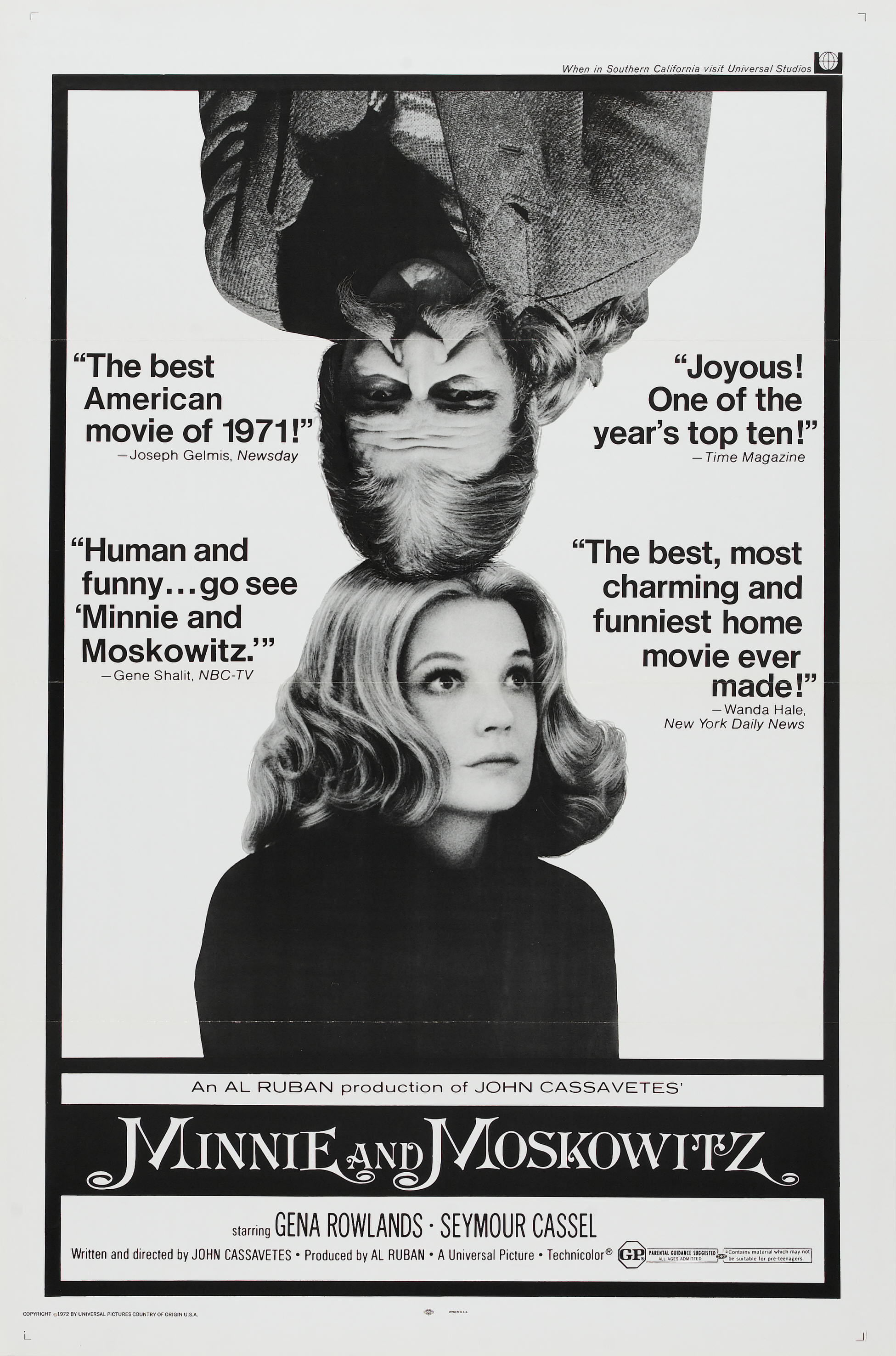
 Minnie Moore (Gena Rowlands) is a mild-mannered museum curator who suffers from intense social anxiety and constantly refuses to put herself out in the world (especially after her lover decided to end their relationship), seeing life as something that has been sold to everyone as being far more easy than it actually is. Seymour Moskowitz (Seymour Cassel) is a parking-lot attendant who may appear abrasive and vulgar at first but actually proves himself to be someone of considerable charm, as well as a resourceful man who is always able to get himself out of a difficult situation. A chance encounter between these two individuals from completely different backgrounds leads to a growing friendship and eventual romance that sees them question not only the social beliefs they frequently took to be true, but also the very nature of love, and how it doesn’t really know any social or cultural boundaries. The heart tends to want what it wants, and Minnie and Moskowitz, regardless of how much they try and avoid surrendering to the very clear feelings occurring between them, can’t ignore the allure the other brings to their life, especially in how they present them with something very different from what they had grown accustomed to over the years. Over the course of only a few days, the unlikely duo get to know each other more, and grow to understand what life looks like from the other side of the social divide, which leads to one of the most poignant and endearing romances ever portrayed on film, and one that is fundamentally grounded within reality.
Minnie and Moskowitz occurred at an interesting period in the career of writer-director John Cassavetes. Made after his subtle, naturalistic independent dramas such as Faces and Shadows, but before his astoundingly complex work in films like A Woman Under the Influence and Opening Night, it would appear this piece represents a transition in the slight change of style the filmmaker demonstrated throughout his memorable career, where he started to explore broader themes. It isn’t a film that bears many similarities to his later films, being far more easygoing and less involved with making bold assertions to the intricacies of the human mind, but still not lacking the profound commentary about social machinations and how humanity is far from just a homogenous bundle of the same needs and desires. It may fall just short of achieving the towering brilliance that Cassavetes was known for, and certainly stands as one of his more undervalued works, but Minnie and Moskowitz, in spite of some minor shortcomings, is a wonderful film about individuality, and the intersections between social categories that can sometimes divide, but also often bring two completely different worlds into collision, providing some poignant and memorable results.
This film follows the same basic formula that Cassavetes would employ throughout his career, from his debut to his final swan song (referring to Love Streams – we don’t talk about Big Trouble around these parts). We’re introduced to a pair of complex characters, played by regular collaborator Seymour Cassel, and Cassavetes’ romantic partner and artistic muse, Gena Rowlands. Two individuals who have their own quandaries and personal problems that they’re trying to overcome in their own way. They each have their vices that help distract from their issues, but it’s only until they finally encounter each other, and experience the expected conflict, that they see how symbiotic they actually are, and find the answers they had been seeking. Cassavetes’ films were never predictable, but he did adhere to a certain pattern, one that doesn’t suggest unoriginality, but rather gave him the chance to work from a very specific niche, and construct a series of films that stand on their own in terms of the story, but speak to many of the same metaphysical concepts. At the time, very few American filmmakers were making movies like Minnie and Moskowitz – these intimate character studies were predominantly found in the European arthouse, and in many ways, this film bears remarkable similarity to the French New Wave, even if the only real resemblance between them is the starting-point of two individuals without much direction trying to navigate a hostile world while retaining their sanity and overcoming their personal issues, and hopefully finding some form of meaningful romance between the existential cracks they both exhibit. Cassavetes presented us with a new form of American filmmaking, one that has been subsequently adopted by filmmakers who agree that sometimes, less is actually more.
As far as I’m concerned, we can divide the art of film performance into two distinct periods: before Gena Rowlands, and after. Unquestionably one of the most fascinating performers to ever work in the medium, her career is populated by innumerable masterpieces that show her as an actress who was capable of nearly everything. Her collaborations with Cassavetes yielded some of the most extraordinary moments in film history, as not only were both brilliant individually when working together, they managed to tap into some deeper understanding of the human condition in a way that eliminated the boundary between the art and the viewer. Seeing Gena Rowlands act is not like any other experience, because she dismantles the distance between us, and gives us the chance to enter into her psyche, allowing us to understand the character she’s playing with such fierce intensity and captivating brilliance. Minnie and Moskowitz is nothing close to what Rowlands did in her later collaborations with Cassavetes – her character of Minnie Moore is not as heartbreaking as Mabel Longhetti, conflicted as Myrtle or compelling as Gloria. Yet, she’s just as complex as ever, doing exceptionally well with a character that’s only character trait is a sense of social anxiety and her extraordinarily wealthy upbringing that normally defaults these characters into the position of being spoiled and charmless. Rowlands commands the screen with a performance elevated an intentionally ambigious character into a captivating figure that may mainly serve as a representation of the upper-class, but becomes enthralling as an individual as well.
Seymour Cassel, one of the great character actors of his generation, takes on the other titular role. Playing the rough but tenderhearted Moskowitz, Cassel delivers an exuberant performance that is both exuberant and tragic – his unique comic timing and warmhearted compassion, not only for his own character, but also those he interacts with, comes through with wonderful resonance in his portrayal of an ordinary man finally realizing that he doesn’t need to be limited to his current social position – ambition costs nothing, and what Moskowitz lacks in elegance and traditional wealth he makes up for in pluck and conviction, going to any reasonable lengths to prove himself as not just being the invisible public servant people initially see him as, but as entirely worthy of respect on his own merits. The film is built out of the conflict that occurs when Minnie, the definition of over-privileged and upper-class, is inadvertently forced into an interaction with Moskowitz, who barely even existed from her perspective. The two performers are exceptional, and while they may both be playing characters that are not inherently likeable, they never recede into the unfortunate qualities that define them.
The two main characters in Minnie and Moskowitz are fundamentally flawed characters, which is precisely what Cassavetes uses to the advantage of the film, building a very unconventional love story out of the relationship between two very different characters. The film very narrowly avoids being just a bundle of romantic comedy tropes or cliches, which normally thrive on the formulaic structure of two polar opposites coming to know each other, clashing as a result of their differences, and eventually coming to a mutual understanding that shows that beneath their incongruity, there is a similarity that none of them realizes until much later, which draws them closer together than ever before, with the subsequent moment of falling in love that normally defines these kinds of stories. Cassavetes is a much smarter filmmaker than this, and there is a lot more to the mismatched pairing than just showing how opposites do tend to attract. Minnie and Moskowitz may be a more lighthearted affair than we’re used to receiving from the director, but there is no shortage of emotional gravitas embedded within this film, with the same distinctive attention to detail and commitment to creating realistic characters in a recognizable social setting. Cassavetes invites us to engage with these characters and form our own interpretation, rather than leading us to a certain conclusion. Ultimately, it’s appropriate to feel something strongly about these characters: frustration, anger and perhaps even pity. We’re supposed to form our own understanding of these characters and how they operate – whether endearing or repulsive, their actions are honest and their own, and considering they’re flawed, but not necessarily bad, and they warrant adoration and attention in much the same way as the protagonists of more innocuous romances do.
Throughout his career, Cassavetes’ work always tended to capture some part of the human spirit. None of his films ever professed to be the definitive statement on the human condition, but when put together, they form a tapestry of existential issues that would only be possible as the result of the work of a director whose understanding of the small idiosyncrasies that define life. Minnie and Moskowitz is Cassavetes’ journey to the heart, his representation of love, passion and desire, crafting a unique story of modern romance in a way only he was capable of. Its a film that thrives very much on the director’s direct approach to real issues and even his portrayal of passion is beautiful but not detached from reality to become implausible. This is romance by way of a director who looked to represent life as its most raw and natural. It doesn’t try to be anything other than honest, and while this often results in some quite bleak commentary on the nature of something as intricate as the experience of falling in love, Cassavetes still manages to find space for a happy ending, which he has shown himself quite adept at when it comes to his often harrowing depictions of human existence. Life is a complex experience, and very few artists were ever able to capture it quite as well as Cassavetes, whose work always felt so fundamentally human, and undeniably gorgeous in how resonant the themes are, and how the audience has no choice but to be transfixed by the work of a filmmaker who never wavered from his steadfast dedication to the human spirit.
 The Postmodern Pelican