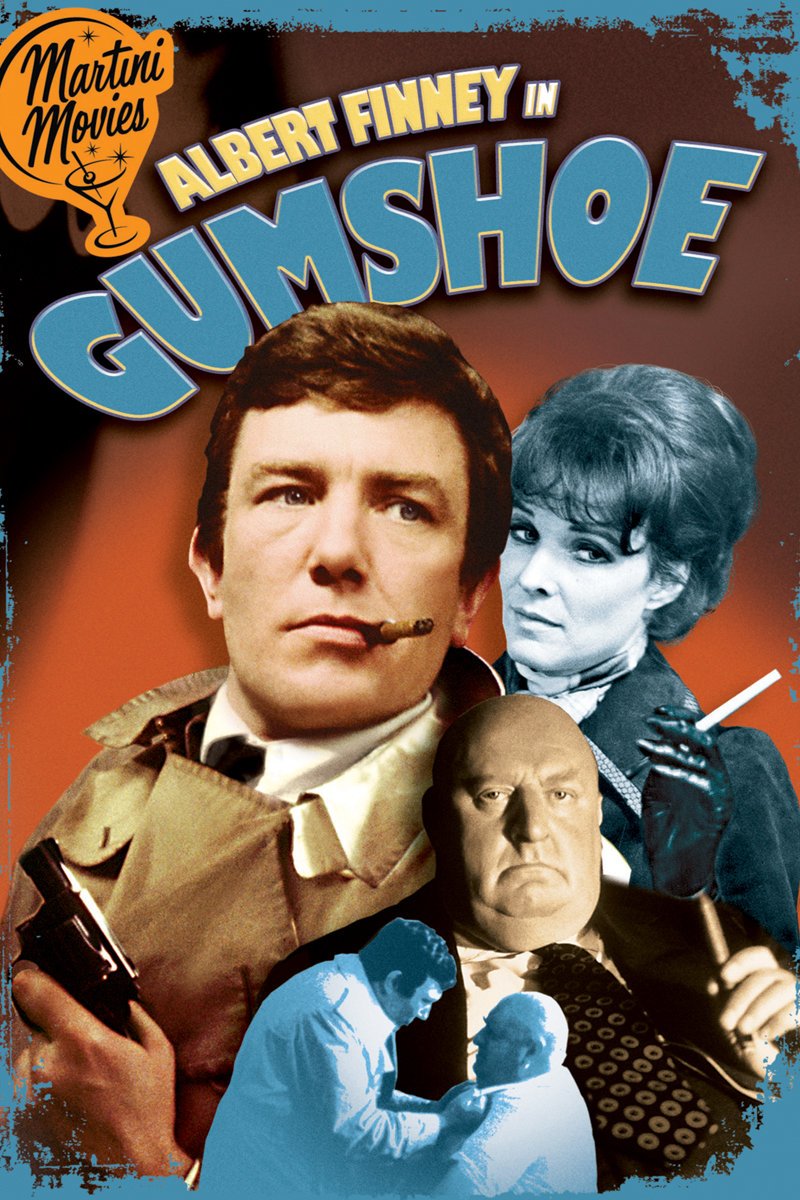
 Gumshoe is the kind of film that had so much potential and squandered nearly all of it. The directorial debut of Stephen Frears, this muddled and convoluted attempt at satire failed almost entirely, never quite finding the right balance between the genres it was trying to work in, nor managing to live up to the promise that it had based on the premise and the magnetic qualities of the leading actor. Not necessarily awful, because it is well-made and it does have an interesting concept underlying it, Gumshoe is a film that finds itself making the wrong decision about nearly everything that could’ve made it one of the most memorable comedies of its era. Working better in theory than it ever did in practice, Frears’ debut pales in comparison to the truly fascinating work he’d go on to do, and while there are some early traces of his predictable but nonetheless reliable style embedded within the film, they never really amount to anything other than a dreadfully safe and perhaps tragically bland homage to a genre of filmmaking that never feels affectionate, even at its most endearing.
Eddie Gimley (Albert Finney) is a professional bingo-caller and amateur stand-up comedian living and working in Liverpool. He is anxiously awaiting his big break, which depends entirely on the people he works for giving him a chance to show off his skills in a space that lasts longer than a couple of minutes. In the meantime, Eddie decides to pass the time as an amateur private detective, putting an advertisement in the newspaper in the hopes that someone would manage to get a laugh out of it. What he doesn’t expect is that someone takes it quite seriously, and the mild-mannered detective story aficionado finds himself embroiled in a conspiracy that involves violence, drugs and illegal activity, and the further Eddie tries to steer himself out of his position, those around him genuinely believe him to be an old-fashioned gumshoe, the only person who can get to the bottom of the mystery. When a variety of strange characters enter the story, such as his sinister brother, his plotting wife, a mysterious American femme fatale and some very violent mobsters, Eddie isn’t quite sure he’s all that ready to enter into the world he had only experienced through detective fiction.
There are many problems with Gumshoe. First of all, it does certainly have a good premise – who can resist the idea of a spoof that lovingly pays tribute to film noir by having one of the most fascinating actors of his generation take on the central role in what had the potential to be one of his best performances? Naturally, most of the film is built around Finney’s rugged charm, and his ability to infuse everyman characters with a sense of intensity that often went underused in his earlier work in films aligned with the kitchen-sink realism movement. This isn’t the first film that had its successes dependent almost entirely on the charismatic star, and normally, they distract from the weaker storylines through the dynamic nature of the actors that occupy it. The same can’t really be said for Gumshoe, as it woefully underuses Finney, who definitely does try his best with relatively paltry material that doesn’t quite land anywhere particularly significant, being just another film that thinks that his unique talents are more than enough to compensate for the narrative shortcomings. To be fair, Finney is very good, but that is more part and parcel of his status as one of the most reliably great actors of his time than anything this film actually does to accentuate it.
The issue is that no matter how much Finney does to overcome the shortcomings that are consistently found in the film, Gumshoe just isn’t very good. It isn’t atrocious enough to warrant a scene-by-scene deconstruction, nor is it interesting enough to dedicate time to comment on how it missed so many opportunities to be great. Essentially, Frears is attempting to make one of the many films that lovingly pay tribute to the film noir era, which had started to fade in both quality and popularity only about a decade before this film was made. Its influences, both in terms of story and its execution, are very clear. There are dozens of references to detective classics peppered throughout the film, to the point where it’s almost more entertaining to spot the influences than it is to actually watch the film. Gumshoe proves that homage is far more than just relying on the replication of beloved tropes and that the story itself needs to be compelling enough to keep the viewer engaged. Unfortunately, Frears is too intent on making what he believes to be a stylish and entertaining detective romp when in actuality it is quite the opposite. The intention isn’t something that should be dismissed – the film definitely had the right idea, but just failed to put it into practice in a way that actually proves to be even an iota as effective as the films it is inspired by.
It’s only made more tedious by the fact that Gumshoe seems to be incapable of deciding on a tone. Frears has not necessarily been one for comedy – throughout his career, he’s made an array of likeable light dramas with comedic elements, as well as the occasional lavish period drama that is effortlessly entertaining. Broad comedy or satire has never quite been his strength, which is most evident here, as he is clearly trying to make something that tends towards the comedic, yet without featuring anything even remotely resembling humour. I’ve seen Gumshoe categorized as a spoof or parody, which seems to be the most significant compliment someone can give this film, because it assumes its lacklustre direction and lack of a coherent story was the result of Frears trying to tackle the notoriously convoluted nature of detective fiction, with its red herrings and labyrinthine plots through good-natured humour that shows how naturally formulaic these kinds of films seem to be. The intention is definitely very clear, but it never manifests as anything particularly noteworthy. Caught somewhere between a dark comedy and a crime thriller, Gumshoe never lives up to either genre – it becomes quite uncomfortable as a result of its fast-paced execution that leaves no space for any development, nor a single moment to allow the viewer to make sense of a very puzzling story, and the result is a film that just can’t amount to anything particularly worthwhile, which is troubling considering how we’ve seen this kind of film work very well when attention was paid less to the idea and more to its realization.
Gumshoe should’ve been a lot better – and there are very few films where the cause for their failure is so obvious. Had it taken a more direct approach and actually constructed a story that didn’t only depend on pandering to fans of the genre, but rather served to be a compelling detective story in its own right, perhaps we would’ve had a great film. There are some small elements that do work – Finney is as captivating as ever, and there are occasional moments of profundity that are genuinely moving and suggest that somewhere within Gumshoe, there was a much better film. Something that works better in concept than it ever does in execution, Frears’ film is a mostly forgettable affair that can’t find much to do with its story, and very often just doesn’t say anything of note. More of a disappointment than an outright failure, there was a lot of potential that could’ve manifested into something that actually made something out of an already tenuous sub-genre of the detective comedy, and without anything that captivates the audience, whether good-natured humour or a compelling mystery, there really isn’t much about Gumshoe that is worth writing home about.
 The Postmodern Pelican
At first glance, the 1971 BAFTA Best Actor nomination for Albert Finney in Gumshoe is a real headscratcher.
John Schlesinger’s drama of sexual mores Sunday Bloody Sunday swept the BAFTAs that year. The only film of any repute to challenge the riveting Peter Finch / Glenda Jackson master class was the Palme d’Or winner The Go Between.
Finch easily won Best Actor in large part to the two other fine performances of the year Gene Hackman’s brilliant portrayal in The French Connection and George C. Scott’s acerbic delivery in The Hospital being ineligible till the next award season due to delayed release dates for England.
Joining Finch and Finney in the Best Actor race were Dustin Hoffman in Little Big Man where his astonishing old age make up overshadowed his performance and Dirk Bogarde giving career best work in Death on Venice. Interestingly Finney received recognition over Alan Bates for his lead performance in The Go-Between.
English critics were kind to Finney. His weak film still generated positive reviews. And the humor seemed more celebrated in the homeland of the filmmakers. Neville Smith’s screenplay also received BAFTA recognition.
Perhaps most likely contributing to Finney’s success was his performance as Scrooge in a popular musical adaptation of Dickens A Christmas Carol that was still in theaters.