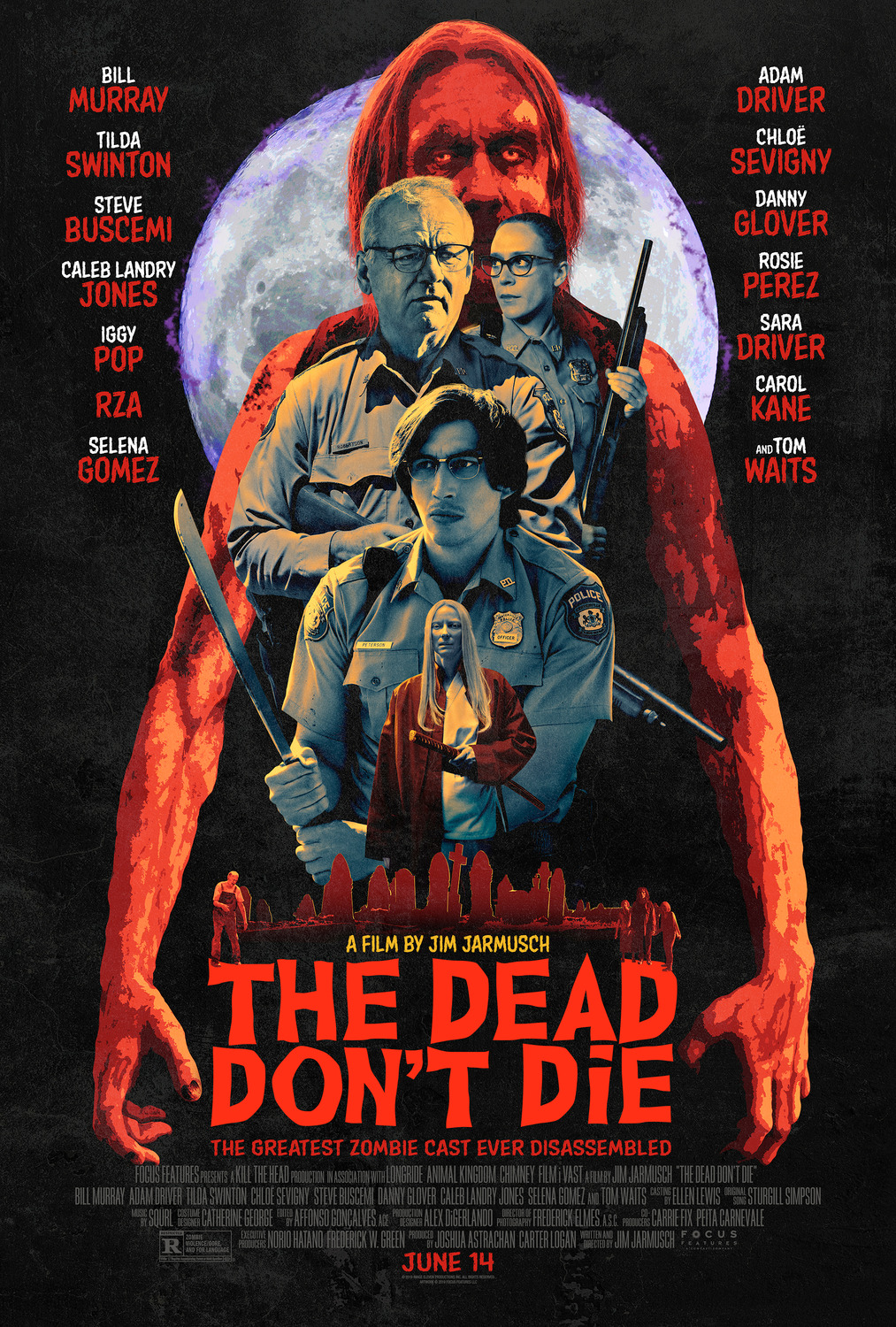
 “Centreville, USA: A real nice place” – visitors to the quaint little town are greeted with these words as they enter, and it’s difficult to argue with the sentiment. Harbouring less than 800 residents, it is the quintessential small Midwestern town that doesn’t make much of an impression, other than being a genuinely lovely place to drive through (its doubtful anyone sees this as their final destination). The people are friendly, the extent of crime involves police investigating stolen chickens, and everyone seems to get along well enough. However, something sinister begins to loom, and police officers Cliff Robertson (Bill Murray) and Ronnie Peterson (Adam Driver) start to realize something is amiss – technology begins to fail, the time seems to be thrown out of balance, daylight patterns are erratic, and there’s a general uneasiness following them throughout the town. It turns out that the rise of industrialization has caused the Earth to tilt off its axis, which means that somehow, the dead have begun to re-animate, emerging from the ground and in search of carnal satiation that the undead tend to be known for. The small town is hit with a zombie apocalypse that they were never prepared for, and everyone does their best to fend off the hordes of vicious creatures that come in search of brains, flesh and the occasional cup of coffee. Centreville, USA turns out to be woefully under-prepared for this invasion, but that doesn’t stop them from doing their best to fend off the ravenous visitors, even if it becomes clear that no amount of decapitated heads are going to stop them from taking over.
The Dead Don’t Die is a film that has unfortunately been subjected to an intensely polarizing reception, with some viewers adoring the film, others finding it hopelessly misguided and unstable. Jim Jarmusch is certainly not a director who makes films that are universally loved, and this is definitely his most divisive film in years. While perhaps being very distant from some of his towering masterpieces, The Dead Don’t Die is still a terrific film, a subversive dark comedy that sees the indie auteur utilizing all of his comic talents in realizing this bleak but hilarious twist on the zombie sub-genre in a way only he knows how. Those who go into this film expecting the same conventions that the genre has adopted when it comes to the living dead will likely be disappointed, because this is quite clearly zombie horror by way of Jim Jarmusch, told in his distinctive deadpan style that can sometimes alienate audiences who aren’t expecting his acidic wit and steadfast rejections of cliches in favour of a more disruptive narrative flow. Perhaps his most accessible film in terms of the execution (it is his most broadly hilarious, and features a more agreeable sense of humour than we normally find coming from him), but far from being an abandonment of his indie credibility, The Dead Don’t Die is daring and funny, and absolutely as acerbic as we’ve come to expect from Jarmusch, a seasoned veteran of the film industry finally taking the chance to explore new narrative avenues, to sometimes very surprising results, as we can see here.
Those who are familiar with Jarmusch know exactly what it meant when he set out to make a zombie film – this was not going to be the dark, harrowing stories of the dead rising from the ground that defined the genre, nor was it going to be the hopeful, predictable comedy about a group of unlikely heroes facing the undead and ultimately being proven victorious when taking against the forces of the supernatural. It was going to be something entirely unique, and while everything about the film may lead you towards thinking that Jarmusch is making something along the lines of Shaun of the Dead or Zombieland (two modern masterpieces in the zombie sub-genre), there is a lot more complexity underpinning the surface, and one that might not always work as well as Jarmusch seems to think it does. Yet, despite the fact that some of the ideas never really land as well as they should, and that The Dead Don’t Die contains one or two subplots too many, we can’t really hold this film to the same standards as the rest of the genre, because it appears more aligned with the director’s previous works rather than the films it is often categorized with in terms of the story. The Dead Don’t Die is a film made for those that may not necessarily be aficionados of this kind of story – in fact, it outright parodies nearly all of the conventions underpinning the genre in a gentle but sardonic manner that exposes some of the trite expectations put upon by audiences – but rather for those that are somewhat disillusioned with the omnipotence of the living dead as fictional villains that have run the gamut and seem to be losing the edge they once had, receding into cliches themselves.
With The Dead Don’t Die, Jarmusch is making the rare kind of zombie film that actually has something to say about the subject, although not one that is particularly obvious from the start. I’ve always maintained that the idea of the dead rising from the group and staggering around, looking for victims, is one that lends itself far more to comedy than it does to straight horror, which is why the most effective films are those that take on a more subversive edge, showing the inherent silliness of the story, rather than trying to pass it on as being something that should be taken seriously. To execute his idea, Jarmusch seems to be bypassing the past half-century of zombie fiction, and moulds his film around the first true masterpiece of the genre, George A. Romero’s iconic Night of the Living Dead, returning to the roots of the genre, paying homage to the simple but effective sense of terror Romero managed to evoke through his portrayal of such a cataclysmic event – he even goes so far as to pepper in direct clues to Romero’s masterpiece, such as the presence of a trio of hipsters from Pittsburgh, and their Pontiac Le Mans, both of which are direct allusions to Romero’s masterpiece. In all honesty, Jarmusch has never been one to follow conventions, and his defiance of well-known rules of horror filmmaking created a true masterpiece in Only Lovers Left Alive, and certainly was effective here, even if not everything in the film worked as well as it should. The Dead Don’t Die is a film that is actually far more entertaining once you strip away all expectations and surrender yourself to the director’s absurd vision, where he is presenting us with a playful and rebellious version of a familiar story, and once you realize who it is making this film, everything tends to fall into place in a way that allows the minor shortcomings to be rendered redundant, as the film works better when looked at as a whole, rather than as the components that constitute it.
As expected, The Dead Don’t Die sees Jarmusch utilizing a large cast (which he hasn’t done for over a decade, with his last true ensemble film being the excellent Coffee & Cigarettes) assembling a motley crew of performers, taken from his repertory of regular collaborators, as well as some newcomers who are welcomed to participate in Jarmusch’s beautifully deranged post-apocalyptic vision. The cast is so large, and there are so many great performances, whether brief cameos or central roles, it is impossible to comment meaningfully on all of them. However, there are some standouts, such as Bill Murray (in his fourth collaboration with Jarmusch) and Adam Driver (his second, after the astounding Paterson), who play a pair of empathetic police officers at the core of the story, who take it upon themselves to defend the town, even though they aren’t quite sure on how to go about it, neither of them being particularly trained in fending off zombies. Tilda Swinton (another Jarmusch regular) plays a peculiar mortician, with the actress seeming to play off her persona that finds itself part-way between vampiric and otherworldly. I’ve always admired Swinton for her ability to have fun in a role, and The Dead Don’t Die allows her to demonstrate her brilliant comedic talents that are slowly becoming a lot more visible through her consistently excellent film choices. Chloë Sevigny, Steve Buscemi, Iggy Pop and Tom Waits also make memorable appearances that build towards an ensemble more intent on having fun than doing particularly serious work – but then again, The Dead Don’t Die is not necessarily trying to be a serious film.
The Dead Don’t Die hasn’t received the love it deserves, which is almost suitable, because this was never going to be a populist hit, and has all the trimmings of a future cult classic. A lot of the success in this film, and why it will be appreciated more in the future, comes from Jarmusch’s ability to balance comedy and horror in a very effective way. It exists mainly to be a representation of the director’s unique style, being an effortlessly cool and laid-back film, despite being a very gruesome zombie horror film, and even at its most grisly, the director doesn’t abandon his casual style in any way. The dry, understated humour blends well with the abstract concepts at the core of the film, and when filtered through the deadpan, sarcastic lens of his unique style, it takes on a lot more than one would expect just looking at the exterior. Anyone who endeavours to watch this film needs to understand that Jarmusch is not interested in changing his own idiosyncratic methods for the sake of satisfying popular tropes – this is his version of a zombie film, so we shouldn’t expect anything less. It’s certainly not trying to be entirely meaningful, embracing its inherent absurdity and combining with the underlying social commentary and a touch of political humour, which is present in the film but doesn’t envelope it in such a way that distracts from the gloriously chaotic stupidity underlying it. The tone may oscillate between whimsical and filled with despair, and it actually manages to be thought-provoking without being heavy-handed, which is something Jarmusch has perfected throughout his career.
The Dead Don’t Die is a slow-paced and measured film that doesn’t ever give the audience everything we want, and features an ending that is far more harrowing than films like this tend to be. It is dark and twisted, an extraordinarily hilarious throughout. The meta-humour is ridiculous but works, mainly because Jarmusch never insists on justifying anything, rather letting the story unfold all on its own, being built on a set of directorial idiosyncrasies only someone with as much confidence in his anarchic style could. This film is one that will be appreciated more in the future than it is now – that’s relatively par for the course with Jarmusch, as his career is defined by a variety of slow-burning, meaningful pieces that are spread across diverse genres, and may not make much of an imprint at the beginning, but prove to be indelible. It may lack the subtletly of his early dramas, or the subversive edge of his more poignant comedies, but it would be foolish to dismiss The Dead Don’t Die as something that isn’t fully and uncompromisingly Jarmusch’s brilliant vision distilled into a silly but memorable social satire. It doesn’t amount to much in terms of being revolutionary but taken for what it is, it is entirely successful. It may not always work, and it may be very different from what we’d expect – but to be fair, can you ever really expect anything when it comes to a film by Jim Jarmusch, a director who still surprises us with his versatility, decades after his revolutionary breakthrough?
 The Postmodern Pelican